





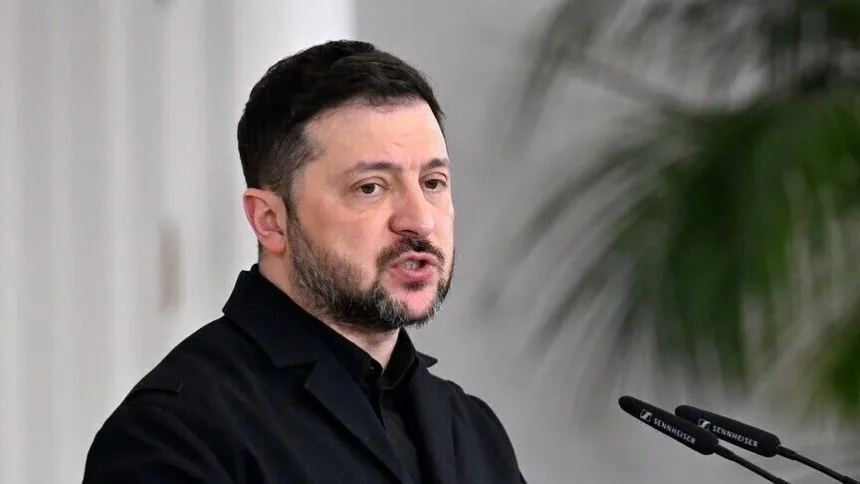
Ukraine and Russia are negotiating a large-scale prisoner exchange involving between 1,200 and 1,300 people from each side, Ukrainian President Volodymyr Zelenskyy said on Saturday, describing the proposal as the most significant outcome of recent talks in Abu Dhabi.
Speaking at a news conference in Kyiv following visits to Denmark and Ireland, Zelenskyy said discussions had also covered a possible ceasefire involving attacks on energy infrastructure, territorial concessions and future security arrangements for Ukraine.
The Ukrainian president described the proposed prisoner exchange as the “main outcome” of the Abu Dhabi negotiations, although he did not announce a final agreement or provide a timetable for its implementation.
Zelenskyy said Ukrainian negotiators had raised the possibility of an energy ceasefire aimed at preventing further attacks on critical infrastructure.
However, according to the president, Russian representatives said they lacked the authority to make decisions on the proposal.
He expressed scepticism about Moscow’s willingness to suspend attacks on energy facilities, saying there was little evidence that Russia was interested in such an arrangement.
Ukraine had proposed discussing the issue directly at the presidential level, but Zelenskyy said Russian President Vladimir Putin had shown no readiness to meet him.
The negotiations also addressed a proposed Russian “humanitarian mission” in Kostiantynivka, a city where fighting between Ukrainian and Russian forces remains ongoing.
Zelenskyy rejected the proposal, citing the continuing hostilities and warning that the capture of Kostiantynivka could enable Russian forces to advance towards the strategically important cities of Kramatorsk and Sloviansk.
The Ukrainian president also disclosed that American representatives had, for the first time, asked whether Kyiv would consider withdrawing from the Donbas region in exchange for NATO membership.
Zelenskyy reiterated that Ukraine would not voluntarily surrender its territory but indicated that he could consult the Ukrainian public on such a proposal if it formed part of a comprehensive security arrangement.
He said any agreement would need to include firm security guarantees from NATO and the European Union, alongside commitments to maintain a strong Ukrainian military with adequate weapons and financial support.
A fully funded reconstruction programme would also be necessary, he added.
“If the American side confirms exactly this to us, together with other NATO colleagues, then I will ask our society’s opinion – do we accept or not?” Zelenskyy said.
However, he made clear that Ukraine would not formally recognise Russian sovereignty over territories currently under Moscow’s control.
He also rejected the possibility of incorporating permanent neutrality into Ukraine’s constitution, insisting that the country would not abandon its constitutional position on its future security alignment.
“Enshrining neutrality means changing your country’s constitution, and Ukraine will not do that,” he stressed.
The Ukrainian president further outlined Kyiv’s preferred sequence for reaching a settlement, arguing that an end to the war must come before the implementation of security guarantees and any subsequent political arrangements.
According to Zelenskyy, the immediate priority should be ending hostilities, followed by the establishment of credible guarantees to protect Ukraine against future aggression.
Only after those conditions had been met should additional arrangements be considered, he said.
The latest remarks highlight the continuing differences between Kyiv and Moscow over territorial control, military operations and the conditions for a lasting peace settlement.
While the proposed prisoner exchange could provide a humanitarian breakthrough, broader negotiations remain complicated by disagreements over Ukraine’s territorial integrity, security guarantees and the future status of Russian-occupied areas.
Zelenskyy’s statements also suggest that Kyiv remains open to considering diplomatic proposals backed by substantial international security commitments, while maintaining its opposition to recognising territorial losses or accepting constitutional neutrality.