





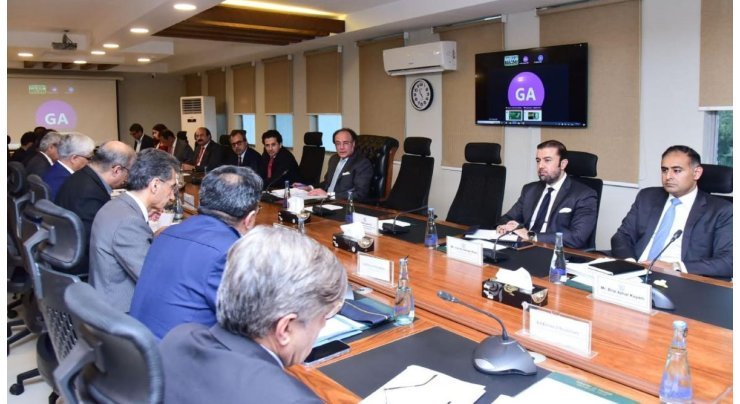
The Economic Coordination Committee (ECC) of the federal cabinet has approved a series of financial allocations and policy measures covering water infrastructure, defence, energy, agriculture and government expenditure.
The meeting, chaired by Federal Finance Minister Muhammad Aurangzeb, also authorised the transfer of Rs15.63 billion in savings from austerity and fuel conservation measures to the Prime Minister’s Austerity Fund, according to City 42.
An official statement said the committee approved Rs275 billion for major water development projects, alongside a Rs54 billion grant to support ongoing defence services projects.
Additional defence-related allocations included Rs29.139 billion for Project Istiqlal and Rs1.094 billion for the induction of a Lineage 1000 aircraft.
The ECC also sanctioned Rs370 million for helicopter maintenance undertaken by Frontier Corps Balochistan North.
In measures aimed at supporting economic activity, the committee approved revisions to the financing tiers and bank rates under the Prime Minister’s Youth Business and Agriculture Loan Scheme.
The changes are intended to adjust the scheme’s lending framework for young entrepreneurs and agricultural borrowers, although further details of the revised financing arrangements were not provided.
The committee also approved continued gas supplies to Fatima Fertilizer and Agritech until December 31, 2026, providing an extension of existing supply arrangements for the two fertiliser manufacturers.
In the petroleum sector, the ECC authorised relaxations in exploration and production regulations to facilitate the extension and renewal of 89 petroleum rights.
A separate allocation of Rs1 billion was approved to extend natural gas connections to villages located within a five-kilometre radius of gas fields.
The meeting also addressed the import and use of emerging surveillance technology, approving restrictions on camera-equipped smart glasses.
Provincial governments were advised to develop workplace regulations governing the use of such devices, reflecting concerns over their potential implications for privacy and monitoring.
The decisions cover a broad range of federal spending and regulatory priorities, with substantial funding directed towards water infrastructure and defence while additional measures address energy supplies, business financing and technology oversight.