





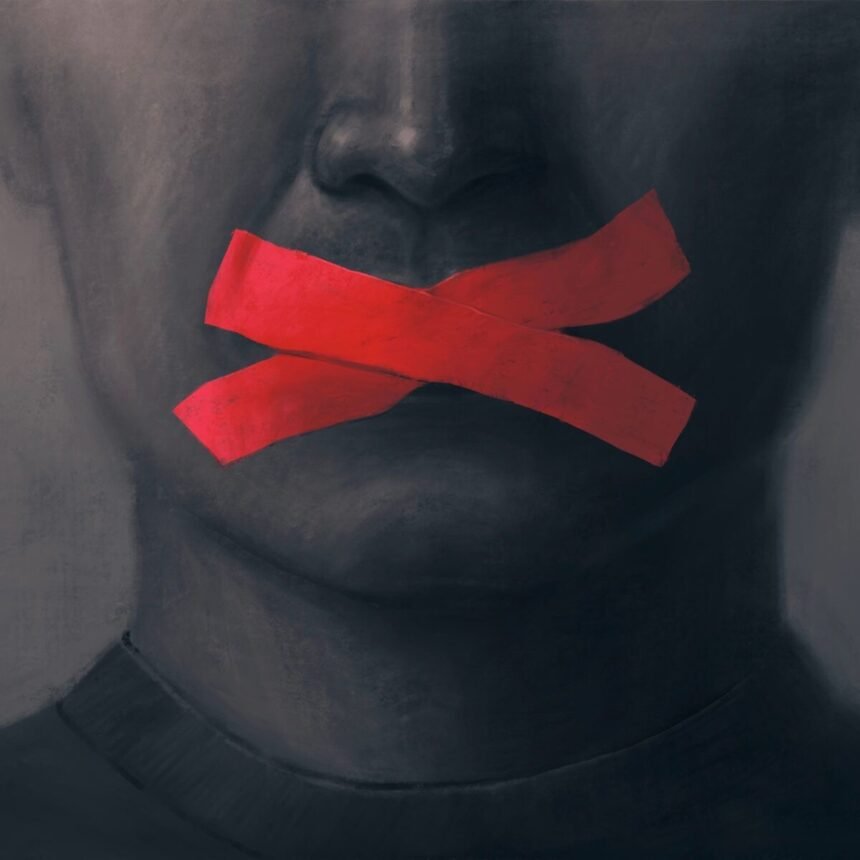
Censorship in today’s world, especially in the context of publishing, isn’t very prominent. It’s not always an explicit rejection, ban, or prohibition. Rather, it becomes apparent in silent deferments, revisions, and indecisiveness. Writers aren’t just encountering rules and restrictions — they are, in fact, negotiating an unwritten code, constantly weighing their words against the risk of overstepping.
Outwardly, media agencies and publishing outlets portray themselves as spaces that encourage unrestricted expression. While the concern for maintaining equilibrium, taking responsibility for one’s words, and upholding editorial standards is completely valid, they often belie a darker complexity. Merit is not the sole determinant; there is always another lingering question: what might this piece trigger? Will it engender unease or censure, or will it entail significant professional jeopardy?
This is where systematic suppression and censorship manifest. It does not always reject a piece directly; instead, it relies on obstructionism. A piece is either consigned to editorial limbo or simply sent back for continuous minor revisions, which ultimately results in tonal dilution. This may appear as a façade of due process, but the result is a muted narrative and a sanitised prose.
Even more pervasive is the silent restraint writers place on themselves. Writers soon decode the system — they identify the patterns. Once they identify which articles are approved straightaway and which ones are lost in a review backlog, they begin to recalibrate their tone, not because they are instructed to do so, but because they understand the system. They file down the jagged edges of their understanding, omitting the most piercing realities.
This form of censorship is insidious because it lacks overt coercion. However, it is a choice dictated by apprehension and rooted in trepidation: the fear of being socially ostracised, of reputational damage, and of being sidelined professionally. Therefore, narratives become sanitised, guarded, timid, measured, and devoid of risk.
A stark example of this can be seen in the way political writing is treated. While articles on ephemeral topics like lifestyle, trends, or general opinions are unimpeded and conveniently published, the process completely changes when pieces lean towards political critique or scrutiny, even if the critique is insinuated, nuanced, or sardonic.
Such articles are reviewed time and time again. They are reformed, questioned, and sometimes moulded to fit the acceptable standard of expression. In numerous cases, they remain unpublished. Although it is not normally explained very explicitly, it is framed as a measure of caution, for strategic timing, or for further deliberation. Yet the divergence in treatment is unmistakable.
The paradox is very difficult to disregard. The pieces requiring the most effort and research — the ones that impel the writer and the reader to contemplate deeply, query meticulously, and attempt to unveil reality — are often the ones that are systematically crowded out. On the contrary, non-contentious content moves forward without any hindrance or opposition.
For outlets and institutions that promise the promotion of free expression, this creates a tacit conflict. Freedom of expression cannot be exercised only when it’s convenient. The notion of freedom becomes limited when specific subjects are consciously and constantly avoided and cloaked in institutional silence, even if no one dares to articulate it.
The discussion is not about holding a certain institution accountable or suggesting measured restraint. It is about acknowledging a pattern where the conspicuous absence of truth becomes the most noticeable part of the story, and where the void in the archives reveals the truest account and carries its own evidentiary weight.
In conclusion, contemporary censorship is not the missing page, but the curvilinear lens. It is about the ideas stifled in the cradle. And maybe the most important inquiry is not about what is present and disclosed, but what is rendered invisible.