





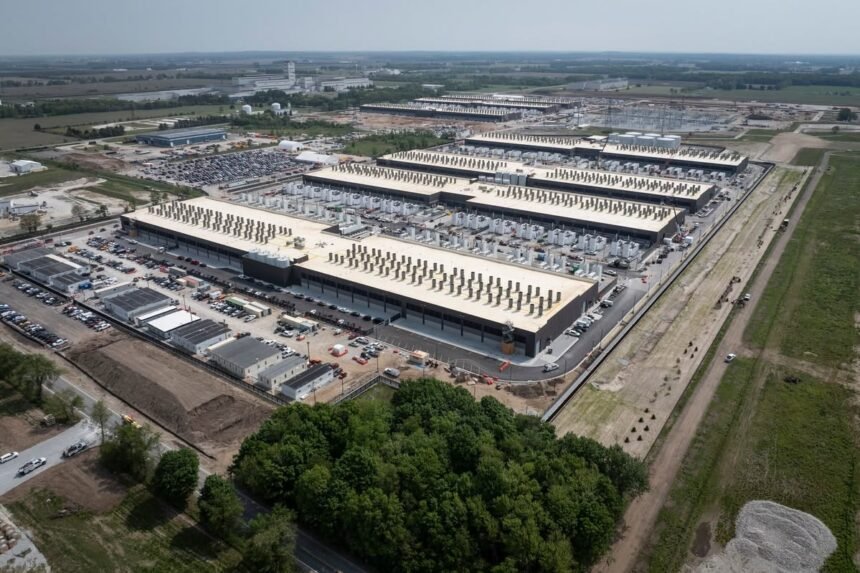
The technology industry calls its data centres the cloud, a name that hides their physical, resource-hungry nature. A cloud is weightless, distant, and free. A data centre is none of those things. It is built from concrete, steel, and copper, with a standing claim on local water and the public power grid, and as demand for computing climbs, that claim is outpacing the rules meant to manage it.
This is no longer a problem for wealthy countries alone. Pakistan, too, is making room for the industry. This piece therefore makes a simple case: data centres should be classified as heavy industry, and approval should depend on measured water and power demand before construction begins, not after.
How Fast Data Centres Are Multiplying
More than 11,800 data centres were operating worldwide in 2024, and the United States accounted for about 45%. Data from billions of connected devices needed storage, and that storage became buildings.
Pakistan is now part of this too. In July 2026, the Prime Minister opened the largest data centre in Islamabad, called Karakoram 01, with a capacity of 8.5 MW. Sky 47 is building another data centre at Port Qasim in Karachi with a 5 MW capacity, and Gul Ahmed Energy Group plans a $230 million facility with Huawei Pakistan for 2027. The government has also set aside about 2,000 MW of electricity for AI data centres and Bitcoin mining. This expansion has drawn little public attention.
The word “cloud” has kept this industry off the ledger where it belongs. Steel mills and refineries are judged by the water that they draw, the megawatts they demand, and the land that they occupy. But data centres have mostly escaped the same scrutiny.
Demand Outruns Every Saving
The first pressure is electricity. The International Energy Agency (IEA) expects data centre consumption to double by 2030, exceeding Japan’s current electricity consumption. Fatih Birol, IEA’s executive director, says that data centres in some countries may account for nearly half of all new electricity demand.
Major technology industries do not deny this. Google’s latest report shows electricity use up 37% in a year, and water use up 34% to nearly 11 billion gallons. Microsoft also reports electricity use up by about a quarter. Meanwhile, both have signed record-breaking renewable energy contracts.
Both facts hold, because as each chip and cooling system grows leaner, their number keeps growing. The IEA found that data centre electricity use rose 17% in 2025, which is more than five times the growth of global demand overall. Economist Kenneth Boulding identified a flaw in this reasoning when he said that anyone who believes exponential growth can continue forever in a finite world is either a madman or an economist.
Pakistan presents its 2,000 MW allocation as a way to use surplus electricity. But surplus power is not water-free power, as the grid runs on thermal and hydro plants. Thermal plants need millions of gallons of water for cooling, and hydropower plants depend on water levels and river flows. Every unit a data centre draws, therefore, carries a water price paid somewhere else, and it never appears on the data centre’s own meter.
The Thirstiest Machines in the Driest Places
Water is the second pressure, and the more local one. Servers generate heat that must be removed continuously. In a water-cooled data centre, some of the cooling water evaporates, and estimates put the loss at about 26 million litres a year for every megawatt, enough to meet the daily water needs of 600 Pakistanis for a full year.
Experts say air-cooled chillers and free cooling will cut that loss sharply, and Karakoram 01 uses both, which is reassuring, but design choice is not a measured result, as no one outside the industry can confirm what was built or how it functions unless the figures are published.
Heat also feeds on itself. Hotter weather forces harder cooling, which draws more power and warms the climate further — a loop the World Economic Forum says could add about 3.3 trillion to yearly operating costs by 2055. Yet about two in three new American data centres sit in areas under high water stress, and 79% of global capacity is exposed to serious climate hazards. Reports suggest large operators will still spend about $750 billion this year. So, money keeps flowing to places least equipped to supply water and power, and Pakistan is one of them.
The World Resources Institute Water Risk Atlas rates Sindh and Balochistan as facing extremely high water stress, and Punjab as high. These provinces also host power plants and farms, so data centres would also draw on the same limited supply.
Why This Is a Question for Foreign Policy
The pressure on these provinces is not accidental. Governments treat computing capacity as a strategic asset, and the contest to host it rewards the quickest approval, not always the careful one. Places with cheap land, cheap power, and flexible rules attract data centres. At the same time, local communities bear the burden of water and grid strain, while firms and customers elsewhere reap the benefits.
This is an old extractive-industry pattern in a sector that has convinced itself it extracts nothing. Google drew criticism in Mesa, Arizona, for paying about $6.08 per 1,000 gallons of water while residents paid $10.80 for the same water.
The employment potential is also thin. Staffing falls by about 90% once construction ends, and the building lasts only 10 to 15 years. Foreign investment and IT jobs are fair goals for a country, but no district should trade its water for a handful of stakes without knowing the price.
Law Has Yet to Catch Up
Courts abroad have started to act where regulators have not. In Buckinghamshire, Foxglove and Global Action Plan took the British government to court over its approval of a hyperscale facility at Woodlands Park, arguing that its energy and environmental impact was never properly assessed. The government admitted a serious error and agreed to quash the approval, and the developer later accepted legally binding environmental conditions.
But Pakistan’s law has yet to catch up. The National AI Policy 2025 speaks of innovation and investment, but has no clause requiring data centres to report their water use. The National Water Policy 2018, by contrast, treats industry as one block and does not recognise digital infrastructure as its own category. As a result, data centres fall under general industrial permits that ignore evaporation losses.
There is a foothold, though. Section 11 of the Pakistan Environmental Protection Act 1997 bars discharges above the national environmental quality standards. Experts argue that heated water released back into these local water systems counts as pollution.
What Should Change
To put the case into practice, data centres should first be classified as heavy industry so that heavy-industry rules apply to them by default. Three further steps would then help control the drawbacks:
- First, operators should publish water and electricity figures for each site, with independent water audits every two years and public results.
- Second, no large data centre should receive a no-objection certificate without a water-scarcity impact report, and provincial centres should also run assessments so affected communities can participate.
- Third, siting and cooling rules should test every proposal against heat and drought, following the bans on fresh water use in South Africa and the UAE, but adapted to Pakistan.
Incentives can help too, such as a tax credit for facilities using under 0.5 litres of water per kilowatt-hour. None of this is meant to stop heavy industry from developing. The aim is to make sure it is accountable for its water and power use from the start.