





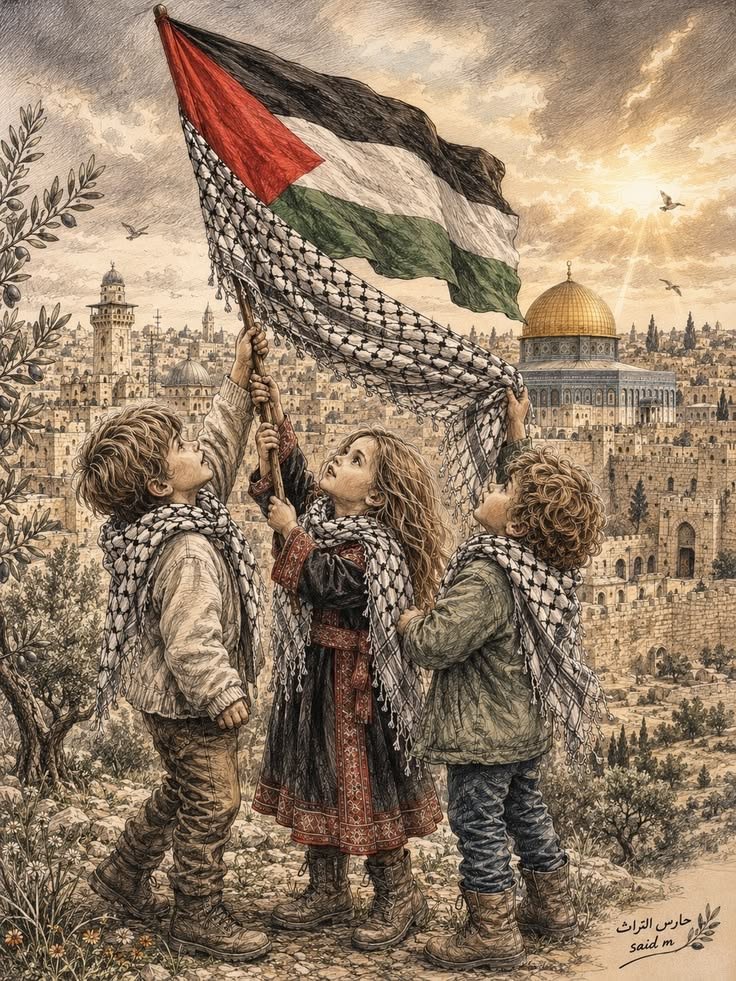
The land of the great Palestinian people, also known as Canaan, was divided by the end of the 1949 war. Israel took much of the territory as a Jewish state, Jordan took the West Bank, and Egypt took over control of the Gaza Strip. Syria and modern Iraq were occupied.
A historical and geographic region in Western Asia, the State of Palestine is the present political territory. The land is situated between the Jordan River and the Mediterranean Sea. The name comes from the ancient Philistines. In 135 CE, the Roman Empire changed the name of the province of Judea to Syria Palaestina. It is also known by different names. It is called the Holy Land, Canaan, or the Land of Israel, depending on historical and religious context. In the present age, it is known as the West Bank and the Gaza Strip.
The State of Palestine is a government entity declared in 1988 by the Palestine Liberation Organization. The United Nations recognizes it as a non-member observer state, and a majority of UN member countries officially recognize it as an independent state.
Britain played a foundational and controversial role in the creation and early history of Israel, beginning with the Balfour Declaration in 1917, which expressed government support for a national home for the Jewish people in Palestine.
- How it happened in 1917: British Foreign Secretary Arthur Balfour sent a letter to Zionist leader Lord Rothschild, committing Britain to supporting a Jewish national home, which laid the ideological groundwork for Israel’s eventual creation.
- The British Mandate (1920-1947): The League of Nations granted Britain administrative control over Palestine. During this mandate, large-scale Jewish immigration took place, and tensions and violent conflicts escalated between Jewish communities, the Arab population, and British authorities.
- Handing over to the United Nations (1947): Unable to reconcile the competing national aspirations and escalating violence between Jews and Arabs, Britain relinquished the mandate and turned the issue over to the newly formed United Nations, leading to the 1947 UN Partition Plan and the birth of Israel in 1948.
- Modern Relations and Recent Developments
- Diplomatic and Trade Ties: Over the decades, the UK and Israel developed robust trade, technological, scientific, and security cooperation.
- Policy Shifts and Sanctions: Tensions have grown regarding West Bank settlements. The UK government declared Israeli occupation practices and settlement expansion unlawful, moving to ban imports from illegal settlements and place sanctions on extremist settlers, promoting localized diplomatic strains.
- British Mandate for Palestine officially ended at midnight on May 14, 1948, after nearly three decades of British administration of Mandatory Palestine.
- The End of the Mandate: Britain gave up control on May 15, 1948, after returning the problem to the United Nations.
- Rising Tensions: Years of fighting between Jewish groups, Arab groups, and British forces made the region impossible for Britain to govern.
- UN Partition Plan: The United Nations voted in November 1947 to divide the land into separate Jewish and Arab states, but the plan was rejected by Arab leaders.
Declaration of Israel
- May 14, 1948: Jewish leaders in Tel Aviv declared the creation of the new State of Israel just before the mandate expired.
- Quick Recognition: The United States recognized the new nation of Israel on the same day.
The 1948 War
- Outbreak of War: Neighboring Arab nations launched an attack immediately after the British left and Israel was declared.
- New Borders: The war ended in 1949 with the land divided. Israel controlled much of the territory, Jordan took control of the West Bank, and Egypt took control of the Gaza Strip.
- Displacement: Hundreds of thousands of Palestinian Arabs fled or were forced from their homes during the conflict.
The 1936-1939 Arab Revolt in Palestine also called the Revolt, was a nationalist uprising by Palestinian Arabs against British colonial rule and the promotion of a Jewish national home.
- British Mandate: Britain governed Palestine after World War I, supporting the Balfour Declaration which favored a Jewish national home.
- Immigration Surge: Rising antisemitism and Nazi persecution in Europe drove a sharp increase in Jewish immigration during the 1930s.
- Land and Dispossession: Land purchases by Zionist organizations often displaced rural Arab tenant farmers (fellahin), creating deep economic distress.
- The Spark: Escalating clashes and retaliatory killings in April 1936 ignited the broader rebellion.
Key Phases of the Revolt
- The General Strike (April – October 1936): A strike led by the newly formed Arab Higher Committee under Grand Mufti Amin al-Husseini. Arabs launched a massive six-month general strike, boycotting goods and demanding an end to Jewish immigration, land sales, and British rule.
- The Peel Commission (1937): A British inquiry commission declared the mandate unworkable and recommended partitioning Palestine into separate Arab and Jewish states. Palestinian leadership rejected the plan, while Zionist leaders accepted partition in principle.
- Armed Insurgency (1937-1939): The movement shifted into an intense guerrilla campaign in rural and urban areas. The British deployed over 20,000 troops, using harsh crackdowns including martial law, summary executions, house demolitions, and the exile of political leaders.
Outcome and Aftermath
- Casualties – Arab Losses: More than 5,000 Arabs were killed, over 15,000 were wounded, and approximately 5,600 were imprisoned by British authorities.
- Exiles and Displacement: As many as 40,000 Palestinians fled or were forced into exile, removing a large portion of the active population and leadership.
- British and Jewish Casualties: Hundreds of British soldiers and police officers were killed, alongside hundreds of Jewish residents targeted during the armed resistance and general strikes.
- Weakened Leadership: Palestinian political structures were shattered. Leaders were killed, arrested, or forced to flee (such as Haj Amin al-Husseini), leaving the population divided and disarmed.
- The White Paper of 1939: Issued under severe Arab pressure, the White Paper of 1939 limited Jewish immigration (capped at 75,000 over five years) and also restricted land sales to Jews.
- Zionist Self-Reliance: While the Arab population was exhausted and economically crippled, the Jewish community in Palestine used the period to strengthen self-reliance and expanded underground defense organizations like the Haganah.
- Long-Term Impact: The devastation and division caused by the failure of this revolt left Palestinian society unprepared for the 1948 war and the subsequent Nakba.
The 1916-1918 Arab Revolt (World War I) was led by Sharif Hussein ibn Ali against the Ottoman Empire with backing from the British and French.
Casualties
- Exact figures are difficult to confirm, but Arab irregular and regular forces suffered thousands of casualties (dead and wounded) through desert warfare, disease, and direct combat against Ottoman forces.
- Ottoman and Civilian Toll: Tens of thousands of Ottoman soldiers were killed, captured, or incapacitated across the Hejaz, Sinai, and Damascus campaigns, alongside severe civilian famine and suffering in the Levant.
Outcome and Aftermath
- Ottoman Rule Collapsed: The revolt successfully destabilized Ottoman control in the Arabian Peninsula and Levant, paving the way for Allied victory in the Middle East.
- The Sykes-Picot Betrayal: Despite promises of a unified independent Arab kingdom, Britain and France secretly divided the region under the Sykes-Picot Agreement and League of Nations Mandates (creating modern Iraq, Syria, Lebanon, Jordan, and Palestine).
- Lasting Geopolitics: The Hashemite dynasty established control in Jordan and briefly in Hejaz (before conquest by Ibn Saud in 1925), while the unfulfilled promise of complete independence created deep, lasting regional resentment towards Western powers.
There was never a complete Palestinian empire in the southeast, mostly known as Arab Land. So the Emir of Mecca, Sharif Hussein ibn Ali, led the Great Arab Revolt from 1916-1918 to secure Arab independence from the Ottoman Empire. As the hereditary ruler and Sharif of Mecca, he fired a symbolic shot on June 10, 1916, to start the uprising against Turkish rule. Hussein started correspondence with British Lord McMahon and other British officials, expecting support for a large independent Arab kingdom in exchange for fighting the Ottomans. He sent his sons, including Faisal and Abdullah, to command military expeditions alongside British advisors like T.E. Lawrence (Thomas Edward Lawrence, a British army officer and archaeologist and a famous figure, Lawrence of Arabia), to capture key cities and railroads. He declared himself King of the Arab countries, but his Arabian allies only recognized him as King of Hejaz and later sidelined his ambitions through the secret Sykes-Picot Agreement. Refusing to accept the post-war treaties that divided Arab lands, he lost British backing, faced defeat by Ibn Saud, abdicated in 1924, and spent years in exile before dying in Amman in 1931. His son Faisal I ruled as King of Syria for a short while in 1920 before the French removed him, and he later served as King of Iraq from 1921 to 1933. His other son Abdullah I established the Emirate of Transjordan in 1921 (later the Hashemite Kingdom of Jordan) and ruled it until his assassination in 1951.
Abdulaziz Al Saud, known as Ibn Saud, was the founder and first monarch of modern Saudi Arabia, who defeated the Hashemite Sharif of Mecca, Hussein bin Ali. Abdulaziz Al Saud led the Third Saudi State and unified much of the Arabian Peninsula, eventually declaring the creation of the Kingdom of Saudi Arabia in 1932. His opponent, Hussein bin Ali Al-Hashimi, was the Sharif and Emir of Mecca and King of Hejaz. During the Saudi conquest of Hejaz (1924-1925), Abdulaziz’s forces and their Ikhwan allies defeated the Sharif’s armies, forcing Hussein bin Ali to abdicate and annexing the region into the expanding Saudi State.
Palestine was never a kingdom or empire that existed in South Asia, but the word Palestinian was used by the grandson of Prophet Abraham, Prophet Jacob, for the unbeliever people who worshipped many gods. Some became Christians, and when, by the advice of the Holy God, Prophet Moses led Israel to the Promised Land, this land was known as Canaan. Some of those people who were living in the habitat of Jews (Hebrews) became Jews, but they were never considered as Jews by the sons of Abraham. Herod the Great and his sons (Gospel of Luke 3:1 – Herod being Tetrarch of Galilee, also known as Antipas, and his brother Philip, Tetrarch of Ituraea and of the region of Trachonitis, and Lysanias the Tetrarch of Abilene) were examples of Palestinian Jews. So they were never obedient to the law of Jews and the Jewish Temple, as one of Herod’s sons married his brother’s wife, even though he was bitterly asked by Prophet John the Baptist to leave his brother’s wife (Gospel of Luke 3:19), but instead of obeying God’s law, he slaughtered him. And when the Temple of the Jews sent Jesus to his court in hope of a death verdict, he sent Jesus back (Gospel 23:11). This is only to say that there are many Palestinian Jews, and many Jews and non-Jews and Gentiles followed Jesus Christ. There are many Palestinian Christians, and after 650 AD, with the blessing of Prophet Muhammad (PBUH), Palestinians embraced Islam, so practically all Palestinians became believers and worship one Holy God. As I have already stated above, the great Canaan is divided into many Muslim countries, but in this modern world, to accommodate the so-called Palestinian people, the leadership of America, Britain, and Israel, accepting the demand for land for Palestinians, the historic peace agreement was signed by Egyptian President Anwar Sadat and Israeli Prime Minister Menachem Begin at Camp David after twelve days of secret negotiations mediated by US President Jimmy Carter on September 17, 1978. Negotiations were conducted from September 5 to 17, 1978, and signed at the White House. It had two frameworks: for a peace treaty between Egypt and Israel, and a framework for broader peace in the Middle East regarding Palestinian self-rule. The first framework led directly to the formal Egypt-Israel peace treaty in March 1979, ending 30 years of war and returning the Sinai Peninsula to Egypt. President Anwar Sadat and Menachem Begin shared the 1978 Nobel Prize. The second framework was rejected by the wider Arab world and the Palestine Liberation Organization, viewing it as a separate peace that ignored broader Palestinian sovereignty, as it was negotiated without Palestinian representatives. Moreover, Egypt faced temporary suspension from the Arab League.
In 1988, Jordan officially relinquished its administrative and legal claims to the West Bank in their favor, clearing the way for Palestinian nationalist claims. Later that year, the PLO declared the independence of the State of Palestine, which has gained symbolic recognition from a majority of United Nations member states, and in 1993-1994 at Oslo, bilateral negotiations between Israel and the PLO led to the Oslo Accords, which established the Palestinian Authority (PA) consisting of 3-area bodies. In world history, from beginning to end, the West Bank is the only Palestinian empire.
The 2000 Camp David Summit was a historic meeting held from July 11 to 25, 2000, between US President Bill Clinton, Israeli Prime Minister Ehud Barak, and Palestinian Authority Chairman Yasser Arafat to reach a final peace agreement at Camp David, Maryland, USA.
Core Issues Discussed:
- Jerusalem’s sovereignty and status of the city
- The creation of a potential independent Palestinian state and the future of Israeli settlements
- The right of return for Palestinian refugees
- Israeli control over borders and airspace
It is my proposal that world leaders and Palestinians themselves consider a great blessing from the Holy God.
- Go to the West Bank and live there, and make it a great country.
- Leave the bad job by which you earn your bread by becoming a buffer for other countries. Learn good jobs, give up being professional insurgents.
- I ask world leaders to ask those countries where all Palestinians are living to accept them as their citizens under a loyalty oath, and special funds should be raised to help these centuries-old miserable people with mercy.
- President Trump, star of peace, can do this to help these Palestinian people. You have to make a decision that you need peace for your races.
- I request Elon Musk that these Palestinians consist of Palestinian Jews, Palestinian Christians, and Palestinian Muslims. If no country is giving these innocent people a place to live in the premises where they are living since centuries, then shuttle these beautiful, hardworking, and intelligent people to the moon, or beyond… where they can live as their own.
Brave Palestinian people, you are struggling for your liberation by hijacking air passengers and being insurgents in other states, being a buffer for other countries’ privileges, you are not satisfied. I propose peace: with your own efforts, take the way of peace, be loyal to the country where you are living, ask world leaders and the United Nations to help you be citizens of those countries where you are inhabiting, then you and your children will have a beautiful country of your own, but first you have to take the first step.
May Holy God and Jesus Christ, Prince of Peace, bless you with peace and bless all the world.