





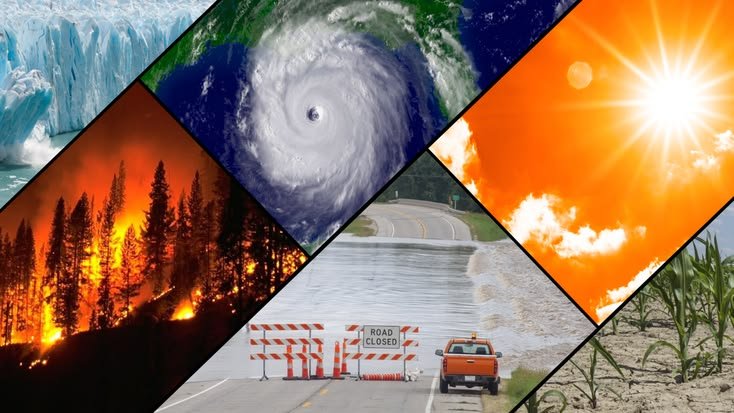
Climate change doesn’t happen as an abrupt, immediate event. It takes its time. It happens slowly in the background while the world keeps up with issues it witnesses at eye level. Rob Nixon terms this concept of gradual environmental change that leads to climate change ‘slow violence’ in his book Slow Violence and the Environmentalism of the Poor. He defines it as;
“a violence that occurs gradually and out of sight, a violence of delayed destruction that is dispersed across time and space.”
It happens while hiding in plain sight until, suddenly, it starts to catch people’s eye that things have been making the very environment they live in undergo ecological changes and harm. Instead of operating at the individual level, it causes collective destruction. It doesn’t affect one locality but has a collective, global effect. It doesn’t offer one single dramatic event.
Even though eco-critical narratives have been dominating fiction and helping shift perspectives on nature and the environment, fully encapsulating the notion of climate change in fiction seems rather difficult. Fiction typically involves individual protagonists around whose experiences the piece is centred.
This raises the question of whether climate requires new forms or whether older traditions already contain languages for environmental grief and displacement.
There is plenty of criticism that certain forms fail to convey ecological grief and the reality of climate change. In his book The Great Derangement, Amitav Ghosh argues that traditional plots of fiction cannot portray nature as an active being which experiences and evolves. If we try to fit it into typical plots with a beginning, climax, downfall, and resolution, it often comes across as a passive being rather than one that actively evolves. The drastic effects are mentioned only as separate events rather than acknowledged as consequences of decades of damage. He also argues that we lack the mindset to understand and empathise with nature, and hence our writing cannot do justice to the portrayal of ecological destruction and the grief and consequences that human-led destruction inflicts on nature.
However, there are instances that reveal how traditional writing has somewhat been representing ecological loss, and hence it can be said that there does exist language to pen it down. We can see it in pastoral poetry, such as John Clare’s writings; discourses on ecological destruction; Palestinian literature mourning the loss of its former beauty; writings on the impacts of industrialisation and world wars on nature; and eco-critical writings.
Pakistani fiction and poetry are beginning to respond to floods, heat, drought, polluted air, and ecological loss. Climate change and its consequences are among the emerging topics being noticed and written about. Uzma Aslam Khan is among the significant names writing in climate fiction. In Thinner than Skin, she highlighted issues such as glacier melt in the Karakoram and the water-division issue we’re facing, suggesting that we, humans, are exploiting it, framing it as an active presence rather than a passive, background entity. Ayisha Saddiqa and Safia Humayun also contributed to Pakistani climate fiction through their poetry and prose. Mainly, Saddiqa’s collection of poems, On Humanity, explores themes of ecological grief and its effects, while Humayun’s ‘Under the Currents’ in Shattered Echoes features these themes prominently.
Pakistan is a country with many complex issues that have evolved since its creation. There are authors, like Mohsin Hamid, who amalgamate these issues with themes such as ecological destruction and the grief that follows in novels not explicitly about climate change. This is very prevalent in his works such as How to Get Filthy Rich in Rising Asia. Awais Khan, too, wrote fiction exploring themes of class, hierarchy, gender, and ecology. Someone Like Her and No Honour are examples.
The challenges typically faced when writing about ecological loss include the aestheticisation of loss, which turns the piece into a depiction of scenery rather than violence. Nature is seen as a passive entity instead of a living, evolving one. When we talk about the slow changes and destruction that nature undergoes, using realism and imagery to depict such gradual loss, it often ends up with a visual appeal, making it more of a glamourised version of the grief it actually carries.
Moreover, most of the discourse visualising the effects of climate change focuses only on the major events that result from the long-term violence shed. This ends up neglecting the factors that have long contributed to climate change. In order to cope with this, we need to start looking at nature as an active being which experiences. Literature can make slow, distributed crises emotionally visible.
Climate change is typically tracked through statistics; hence, to add an emotional appeal, there needs to be literature that encapsulates the suffering effectively without aestheticising it.
Since climate fiction and eco-criticism are emerging genres in Pakistani literature, there are many angles and forms that are yet to be explored. Pakistan, being a state of complex issues, all intertwined, needs discourse which addresses it in a way that makes readers gain empathy and accountability without turning the destruction into an aesthetic, romanticised version of it