





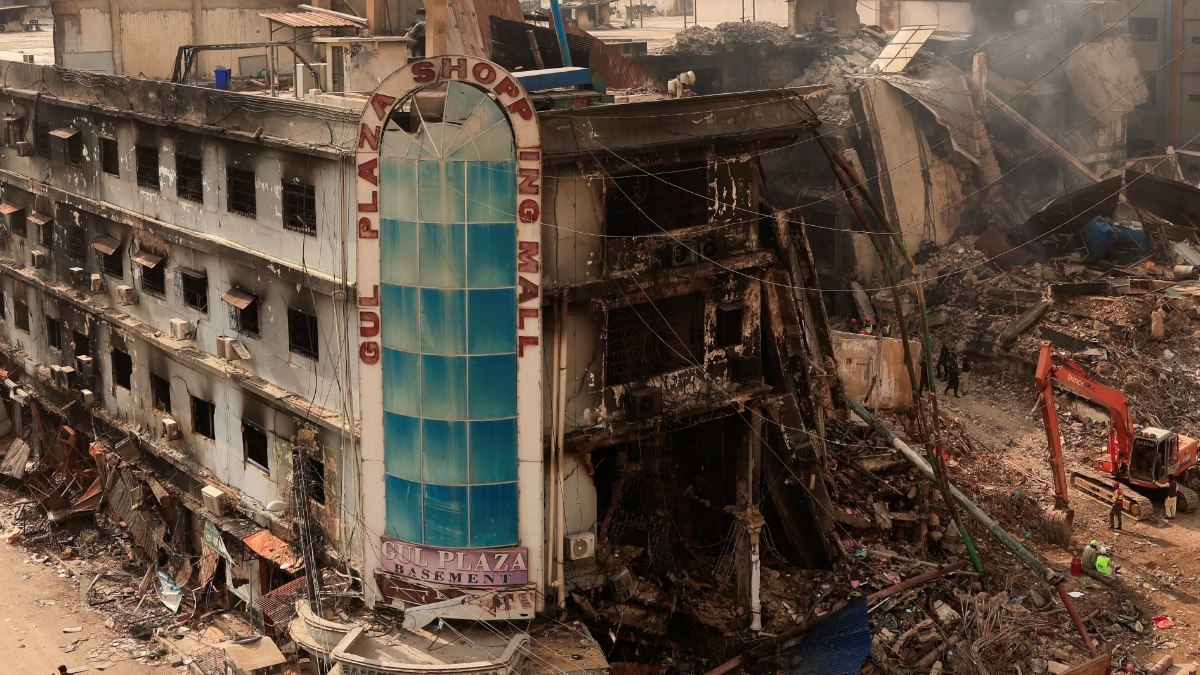
A judicial commission investigating the deadly Gul Plaza fire has concluded that the tragedy resulted from a collective failure involving multiple institutions, building management and successive provincial and local governments, rather than the shortcomings of any single authority.
The Sindh Home Department has released the commission’s report, which identifies a series of longstanding fire-safety violations as well as failures in the initial response and subsequent firefighting operation.
According to the report, Gul Plaza continued operating as a commercial building despite being considered hazardous and repeatedly failing to comply with fire-safety requirements.
Civil Defence inspections conducted in 2024 and 2025 had already identified serious deficiencies, including the absence of adequate firefighting equipment, storage of inflammable materials and problems with emergency exits. The commission found that the building management failed to adequately address those concerns.
The report also criticised what it described as an “extremely unwise” delay in notifying the fire brigade after the blaze began.
Conditions inside the building deteriorated further when the electricity supply was disconnected, plunging parts of the plaza into darkness and making it more difficult for people trapped on upper floors to find escape routes.
Despite the building having a public-address system, the commission found that it was not used to warn occupants or provide evacuation instructions during the emergency.
The inquiry also uncovered discrepancies in the number of commercial units inside Gul Plaza. While the regularised building plan showed 1,102 shops, investigators found 1,153, many containing substantial quantities of flammable commercial goods.
The fire brigade also came under criticism. The report said its response fell short of its own prescribed standards, with effective firefighting operations beginning approximately 35 to 40 minutes after the blaze started.
Firefighters subsequently faced shortages of water, while delays in replenishing supplies further impeded efforts to control the fire and carry out rescue operations.
In his report, Justice Agha Faisal invoked a verse by Pakistani poet Mustafa Zaidi to illustrate the breadth of institutional responsibility:
“On whose hands should I search for my blood, when the entire city is wearing gloves?”
The commission ultimately concluded that responsibility extended across the system, pointing to failures in regulation, enforcement, building management, emergency preparedness and firefighting, as well as longstanding shortcomings under successive provincial and local administrations.