





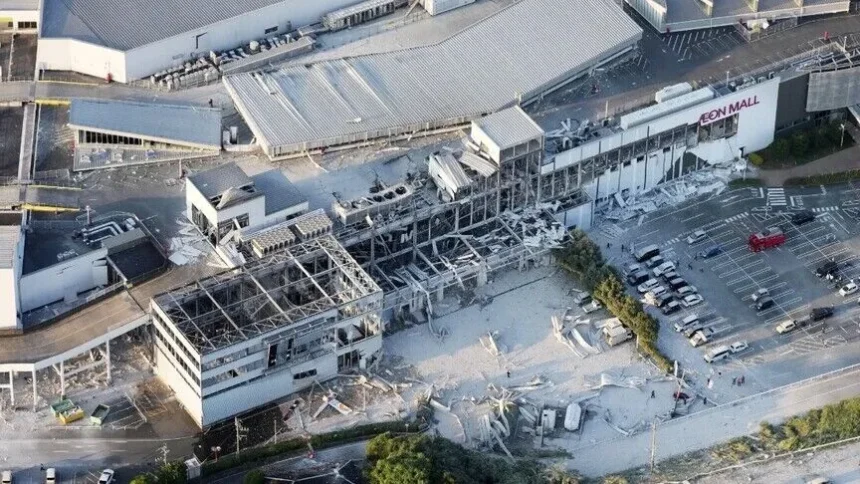
The death toll from a powerful earthquake that struck Japan’s Kumamoto Prefecture has risen to 13, with 33 people injured and seven others missing, Prime Minister Sanae Takaichi said on Wednesday.
The magnitude 7.1 earthquake caused widespread damage across the region, triggering house fires, collapsing buildings and bridges, toppling steel towers, and leaving around 48,000 households without electricity.
The quake registered the maximum 7 on Japan’s seismic intensity scale, the highest level, marking the strongest shaking recorded since the 2024 Noto Peninsula earthquake.
A paper mill in the city of Yatsushiro was among the worst-affected sites. Authorities said 11 workers were trapped after the quake. Four have been rescued, including two who were found in cardiac arrest and two with serious injuries, while search-and-rescue operations continue for the remaining workers.
The U.S. Geological Survey (USGS) initially measured the earthquake at magnitude 7.1 before revising it to 6.8. The quake struck at a depth of 10 kilometres at 4:27 p.m. local time, about 5 kilometres east of Uto in Kumamoto Prefecture.
A magnitude 5.6 aftershock followed at 5:08 p.m., centred about 16 kilometres northeast of Tsunagi, according to the USGS.
Rail services on the Kyushu Shinkansen bullet train line remained suspended on Wednesday, while tram services in Kumamoto City were expected to resume at reduced speeds. Local transport authorities warned that services could be halted again if further strong earthquakes occur.
Officials have urged residents to remain vigilant as aftershocks continue.
Japan lies along the seismically active Pacific Ring of Fire and experiences around 20% of the world’s earthquakes measuring magnitude 6.0 or greater.