





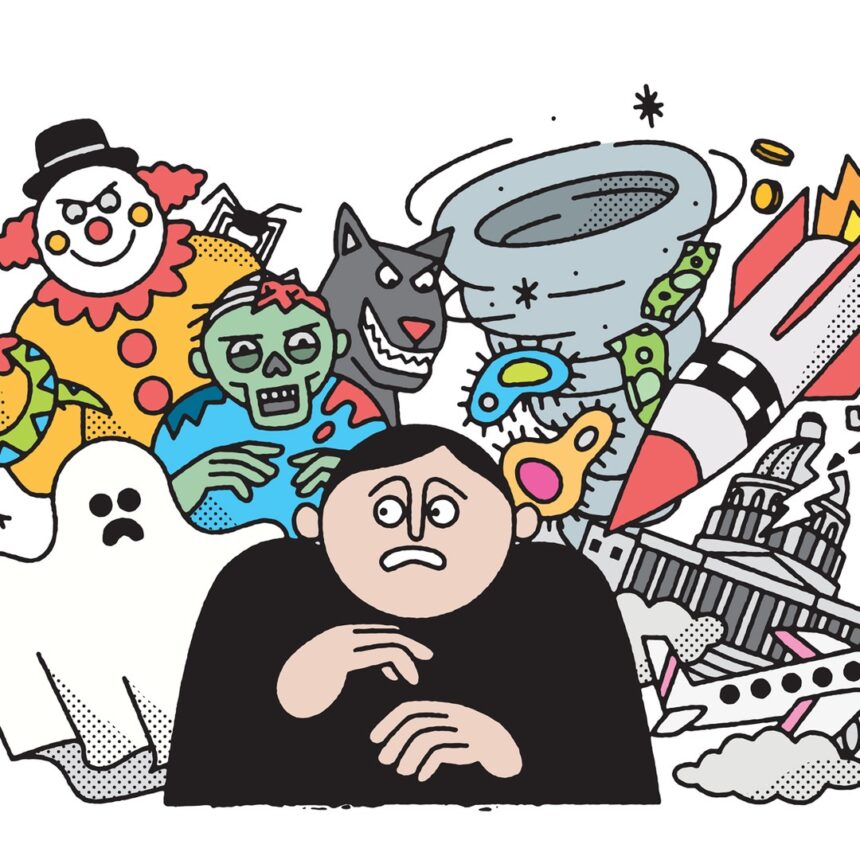
Feeling petrified by the online harassment these days, or are you worried that artificial intelligence might take your job away? Thinking you are the only unlucky generation to be exposed to such savagery, but that’s not true; our fears might be different from our ancestors’, but fear has always lived, even from the times of dinosaurs. The only difference is that we were not there to witness how horrifying the old days were for our ancestors and for their forefathers.
Let’s dive into society’s oldest emotion: fear. Since fear is older than the dinosaurs and the myths we heard about vampires, learning about its history might make us appreciate it more fully, with greater perspective.
Life Under Constant Threat: The Fears of the Early Twentieth Century
Over a century ago, people lived in a real life haunting movie, when science was not much into fashion and people died in massive numbers through diseases like tuberculosis which led to 10 to 20% deaths in European and North American cities in the early twentieth century, mentioned in the reports of the CDC, accompanied with another viral disease polio which is estimated by the World Health Organization to kill or paralyze more than 500,000 people worldwide every year until the development of medicine. No antidote was present in those times; nobody cared about the loss of lives, but only wished for survival in that time of distress.
Fear of death lingered in every household, something that today’s generation can’t interpret due to the rise of modern medicine. People suffered from scarcity of food and proper medical treatments, which is why many newborn babies died soon after their birth, making the early twentieth century a place of helpless cries, where survival was extremely difficult.
Despite the emergence of effective antibiotic treatment during the twentieth century, its accessibility was still a bone of contention, as it was not available to everyone. People were suffering from famine in those days, and due to financial struggles, many were unable to afford the effective treatment; hence, the death toll remained high.
The Cold War Era: Living Under the Nuclear Shadow

So fear only lingered 100 years ago? After that, fear should have evaporated, but guess what? When it was hoped that things would settle down after the end of WWI and WWII, along with the development in medical research, new problems arose which further amplified the feeling of fear among individuals. Subsequently, in the early 1970s, the fear of nuclear annihilation arose among the commoners, as many new nuclear weapons were introduced into the market. During that year, the Cold War was unfolding between the Soviet Union and America. In the pursuit of regional influence, both superpowers competed to maximise their nuclear arms and technology to deter each other. Just like its name, the tension between the Soviet Union and America remained cold, and luckily never escalated into massive destruction. However, throughout the Cold War era, the greatest fear still remained about nuclear holocaust among the allied countries of both superpowers.
This fear might be called abstract or ideological, but society at the time was also unstable because of high inflation, which led to another fear of economic crises and made people doubt the longevity of their jobs. The concern was not only related to job security but also about their personal safety. According to the National Crime Survey, the percentage for assault and other crime rates rose in the 1970s; as a result, people were concerned about their safety. The expansion of industries heightened people’s fears of energy and environmental crises; more industries meant more resource usage, and that eventually led to the release of greater amounts of toxic gases into the surroundings.
Unlike the problems of centuries ago being resolved over time, many fears of the 1970s are still part of today’s current issues, like the fear of losing one’s job, the WWIII occurrence and even the energy and ecological perseverance concerns, which reflects that fear never disappears; it simply alters its appearance from generation to generation.
2026: Anxiety in an Interconnected World

Many years have passed, making the world’s technological and social systems much more complex than they were before; now not just adults but even kids are prone to various threats. As the internet has become fundamental to our routine lives, fear has grown stronger than ever related to online privacy and digital crimes. This era has shifted crimes from the streets to the digital sphere, alongside the invention of artificial intelligence, which is another horrible fear for workers’ occupational positions.
According to one study from the BMC Psychology journal in 2024, compulsive scrolling on social media leads to increased stress levels of anxiety among peers. People tend to experience psychological experiences like Fear of Missing Out, making them anxious if kept away from their virtual space for a longer time. This alluring yet alarming change in human behaviour amplifies the spooky experience of the internet.
Industrial developments have released plenty of greenhouse gases into the atmosphere, causing heatwaves, forest fires, and excessive floods that ruin agriculture in many underdeveloped areas; subsequently, this has made people worry about their future due to a high probability of energy and resource crises.
Unlike fears of earlier eras, today even fear itself has gone global due to globalisation. Due to digitalisation and globalisation, a financial crisis in one state, an agricultural crisis in one country, or an energy crisis in one nation will essentially affect other countries. The globalised nature of fear was clearly witnessed in a recent event when Iran blocked the Strait of Hormuz; the fear of oil and petrol prices transcended the Middle Eastern region and equally terrorised the European, Asian and North African territories. Not only that, but the spread of Covid-19 also ensured the sensation of fear was equally experienced by all countries worldwide. Thus, the fear of isolation, healthcare, and economic crises was equally felt round the globe during Covid-19’s viral transmission.
The Enduring Legacy of Fear
Perhaps the history of fear is the history of humanity itself; the cause of anxiety may fluctuate from time to time, from disease to war to algorithms and climate change, but the sensation remains familiar. Every generation believes that they are faced with excruciating challenges; indeed, they do – but no differently than previous generations. Fear is not just a reflection of what is alarming but also a reminder of what we have to work on and what we value most. And as the world continues changing, so too do our fears, which quietly shape our realities.