





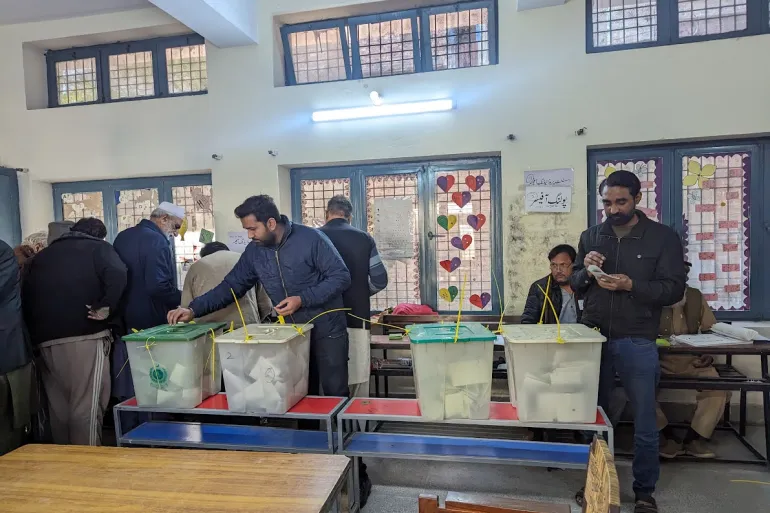
On the morning of February 8, 2024, Pakistanis went to vote in a general election. By that evening, the internet had been switched off. By midnight, it was clear that candidates affiliated with Imran Khan’s banned movement had won the most seats of any single political grouping, running as independents without their electoral symbol, without media access, and with their leader in prison on charges that Amnesty International had described as politically motivated. By the following week, a coalition government had been assembled from parties that had collectively received fewer votes, and the country had a new prime minister with a mandate that existed, in any meaningful democratic sense, primarily on paper.
This is not a story about an election stolen in the crude old way, with ballot boxes dumped in rivers and results announced before the counting was done. It is a story about something more sophisticated and, arguably, more corrosive: a political system that has retained the vocabulary and the timetable of democracy while methodically removing its operative content. Pakistan has elections. It simply arranges for the wrong people not to win them.
Democratic theory offers several accounts of why elections matter, and they generate different predictions about what happens when they are managed. The procedural account says elections matter because fair process produces legitimate outcomes. The substantive account says elections matter because they are the mechanism through which governments are made answerable for what they actually do. The Schumpeterian account, named for the economist Joseph Schumpeter, says democracy is essentially a method for selecting between competing elites, and its value lies in the continuity of the competition rather than any particular outcome.
All three accounts point to the same problem with Pakistan’s current arrangement. Procedurally, an election in which the most popular candidate is in prison and his party’s symbol has been confiscated is not a fair process by any definition that takes the word seriously. Substantively, a government assembled from parties that lost the popular vote has no plausible accountability mechanism. It cannot be punished electorally for its failures because it was not electorally produced by anything resembling popular will. And the rotation of elites that competition is supposed to provide has been suspended. The same families, the same military patrons, the same economic networks cycle through power while the genuinely popular movement is imprisoned or excluded.
A regime that cannot lose an election peacefully accumulates pressures that eventually discharge themselves violently. History does not make exceptions to this rule.
The argument offered, explicitly or implicitly, by defenders of this arrangement is security. Imran Khan’s government was chaotic. His foreign policy was dangerously independent. His relationship with state institutions was confrontational. The establishment’s intervention, on this account, was not anti-democratic but stabilising. One notes that this is the same argument that has been made for every military intervention in Pakistani politics since 1958. The country is now in its fourth generation of being stabilised and has yet to arrive at stability.
The Trust Deficit
Political trust is a strange commodity. It is built slowly, across decades of institutions behaving predictably and fairly. It is destroyed quickly, in single events that confirm what the sceptical have always suspected. Research by the political scientist Tom Tyler has consistently shown that citizens will accept adverse outcomes, lost elections, unfavourable court rulings, economic hardship, with considerably more equanimity when they believe the process that produced those outcomes was fair. People can handle losing. What they cannot handle, at least not for long, is the conviction that the game was fixed.
Pakistan’s institutional trust indicators were already poor before 2023. Gallup Pakistan surveys through the 2010s showed declining confidence in the judiciary, the election commission, and the federal government, the precise institutions on which any functioning democratic system depends. The handling of the 2024 election and the judicial proceedings against Khan have accelerated this decline among the demographic that matters most for any country’s institutional future: young, educated, urban voters who had previously engaged with democratic processes with something approaching genuine hope.
The internet shutdown on election night was not merely a logistical inconvenience. It was a message. The message received, whatever the message intended, was that the state did not trust the democratic process enough to allow it to operate transparently. When a government that claims democratic legitimacy is afraid of its own vote count, it has communicated something indelible about its relationship with the governed.
What People Do When They Cannot Vote
When large numbers of citizens cannot see their preferences represented through legitimate channels, they do not abandon those preferences. They route them elsewhere. Some emigrate. Pakistan’s Federal Board of Revenue data and passport authority records both show surges in applications following political shocks, with the most recent spike coming after the events of 2023. The people most likely to leave are engineers, doctors, technology professionals, and entrepreneurs, precisely the people a developing economy with a balance-of-payments crisis can least afford to lose. Their departure is a vote of no confidence conducted at considerable personal expense.
Others stay and radicalise. The literature on political disengagement consistently shows that exclusion from formal politics does not produce passive resignation. It produces anger, and anger, absent legitimate channels, tends to flow toward less constructive destinations. Pakistan’s history of politically motivated violence cannot be explained by economics alone. It is, in significant part, the product of a system that has repeatedly told large segments of its population that their preferences do not count.
The current settlement is, its architects appear to believe, a form of realism: imperfect democracy constrained by institutional guardrails in the interest of long-term stability. Bangladesh tried a version of this logic for fifteen years under Sheikh Hasina, who won elections of increasing dubiousness while progressively eliminating meaningful opposition. In August 2024, she was removed from office not by an election but by a student uprising that swept her government from power in a matter of weeks. The stability was revealed, at the end, to have been a performance. Underneath it was everything that happens when people are given no legitimate way to say no.
The Precedent That Outlasts the Crisis
There is one more thing worth saying about what restricted political competition produces, and it is perhaps the most insidious. Democratic norms are not self-enforcing. They are maintained by the accumulated practice of actors who choose, sometimes at considerable cost, to respect them. When a state systematically demonstrates that elections can be managed, that courts can be directed, that popular mandates can be set aside, it teaches that lesson to everyone, including to future actors whose political programme the current establishment does not favour. The tools used today against Imran Khan’s movement will not remain the exclusive property of whoever is using them. They will be available, precedent firmly established, to whoever comes next.
Pakistan’s democratic problem is not Imran Khan. He is the occasion, not the cause. The cause is a political culture that has never fully accepted that the losers of elections are entitled to lose gracefully rather than be imprisoned, and that the winners are entitled to govern rather than be managed. Until that acceptance arrives, the elections will continue, timetabled, televised, and carefully arranged, and the country will continue to wonder why it can never quite get where it is trying to go.