





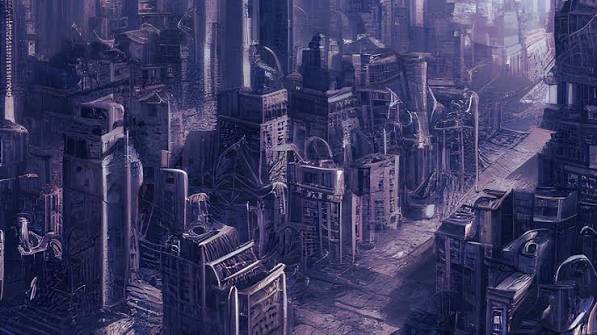
The world of fiction offers a variety of genres. From various love tropes to historical fiction, every reader can pursue the genre they can rejoice in. Amidst all this, dystopian fiction stands out.
Destruction, adventure, resistance, Love. Dystopian fiction has it all, entertaining its readers through the dark settings and narration it presents, which, though at times exaggerated, presents a view of the world we inhabit and the society we reside in. Through a display of a bleak, gloomy, and violent reality, it captures the interest of all those who come across it, teaching us more about power, leaders, and politics than our education ever could.
My own journey as a reader began with it. From never having the patience for books to reading the entire series of Shatter Me over the course of my summer vacations three years ago was nothing short of a miracle.
It seems odd, though, that fiction, to a certain extent, is meant for escape. It lets us imagine a reality that takes us on an adventure which is alien to our current life, or perhaps allows us to travel the world with different identities. Yet dystopian fiction offers us a place at the centre of the world that is embedded in brutal suffering: climate collapse, oppressive societal control, surveillance and dehumanisation in various creative but persistently brutal ways. However, we are still drawn to it. So much so that it dominates contemporary fiction.
Growing up, as I achieved consciousness, the brutality of the world unfolded. With which I developed this unnerving feeling that the world is doomed. Consumerism, billionaires, modern slavery and genocide have been the highlights of my life.
It dawned on me that perhaps my interest and intrigue for such a genre is far-rooted in the realisation that these novels are just a reflection of my planet in its most unfiltered form.
But Big Brother’s omnipresent surveillance from George Orwell’s 1984 doesn’t exist today, nor has it ever existed in the past. Nor is the world divided into districts as it were in The Hunger Games. We are not governed by regimes such as the Reestablishment in Shatter Me, where every individual under the regime is just a tool to maintain the regime’s power.
So, is dystopian fiction reflecting social anxiety or actively contributing to it?
All these brutal entities or phenomena do not exist in our reality. Yet, if one were to ponder how subtle yet ever-present they are, we can come to the realisation that it is not far from the truth.
Parallel to the brutal surveillance by Big Brother or The Reestablishment, we have our social media platforms, where surveillance is wrapped gloriously to delude us quietly. Each reel we scroll past, the online purchases we make and everything we interact with on the internet might be free of cost, but all is essential data acquired and sold by Big Tech. Ever come across an ad for something you wanted to buy? Or perhaps your For You page expresses your interests in a way that often renders you speechless? They can know us intimately without ever compromising the illusion that our lives and choices are in our own control.
Furthermore, as AI bots are increasingly being built and updated in real time, our data is of the utmost importance. For them to work as efficiently as they are expected to do, they need us as they can’t create anything on their own. And our data helps them to do their jobs using gallons of fresh water and robbing artists of their work, but ‘hey, I don’t have to think and exercise my humanness anymore!’ as if people are not suffering enough across the globe as it is!
Since 2023, the Palestinian genocide has been broadcast live on various platforms, and it continues to show the barbarity by Israel, which has been complicit in war crimes since 1948 and only now do we realise. For years, we have been consuming brands that have actively funded the genocide in Palestine as well as slavery in Sudan. From Apple and Unilever to KFC and McDonald’s, our lives have continuously been entrenched in the blood and brutal injustice of millions solely because they were born in a certain piece of land with a certain ethnicity and colour, rendered unacceptable. All because we, the common people, were manipulated by rich giants to consume their products, a perception painted carefully as affordable, trendy and an ‘essential’ part of our lives.
Dystopian fiction, with its stories of decline, will always be relevant, as the imagination of those authors has been rooted in observing a world that rationalises the pain of the voiceless, all because it maintains the illusion of comfort and order for us.
The only difference is that dystopian fiction demonstrates support for those who resist. Our reality, on the other hand, is carefully managed. One where the rich get richer, but we, the common people, are not stripped of ourselves nor of the opportunities; rather, we are contained so we are occupied enough to not question them. And in all honesty, the brutalities do benefit us. We might not be complicit, yet our silence speaks volumes. Our comfort in not being involved, not speaking up, not consuming consciously is supporting the slow yet persistent decay of people whose geographical luck was made to become a chokehold for them.
Hence, dystopian fiction will always win. Because we will always know deep down that it is true in one way or the other. As Katniss from The Hunger Games said, “I want to tell people that if you think for one second the Capitol will treat us fairly if there’s a cease-fire, you’re deluding yourself. Because you know who they are and what they do.”