





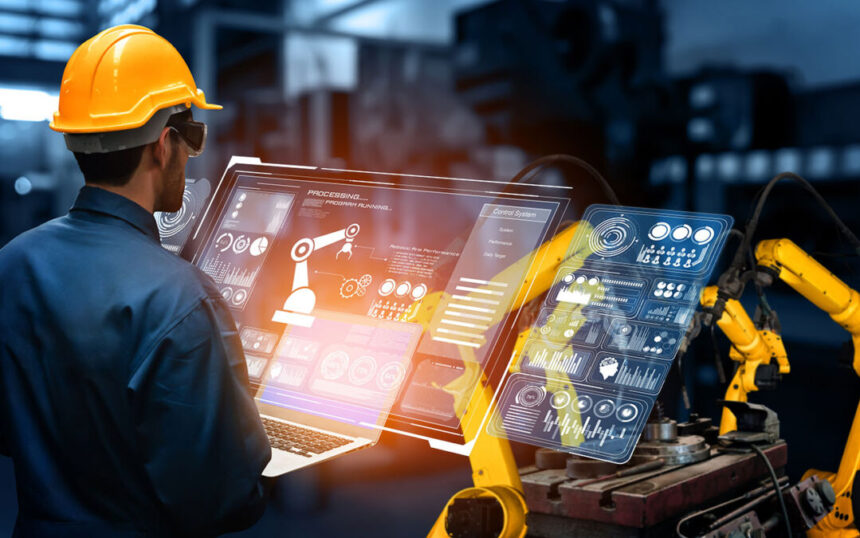
Technological change has repeatedly transformed labour markets, eliminating some occupations while creating others. This piece examines what previous technological transitions can teach us about automation, which sectors are most vulnerable to disruption, and whether AI differs fundamentally from earlier waves of innovation.
My father spent 30 years doing a job that no longer exists. All the knowledge and skills he learned doing that job have been consumed by software that costs less than a month’s salary. He was not replaced dramatically. There was no announcement, no moment of rupture. The work simply became something a machine could do, and the world moved on. I think about this often when people ask whether artificial intelligence is really different this time.

Technological change has always had an impact on the labour markets. The industrial revolution, for instance, mechanised agriculture and the textile industry, leading to the displacement of millions of rural workers and forcing that generation to seek employment in the cities. The introduction of electricity restructured manufacturing. The personal computer eliminated entire categories of clerical work, typists, bookkeepers, and telephone operators, while simultaneously creating industries that had not previously existed. In each case, the transition was painful for those caught in the middle, and the economy eventually produced new categories of work to replace what was lost. The optimists point to this pattern and ask us to trust it again.
Yet there are reasons to be cautious about this reassurance. Most previous technological transitions have automated physical tasks or routine cognitive tasks. Humans were valuable for those tasks because we possessed cognitive abilities that machines could not emulate at the time. AI is now encroaching upon those tasks. It writes, reasons, diagnoses, designs, and advises. The skills that previous generations retrained into, the knowledge economy, the creative professions, and the analytical roles, are no longer automatically safe. This is not a transition from muscle to mind. It is a transition that puts the mind itself under pressure.

The sectors most exposed are not the ones people typically imagine. Manufacturing has been automating for decades; those losses are already priced in. The more immediate disruption is unfolding in white-collar work: legal research, financial analysis, content production, customer service, medical imaging, and basic software development. These are graduate-level, middle-class professions that economies like Pakistan’s have spent a generation building educational systems to produce. The promise of the young to work hard, earn a degree, and find stable employment is becoming harder to keep. Not because the promise was bad advice, but because the profession is changing beyond recognition.
What is less discussed about the disruptive power of automation is that the benefits often manifest in different geographies. The automation of processes in one part of the world may eliminate the need for workers in another part of the world altogether, creating no replacement jobs in the region that once relied upon those automated processes. The historical assumption that disruption would eventually be followed by new opportunity has largely ignored the fact that, in the current globalised, digitised economy, new opportunities tend to emerge elsewhere altogether.
I am not arguing against technology. Automation literally produces efficiency and cost reduction, and can free human beings from drudgery; these are not insignificant gains. The debate is about allocation: who bears the cost of transition, and who gets the benefit. Historically, the answer has been that workers bear the cost and capital captures the benefit, until policy intervenes to rebalance the equation. The question for this wave of automation is whether institutions, governments, educational systems, and labour markets can move quickly enough to intervene before the damage becomes structural.

My father adapted. He learned novel tools, found work, and reconstructed around what the machines could not yet touch. Given time and support, most people do the same. The concern is not that human beings lack adaptability; history suggests otherwise. The concern is that this transition is moving faster than the support structures designed to cushion it, and that the people least equipped to absorb the shock are the ones being asked to absorb the most of it. Trusting the pattern of history is reasonable. Assuming it will repeat on its own, without deliberate intervention, is not.