





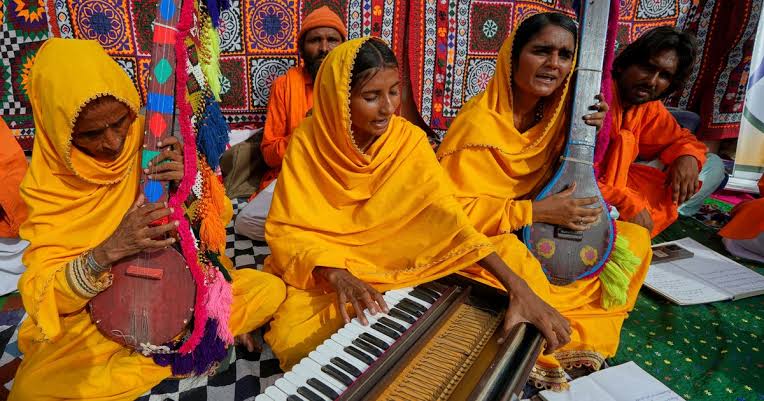
Music is being subtly revolutionised, yet it has not lost its ancient essence.
Folk music is still part of the prevailing fashion globally. Not in the form of some old records kept behind a showcase in a historical archive, but rather, it is very much alive and breathing, enjoyed on Spotify and remixed in studios by teenagers who have never held a vinyl record before. And yet somehow, clustered between pop songs and diverse beats, these songs that their grandparents listened to in their youth have taken up a noticeable space.
Belonging is the essence of folk music. Long before the days of recording equipment, communities have used song to tell their history, to say goodbye at the end of one season, and to say hello at the beginning of another, to grieve for losses, and to celebrate harvests. There was a signature sound of every region, its very own raga and taal, and its very own storytelling rhythm. Soon came the mass media, and over time, these fingerprints became fuzzy. In the fast-paced digital age, the system has flipped.
The content considered niche is now available on all streaming platforms. For example, a listener in Seoul can discover folk music from Rajasthan, and a university student in Pakistan can recapture and experience the Sufi poetry their grandmother used to recite, which has now been transformed into electronic beats. For all it matters, the algorithm is not restricted to geographical barriers.
And this hunt for new music is not entirely due to access, but the younger generation is eager to listen to folk music and remember it. And, surrounded by curated aesthetics and digital noise, the music seems more organic and rooted in real places and people, which feels like solid ground. It is the burden of life’s existence. Folk is a powerful yet understated medium for identity seekers in an increasingly borderless world, helping them find a sense of place and purpose. From the audience in the courtyard of the shrines to the audience of university students in Karachi, London, and Toronto at midnight as they roll reels. What used to be traditional is expanding. The secret is not that these sounds remain unchanged but how the old and the new collide. Today’s artists are using traditional music and instruments and learning from the past as they compose songs in regional languages. What comes out the other side isn’t quite folk and isn’t quite pop. It’s a middle ground: music that’s at home, familiar, and new all at once. And no country has done this more boldly, or with more impact on the world stage, than Pakistan.
The first to take it out of the subcontinent completely was Ustad Nusrat Fateh Ali Khan. The tabla and harmonium structure under him, his voice soaring into improvised sargam and rising beyond human, the audience, who knew nothing of Urdu or Punjabi, started shedding tears when he performed in England at the WOMAD festival. He was later called “my Elvis” by Jeff Buckley. Nusrat demonstrated in one midnight concert that qawwali, centuries-old Sufi devotional music based on the principle of call and response, on ecstatic repetition, on the ancient tradition of sama, did not need translation. He believed in it, and it came to him.
That trust became a blueprint. A generation later, Coke Studio Pakistan passed on this instinct and has been where folk music met contemporary production in the most productive of ways. Its sessions didn’t treat folk music as an exhibit in a museum, but rather as raw material to be worked with. In 2011, the renowned Punjabi folk singer Arif Lohar performed with pop artist Meesha Shafi to revive Jugni, a folk piece passed down through generations in Punjab’s oral tradition. The chimta didn’t get lost in the composition. It anchored it. Around that iron pulse, a full contemporary band was built, and the result crossed borders the original could never have crossed; a way for younger listeners to get into a tradition they may have thought was for other times.
Coke Studio was to do this magic again and again; most memorable times when rock band Strings joined the Sufi qawwal Saeen Zahoor, at the brink of decades of devotional singing. Sufi folk started to resonate in Raw voices and electric guitar. The brilliance of this was that it was not a repeat of the music that made it cool down here, but the trance-like insistence to repeat the same phrase again and again until something in the listener opens up. This was a sacred outcome that was not impossible; a bridge built with care so as to hold up both sides.
The ghazal, which has evolved over centuries of Urdu and Persian poetry and relies on rhyming the words within, is also a genre that has quietly revolutionized itself. The emotional lexicon of the ghazal and Punjabi folk song came largely from Noor Jehan, Malika-e-Tarannum, in Pakistan. She died in 2000, but her voice is never really gone; it is now heard in resampled versions and new contexts on TikTok and YouTube, and is being discovered by people who were not around when she recorded it. This is the unique strength of this revival: it doesn’t need to be close to the past; it just needs to be connected to it. Born into a family that passed him music down from one music box to another for generations and trained him under masters of both genres, qawwali and khyal, Ali Sethi has emerged as the most unambiguous heir to a tradition that merges with the current moment. His 2022 track ‘Pasoori’ was the first-ever Pakistani song to crack the Viral 50 Global chart on Spotify. It is traditional and modern. A song without a side.
And then there are the Punjabi folk melodies as heard on Desi Soldiers’ 2023 album titled Ki Puchde O Haal: a Punjabi song with clean, modern production that plays at a Lahore wedding and in the London flat of a Punjabi diaspora couple on the same weekend, and that has exactly the same emotional impact. None of that “frame it” or liner-notes nonsense! The tune hits the right mark! It makes you nostalgic for home. This is exactly where something new is brewing, extending beyond borders. Be it Qawwali, ghazals, Punjabi folk, or Sufi devotional music, the kind of music that once thrived within shrine walls, mehfils, or even rooms of cultural memory is now accessible across borders, languages, and generations. For example, a listener in Toronto is hearing the same-quality remix, and another is sitting in Lahore. A Manchester student comes across a ghazal and traces its roots back through centuries of Urdu poetry without ever getting on the subcontinent. What society has accomplished is eliminating the gatekeeper: music doesn’t need a concert hall, a television channel, or a record label to reach its audience. It moves alone and goes out of its way. Perhaps most strikingly, it tells us something about what was happening in the subcontinent: There is a musical heritage that does not quite seem to have been divided, or that has been forgotten, or neglected. These forms are not only being rediscovered but also being revived. They have become the common ground in the hands of a new generation, not something that geography ever did.
All of this was not a coincidence. Folk music is not a relic; it is resilient and built to endure, which is why it has survived. It survived the bending of colonialism, partition, and modernity. And now, in the hands of producers and poets and a generation that grew up between two worlds, it is bending again, into something that carries the past without being trapped in it. The songs have become curvy. The feeling inside them hasn’t. Traditions were never meant to sit still. They were supposed to be transported one way or another, across generations, across borders, and into whatever form they could take in the times. And that’s probably the real definition of folk music: it’s always supposed to last longer than the time it was made. So, if anyone takes it up and carries it on, in any form they say is honest, they’re not breaking any traditions. That’s how it’s done. Folk music isn’t making a comeback. It was always there, but we never gave it the spotlight it deserved.
The article is a well-written and insightful exploration of how folk music continues to evolve without losing its cultural roots. Strong examples, engaging storytelling, and a clear central argument make it both informative and thought-provoking. While some sections could be more concise, the piece successfully highlights the enduring relevance of tradition in a modern, digital world.
Felt like reading my thoughts
SO AMAZING!!! loveit!!
Incredibly well written and informative.
Amazing very nice 👍 best wishes for you my sweet daughter
Good. Keep it up
Lovely to read such thoughtful writing about our rich folk music. Glad that writers are giving the due space and importance to this epitome of pleasure.
The article depicts how and why we need to conserve our culture in this modern world and that i guess is a very important message for us , the youth.
Very well written
Beautifully argued—folk survives not by staying frozen, but by evolving without losing its soul. The piece captures that tension between memory, identity, and modern sound really well.
Impressive piece Zoha, beautifully argued. Pasoori as proof that tradition and virality aren’t opposites feels like the perfect closing note. Coke Studio section especially nails why these collaborations work: it’s not nostalgia dressed up
Tradition doesn’t have to stay in the past. When folk music embraces modern sounds, it creates a beautiful bridge between generations. Good music proves that timeless stories can always found a new listeners.
Excellent piece, love it.