





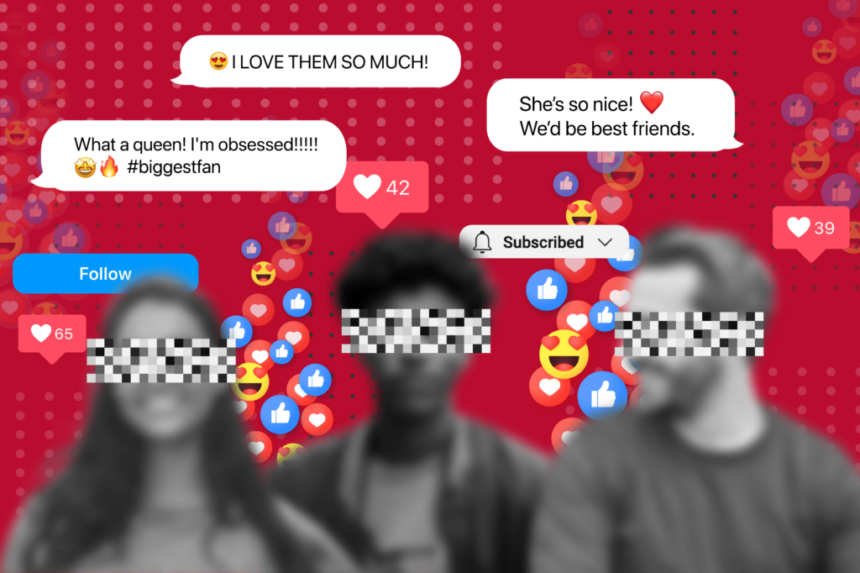
Somewhere between 2015 and now, a particular kind of relationship slipped out of the sociology textbooks and into everyday life. It sits now in casual conversation the way trauma did a decade ago — half-understood; overused; and pointing, despite itself, at something real.
People describe it without quite naming it. I know everything about her. He feels like someone I actually know. The clinical term is ‘parasocial’ — the strange intimacy of knowing someone who does not know you exist. Horton and Wohl identified it in 1956, watching television audiences mourn hosts who had never learned their names. They called it “intimacy at a distance” — curious rather than alarmed. The alarm came later, once the thing had scaled.
In Pakistan and across the South Asian diaspora, the bhai-and-wife format found its own particular idiom. The YouTube husband. The wife who has learnt exactly how much of herself to reveal and how much to withhold. Their thumbnails are a particular kind of art: mouths open in staged astonishment, eyes wide with manufactured disbelief, text communicating urgency about a trip to a relative’s house. The knowing eye feels a faint, involuntary wish to introduce the creator to the concept of restraint.
And yet the knowing eye also watches.
In 2015, before the Pakistani bhais and their wives existed as a genre, before the sisters and the ammas had discovered that a ring light and a kitchen could constitute a career, there were American family channels – and a girl watching them from somewhere considerably further away, absorbing Costco hauls and gender reveals as though they were dispatches from a life adjacent to her own. The mundane, filmed consistently and with enough warmth, begins to feel like correspondence. Like someone is writing to you specifically. Like you are — in some loose, unearned, entirely real sense — included.
This is not exclusive to real people. Garrett Graham — the hockey player from Elle Kennedy’s The Deal, who lived for years in readers’ heads before the cameras arrived to render him officially — is also a parasocial relationship. The reader who built an emotional life around a fictional character, who experienced the adaptation a decade later as either confirmation or betrayal depending on the casting: she was not confused about what was real. She simply found, in the constructed intimacy of a character written to be known, something that answered a need. The medium changes. The mechanism does not.
Beyond the domestic vlogger sits a more consequential category: the identity architect. The Kardashian-Jenner family industrialised the female body as a site of aspiration – a succession of surgically constructed body types, each presented as natural and each absorbed by an audience that had no reason to disbelieve it. The harm is not the alteration. It is the sustained, profitable dishonesty about the means of production. Huda Kattan asked a different question — who has been left out, and how do we account for them? — which is structurally more honest, if commercially imperfect. Lizzo offered something rarer: a body like hers presented not as acceptable but celebratory. For many people, this was not branding. It was oxygen. And then Ozempic arrived, and the audience that had built its self-acceptance inside her image was left holding the receipt for a renovation that has already been gutted.
For young men, the template arrives with more structural damage. Andrew Tate provided a production upgrade to a pre-existing ideology: a face, a voice, a lifestyle of private jets wrapped around a worldview that told young men their failure was the deliberate project of a feminised world. Netflix’s Adolescence returned this to mainstream scrutiny in 2025 — not Tate as the singular cause but the ecosystem, the shared vocabulary of a community finding in his parasocial presence what peer relationships were not providing.
There is a specific scene: the school counsellor, her face doing the work her composure will not permit her mouth to do. Watching it produces, in the particular viewer who has spent years watching this ideology travel from forum to comment section to thirteen-year-old boy, something that sits in the body. Something akin to nausea. Because Tate’s use of Islam to justify a theology of male entitlement is a specific kind of theft — of a faith’s language and weight, redeployed in service of an argument the faith does not make and would not recognise. The nausea is the correct response. It is also, unfortunately, not sufficient.
The ecosystem that produces the thirteen-year-old boy is not sustained by bad actors alone. It is sustained by the same infrastructure that sells the atta brand and the face wash and the renovated kitchen — the monetisation of trust, which does not distinguish between what it carries. In Pakistan, creators who began with a camera and a kitchen now command audiences in the millions. Internationally, the influencer industry was valued at over twenty billion dollars in 2023. Not advertising. The monetisation of trust — which also funds hyperconsumption, which also places the child in the frame.
That child did not negotiate their presence. Placed there before they had language for consent, they remained as the audience learnt their nicknames and the particular way they cry when tired. A child documented from infancy has a digital architecture — milestones are timestamped, and appearance is machine-searchable. Generative AI extrapolates from available images. Voice is synthesised from audio. The parent uploading the birthday video is not thinking about datasets. This is precisely the gap exploitation occupies — not in obvious malice but in absolute innocence. The love is real. The danger is also real. These two things do not cancel each other out.
A generation has grown up with all of this available at any hour, optimised for engagement, architected to feel like presence. The American Surgeon General’s 2023 advisory identified young people aged fifteen to twenty-four as experiencing the sharpest decline in social connection over two decades. The online world did not solve isolation. It deepened it.
The adolescent who has processed every significant emotion through the mediated presence of a creator has, in a technical sense, had company. They have not, in any sense that matters developmentally, had a relationship. Something hollows out slowly, through accumulated substitution, until the original function has been replaced so thoroughly that its absence is no longer legible as absence. It simply feels like the way things are. Two people in the same room, each with their own cast of parasocial companions, neither of them quite present enough to begin with.
A generation sold the sensation of never being alone has arrived at adulthood profoundly undertouched — not for lack of connection but for lack of the kind that costs something. The word ‘antinatalist’ is a blunt instrument for something still being worked out. But it is present. The way a door is present when it has not yet been opened — visible, not yet walked through, and impossible to unsee.
The reader who fell for Garrett Graham understood, on some level, that the relationship was constructed. The thirteen-year-old boy understood the man had never met him. The woman watching the kitchen tour understood the Atta brand was paying for the ring light. The girl who traced her lip liner past its natural edge understood she was trying on an image rather than becoming one.
Understanding has never been the problem.
The infrastructure does not require belief. It requires only attention — from people who are younger and lonelier and more available than any previous audience. It offers the sensation of company, of identity, of being known.
Nullum gratuitum prandium.
There is no free lunch. There is only the question of who is paying, and what — precisely — is being consumed.