





The debate over Pakistani women’s dress is never really about fabric — it’s about power and control. The strange thing about modesty debates in Pakistan is that they rarely stay about modesty for long. A conversation about jeans quickly becomes a conversation about honour, culture, religion, family values, and national identity. In early 2021, female students at Bacha Khan University erupted in protest after being told they could no longer wear jeans or t-shirts to class. ‘Everyone here is a mature adult,’ Hina, a student of the university, told reporters. ‘If our families have no issue… the university has no right to prevent us from wearing what we like.’ Also, her classmate pointed out that such rules make Pakistan look “narrow-minded” abroad. Another case was when Malala Yousafzai was photographed in jeans and boots, a storm erupted online. For many Pakistanis, a single image of a young woman abroad symbolised ‘lost honour’.
Pakistani women are frequently positioned as the guardians of family honour and cultural values, yet they are rarely given the choice to decide whether they want that role in the first place.
The debate over modesty in Pakistan is rarely about women’s comfort or personal choice. Instead, clothing becomes a social tool used to regulate women’s behaviour, movement, visibility, and respectability. The standards themselves shift depending on class, geography, politics, and who is making the judgement. A young woman’s outfit becomes the subject of public debate not for her sake, but for someone else’s.
Historically, debates about modesty in Pakistan have roots in both culture and politics. Concepts like ‘haya’ (modesty/shame) and ‘ghairat’ (family honour) tie a woman’s attire to the reputation of those around her. During General Zia-ul-Haq’s regime in the 1980s, Pakistan saw an official push for conservative dress and behaviour in public institutions. However, unlike places such as Iran or Saudi Arabia, Pakistan never settled on one single national dress code — women from Karachi to Khyber have always defined modesty in diverse ways. As the journalist Aamir Ali Shah notes, “Pakistan lacks a dominant, society-wide standard of covering.” Still, during the Islamisation era, some universities tried to enforce Islamic dress uniforms, and laws like the Hudood Ordinances echoed conservative values. Decades later, these formal campaigns faded, but policing of morals persisted.
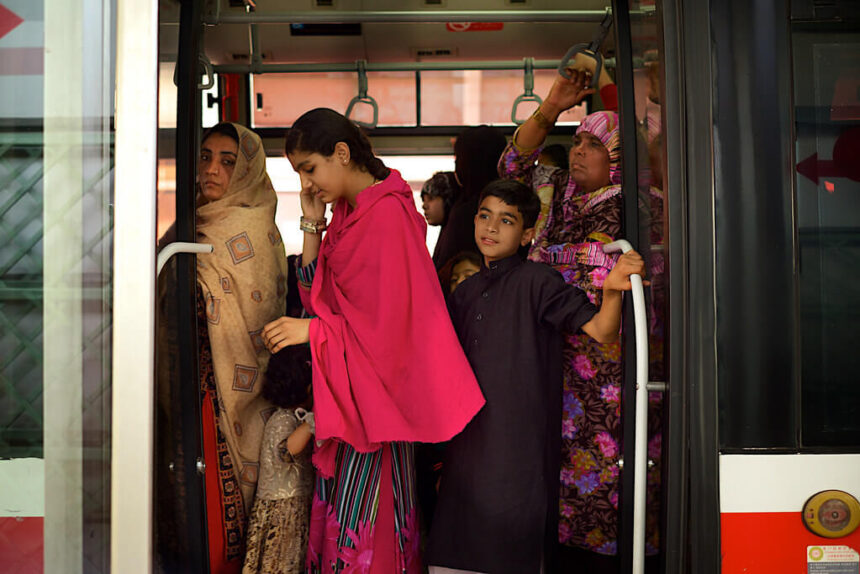
Most young women of Pakistan wear salwar-kameez with a loosely draped dupatta, an outfit widely regarded as modest across cultures, yet they find themselves judged by ever-shifting standards.
Slogans from the Aurat March rallies in 2015–2016 sum up the stakes: “Women are killed…in the name of honour,” one sign demanded: “End to these compartmentalisations and let women be viewed as human beings at least.” In other words, while conservative voices speak of “protecting izzat,” activists call for seeing women as individuals with rights, not as symbolic bearers of family virtue.
In many corners of Pakistan, institutions and elders still enforce strict modesty rules among women. The recent example from Peshawar isn’t different. In the year 2021, universities in Khyber Pakhtunkhwa announced bans on jeans, makeup, and “tight” clothes. Female students were told to wear “conservative formal dress” and even black abayas with headscarves, and the officials justified it by stating “our religion and culture.” Hazara University’s assistant deliberately cited “religion” when imposing a dress code, while a ruling-party lawmaker claimed the governor’s goal was to foster a sense of equality among the rich and the poor.
Meanwhile, in more rural and conservative families, laws and rules for ‘modesty’ were even more intense. Grandmothers or uncles routinely scolded young girls to cover their heads, sit “ladylike” or lower their gaze. They tell a daughter that her half-closed salwar kameez “brings shame” or that riding a bike is immodest. These moral guards wield the language of ghairat: a woman’s one slip and suddenly “our izzat is at stake.” An outfit not liked by one can be painted as dishonourable, regardless of a woman’s own wishes. This ties modesty to fear, fear of gossip, threats or even violence.
Paradoxically, the same society that demands the veil and reserve also subjects women to harassment. In Karachi, a 2014 study found 70% of women using public buses reported sexual harassment on route. One in five said a bus conductor had harassed them. As a result, 31% of students and 23% of working women reduced their public travel, and 40% now refuse to travel after sunset. Rather than making streets safer, men’s predation becomes another justification for pushing women off public space. In effect, modesty norms and unsafe transit together keep many women indoors or under strict supervision.
Human Rights Watch reports that approximately 1,000 women are murdered in so-called “honour killings” in Pakistan each year. In 2024, the independent Human Rights Commission of Pakistan documented at least 405 such killings, with the vast majority taking place in the Sindh and Punjab provinces.
According to UNICEF, one in five women aged 20-24 years old were married before the age of 18 in Pakistan, and it was often justified as a way of protecting a girl’s reputation and safeguarding family honour. Early marriages often limited girls’ education, mobility, and financial independence long before they could make those decisions for themselves.
In Punjab, only 7.4% of women possess driving licences, while women own just 1.7% of registered vehicles, highlighting how limited independent mobility remains.
Surveys have found that women frequently alter travel routes, avoid travelling after dark, or require male accompaniment due to concerns about safety and social scrutiny.
The other side of the coin is that many educated urban Pakistanis have their own set of expectations. For them, “modesty” can be framed as being fashionable or professional. Some criticise women who choose traditional dress as ‘uneducated’ or desi. For example, young liberals often suggest that progressive Muslim women should drop the hijab for empowerment. There’s pressure to look polished and modern in a Western sense: a businesswoman’s power suit or a voguish magazine cover gets more approval than a salwar kameez with a scarf.
Women who do wear hijab or prefer colourful, old-fashioned clothes may be called regressive. Consider Hena Anwar’s perspective as a fashion designer: she argues that modesty is not a rigid uniform but “a form of personal expression.” Anwar points out, “A starched cotton button-down paired with trousers is effortlessly chic and could be considered modest, depending on how it’s styled… There’s this outdated idea that modesty and being fashion-forward are at odds. “For her and women like model Farwa Kazmi (one of the first covered Pakistani models in mainstream ads), modesty is about feeling authentic. Farwa notes, “Modesty and fashion aren’t mutually exclusive — you can be stylish, confident, and elegant while dressing modestly.”
Yet even these self-defined modest fashionistas face judgement. When a woman like Farwa appears on social media without her hijab, some critics mutter that she is “forgetting her culture.” If she is fully covered, others mock her as an extremist. Urban social media is divided: a tweet praising a teary divorce for lack of a wife’s niqab might be followed by a meme shaming another woman for flashing her midriff in a dress. In classrooms and offices, women whisper about being the “fashion police” who keep everyone else’s attire in check. An often-heard lament: “If a sister of mine gets her eyebrows plucked or doesn’t wear dupatta properly, I feel she’s shaming the family,” one self-styled modern mother admitted. As a consequence, women stand between two “shoulds”: one side urging more coverage and the other insisting on more flair.
What does all this fighting over fabric achieve? Not comfort for women; rather, it accomplishes control. The evidence is stark: Pakistani women’s participation in public life remains very low. Only about a quarter of adult women work for pay, and many cite “social restrictions” and safety fears as barriers. The harassment statistics above translate into real life: young women often adjust their entire day around modesty taboos. Rosa, a college student in Islamabad, said that after one menacing experience on a late-night bus, she started wearing baggy sweaters and wrapping her scarf tightly, not out of faith, but to make herself “blend into the wall”. Yet even those precautions draw comments from relatives who say, “You don’t need all that — it’s bad for your complexion!”
Families sometimes frame these choices as piety or propriety, but many women perceive them as a curfew. A rural teacher, Jameela, explained that after dusk she always wears the same navy blue shawl, leaving no chance for “accidental disclosure.” When asked why she doesn’t just skip night classes, she replied quietly, “If I don’t come, who will provide for my children? I can’t hide forever.”
Pakistanis like to say women are sacred trust (amanat) of the family. But in practice, that notion often means telling a daughter what to wear, rather than guaranteeing her safety on city roads or integrity in the courtroom. Instead of fixing streetlights or prosecuting harassers, the public conversation focuses on cloth length and headscarf knots.
Modesty debates are often framed as protecting women for their own good. Yet year after year, women die or suffer in the same societies where these debates rage. As one Aurat March poster put it, “Honour is not restricted to a woman’s genitals and doesn’t rest on her shoulders.” Ultimately, if comfort and safety were the goal, Pakistanis might focus less on what a woman wears and more on how society treats her.
In the end, “modest for whom?” is not just a slogan — it’s the question every Pakistani woman learns to ask. The answer, so far, has been ‘for everyone but herself.’