





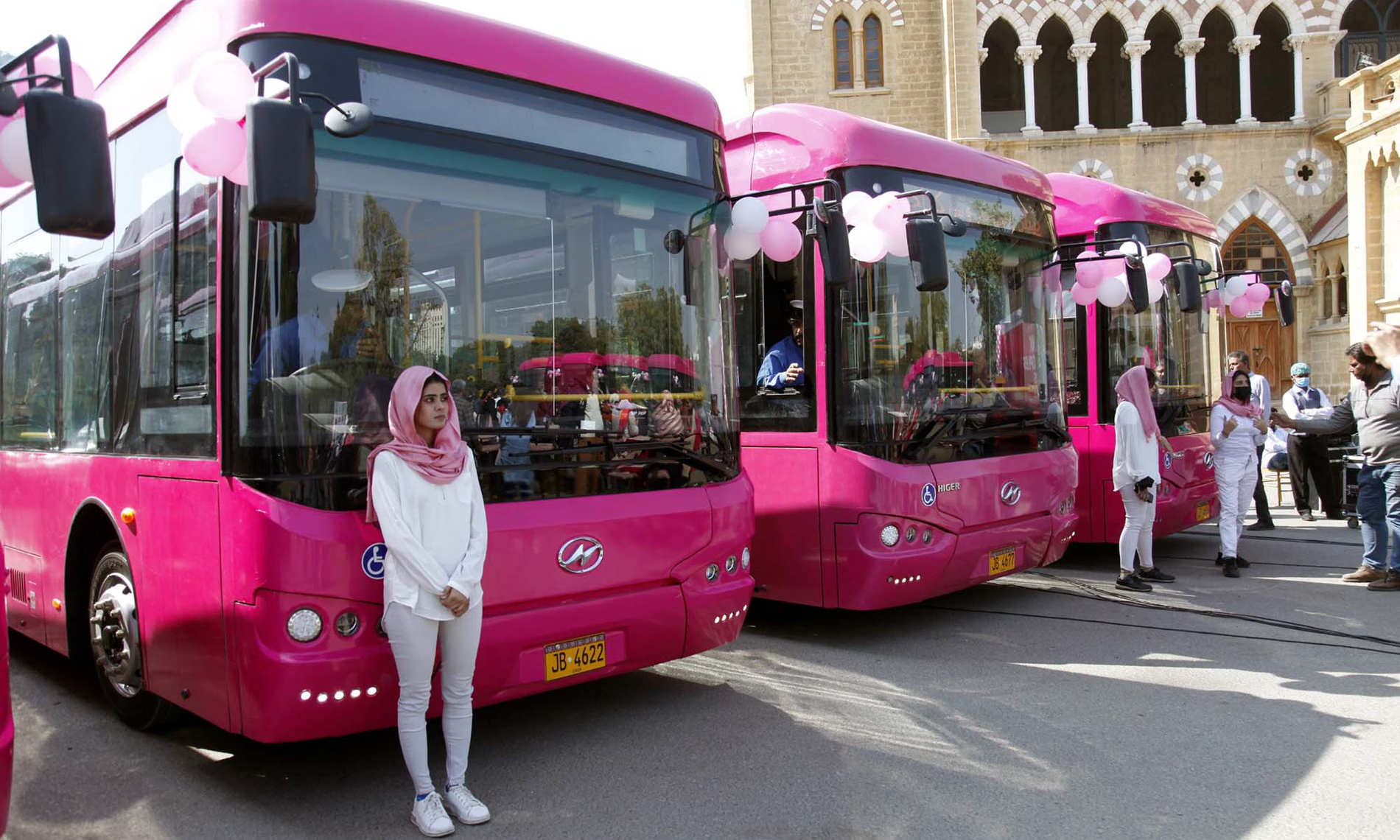
Mobility is the cornerstone of a person’s economic and social independence. Any hindrance to it is not just a nuisance; it can cause someone to be quietly relegated in the cultural hierarchy through systemic exclusion. For women, this struggle is a daily reality. On public transport, the “accidental” grazes and lewd stares have to be painfully swallowed as the cost of venturing outside the home. Over the last several years, the “Pink” commute – female-only buses, taxis and scooters – has been launched in multiple cities in Pakistan to tackle this harassment epidemic. It’s a sigh of relief for every female passenger. But in the bigger picture, does segregating women do anything to combat the patriarchal hostility that forced this measure?
In Pakistan, the government has launched Pink buses in Karachi, Lahore, Islamabad, Gilgit, Quetta and many other cities. The ridership of these buses comprises a spectrum of occupations, including students, teachers, working women and domestic helpers. In Islamabad, they connect rural areas to urban centres to improve access to educational institutions. In Gilgit-Baltistan, where women have to wait for transport on roads and use taxis or Suzuki vehicles, these buses provide a safer option.
In Karachi, as of late 2025, these buses run at least five distinct routes, allowing for harassment-free transport compared to the overcrowded public buses, which means greater female participation in the workforce and in education. These buses fill a real market gap. Private vehicles are not affordable for everyone. And women riding traditional motorbikes are still not socially accepted. So the buses’ immediate impact is improved safety, and the corollary of that is visible economic empowerment for half of the country’s population.
However, the provision of women-only vehicles is also a glaring admission: general public transport cannot be made safe for females. Sonal Shah, a New Delhi-based urban planner and former senior manager at the Institute for Transportation and Development Policy (ITDP), argues exactly this, saying that sex-segregated transport “often becomes a knee-jerk response without consideration of the drawbacks.” If removing women is the only effective solution, it means the prevailing male behaviour is accepted as an unchangeable reality.
The issue of harassment turns from a “man” problem to a “woman” problem; it shifts the onus. So instead of implementing measures to deter vile conduct in public spaces, the government sidesteps that hornet’s nest and simply tells the women to subtract their presence. Women-only buses also give the government the licence to boast about its contribution towards women’s safety without having to address the root of the problem. Installing CCTV cameras, monitoring drivers & conductors, improving road lighting, and swiftly prosecuting harassment on all regular routes are the key actions the government should be taking consistently, but now it faces less pressure to be answerable for them. In the long run, segregation measures – like women-only carriages and female taxis – become part of how society operates. Slowly, it gets accepted that women just don’t belong in public spaces.
A pink commute is not a perfect solution. But waiting for public behaviour to improve can take decades. Sara, a 19-year-old university student, and Farzeen, a hard-working school teacher, need safety in their daily transport today. By allowing women to step out comfortably, we give them the chance to become self-sufficient. Their confidence increases. Handling other public places becomes less daunting, and so more women come into those spaces as well. It’s an entry point to greater economic and social participation and a middle ground between two extremes — either facing daily anxiety during travel or being forced to stay at home and withdrawing from public places completely. It’s not just a question of what the best step forward is, but also of taking a step forward at all.
How effective female-only conveyances are depends on how they are framed. They should be used parallel to public transport policy measures so that we can bring a lasting betterment in women’s mobility. While such transport gives women much-needed relief, it is a band-aid solution. In Pakistan, when the local governments introduced these buses, there were no concrete plans about how the regular public buses would be simultaneously improved. The danger is that we slide into complacency and wake up 20 years later with brightly coloured vehicles still signalling the only place of safety for women. Take the case of Japan, where women-only carriages in commuter trains were introduced in the early 2000s in major cities like Tokyo and Osaka to combat chikan (Japanese for groping); they continue to operate even today, with no signs of them being phased out soon. This could very well be how we in Pakistan end up too.
For daily commuters, their female-only transport experience can bring up conflicting emotions. It can be a reminder that while the vehicle is safer, it still cruises through a city that is not. Sara, the 19-year-old mathematics undergraduate, sits comfortably in the pink bus in Karachi, heading towards her university. She’s revising formulas to prepare for a quiz. She remembers the time before these buses when she used to take public transport and how scrunched up her entire body felt throughout the trip. Her stop comes; she disembarks and immediately sees a passing motorcyclist turn his head to scan her from top to bottom. She keeps walking. At least, the commute to her stop is now peaceful.