





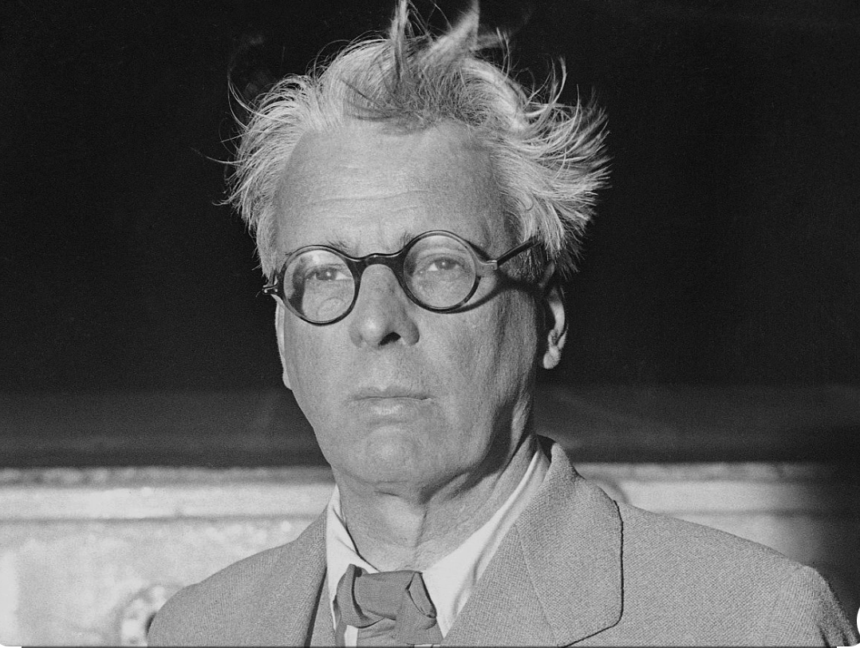
Ireland’s greatest poet spent 30 years chasing a woman who kept rejecting him. She married his rival. He won the Nobel Prize writing about his pain. Then at 52, he married a 25-year-old mystic who changed everything—and realised his obsession had been holding him back.
Stockholm, 1923.
William Butler Yeats stood before the Swedish Academy receiving the Nobel Prize for Literature—Ireland’s first Nobel laureate.
The committee praised how his “inspired poetry gives expression to the spirit of a whole nation.”
What they didn’t mention: much of that poetry was about a woman who’d been refusing to marry him for 34 years.
Maud Gonne was sitting somewhere in Dublin, probably reading about his Nobel Prize in the newspaper, likely thinking “good for William”—and definitely not regretting her decision.
The story starts in 1889.
Yeats was 23, an aspiring poet from an artistic Dublin family. His father painted. His childhood alternated between city life and the mystical western landscapes of County Sligo—ancient ruins, dramatic coastlines, Celtic folklore embedded in every stone.
He attended a gathering and met Maud Gonne.
She was 22, politically radical, intellectually formidable, and committed to violent revolution if necessary to free Ireland from British rule.
Yeats proposed marriage almost immediately.
She refused almost as quickly.
That should have been the end of it.
It was just the beginning.
Over the next decade, Yeats built his literary reputation while simultaneously proposing to Maud every few years like clockwork.
Each time: rejection.
Her reasons varied: “I have political work.” “Marriage would be a distraction.” “I value our friendship too much.”
Yeats kept writing poetry about her anyway.
Not subtle poetry, either. Poems essentially saying “someday you’ll be old and regret not choosing me.”
In 1893, he wrote “When You Are Old,” imagining her as an elderly woman filled with remorse:
“But one man loved the pilgrim soul in you,
And loved the sorrows of your changing face.”
Translation: Everyone else just loves your beauty, but I love the real you, and when you’re old and your beauty fades, you’ll realise I was the one.
It’s beautiful. It’s also emotional manipulation disguised as romantic devotion.
Maud remained unimpressed.
Then 1903 arrived with devastating news.
Maud Gonne—who’d spent over a decade telling Yeats she couldn’t marry because of her political commitments—married John MacBride, a fellow Irish revolutionary who’d fought the British in South Africa.
Yeats was shattered.
She hadn’t rejected marriage. She’d rejected him. She was perfectly willing to marry—just not willing to marry a poet.
Most people would have accepted defeat and moved on.
Yeats wrote “No Second Troy” instead, comparing Maud to Helen of Troy and basically asking “why does someone this extraordinary have to exist in an era unworthy of her?”
The self-pity was extraordinary. The poetry was magnificent.
Here’s what makes Yeats fascinating beyond the romantic drama:
While nursing his broken heart, he was simultaneously building Irish cultural institutions that still exist today.
In 1904, he co-founded the Abbey Theatre—now Ireland’s national theater. He championed Irish playwrights, developed mystical philosophical systems, wrote essays arguing that Ireland needed its own literary tradition separate from England.
When Ireland gained independence, he became a senator in the new government.
His heartbreak was genuine. But it didn’t stop him from accomplishing everything else.
The suffering fueled the poetry. The poetry built the reputation. The reputation created opportunities to shape Irish culture.
It’s almost like he needed the unrequited love to function creatively.
Maud’s marriage to MacBride collapsed within years. He was abusive. They separated but couldn’t divorce—Catholic Ireland didn’t allow it.
In 1916, the British executed MacBride for his role in the Easter Rising.
Maud was finally free.
Yeats, now in his fifties and internationally famous, proposed again.
She refused again.
At this point, you have to wonder: was he actually in love with Maud, or was he in love with the idea of being tragically rejected by Maud?
Because the rejection had become his entire creative identity.
1917 changed everything.
At age 52, Yeats married Georgie Hyde-Lees, who was 25.
Everyone assumed it was pathetic—famous old poet settling for a young admirer after decades chasing his impossible dream.
Nobody expected what actually happened: Yeats became genuinely happy.
Georgie wasn’t intimidated by his fame or his Maud obsession. She had her own interests, her own intellect, her own spiritual practices.
Four days after their wedding, she started doing automatic writing—essentially channeling messages from spirits through her hand while in a trance state.
Real or not, Yeats was completely captivated.
They spent years conducting these sessions together. The material shaped his later work, including his mystical book A Vision. They had two children. They traveled. They built an actual partnership.
Georgie gave Yeats what 30 years of obsessing over Maud never could: reciprocated love, intellectual collaboration, domestic stability.
She didn’t inspire tortured poetry about unattainable beauty. She inspired a functional marriage where both people actually liked each other.
Turns out that’s better for daily life, even if it’s less poetically dramatic.
Yeats died in France in 1939 at age 73.
His body was later moved to Drumcliff churchyard in County Sligo—the landscape that had shaped his imagination as a child.
His self-written epitaph was characteristically dramatic:
“Cast a cold eye
On life, on death.
Horseman, pass by!”
Maud Gonne outlived him by 14 years, dying in 1953.
She never expressed public regret about refusing him. She maintained they’d been better as friends and artistic collaborators than they would’ve been as spouses.
She was probably right.
Here’s what Yeats’s life actually teaches us:
The suffering that creates great art and the contentment that creates a good life are often incompatible.
His decades of rejection produced poetry that won the Nobel Prize and gets taught in universities worldwide. Those poems are beautiful, profound, and completely rooted in pain.
His marriage to Georgie produced happiness, partnership, children, and two decades of productive creative work. That relationship was functional, supportive, and completely undramatic.
He needed both. He got both—just from different people at different times.
We romanticise the Maud Gonne story because unrequited love makes better narratives than successful marriages.
But Yeats didn’t spend his final 22 years pining tragically. He spent them collaborating with his wife on mystical experiments, raising children, serving in government, and writing poetry that was less about suffering and more about synthesizing everything he’d learned.
The Maud obsession gave him the poetry that made him famous.
The Georgie partnership gave him the life that made him whole.
Most biographies focus on the first part because it’s more dramatic.
But Yeats lived the second part—and chose it deliberately after 30 years of chasing someone who didn’t want him.
That’s the real story: not that he loved impossibly for decades, but that he eventually stopped, married someone who loved him back, and discovered that happiness was better than poetry.
He just needed to write all that poetry first to figure it out.