





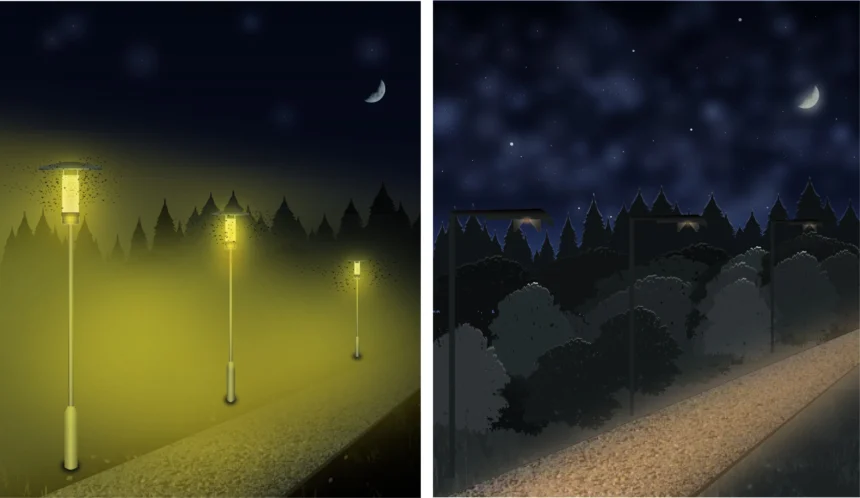
The spark that the night sky once held has faded. Every constellation, every twinkle, every glow is now buried under the icy illumination of streetlamps and neon lighting. In ancient times, the stars were a way to navigate the planet, used by sailors such as Polynesians and Minoans who determined the direction and location at sea by looking at specific stars like Polaris. By observing stars, farmers used to predict seasons to plant and harvest crops accordingly. Moreover, the movement of the sun and stars helped them understand time in the form of years, months and days. Astronomers observed the sky to see the moving stars (planets) and the fixed ones, which helped in the early study of the cosmos. Although we might not use the sky for these means today, the significance of it has not dimmed completely, as it still plays a crucial role for the world’s natural regulation.
The world has become increasingly luminous as humans have evolved and found newer technologies. The electric bulb was a groundbreaking innovation which continues to help us even today. When night arrives, these lights help us find our way back home and illuminate our paths even when darkness has completely taken over. But what if this darkness is not the real villain here?
Light pollution has been increasing approximately by 2% to 10% each year. It is the result of excessive and unnecessary use of artificial light and has certain types, such as skyglow, light clutter, over-illumination and light trespass.
Artificial light causes disruptions in the natural environment. For example, birds that are migrating use starlight for navigation, but due to skyglow, which washes out the stars, they often lose their way or end up colliding with a building, resulting in a lot of deaths every year. Similarly, migratory turtles also fall victim to artificial light and lose their way. Many trees and plants have a hard time adjusting to seasonal variations due to exposure to artificial light; thus, their growth cycles are disrupted. Moreover, insects get attracted to artificial light which kills them upon contact. This affects food cycles, as they are a primary source of food for animals such as birds.
Most importantly, light pollution destroys nitrate radicals, which are needed by the earth’s atmosphere to break down urban smog in order to cleanse itself. Unnecessary use of light also wastes energy, which contributes to carbon emissions. The energy wasted by light escaping into the sky is estimated to cause 1 billion tonnes of CO₂ emissions per year. In the US, outdoor lighting emits 15 million tonnes of CO2 and wastes enough energy to power 35 million homes per year. Furthermore, a 2025 study has shown that artificial light also disrupts natural carbon cycling, as on illuminated nights, ecosystems release more carbon rather than absorbing it. This shows how serious the consequences of ignoring light pollution are.
Humans are also directly affected by light pollution, as it disrupts the body’s circadian rhythm and reduces the production of the sleep hormone melatonin. Exposure to light during nighttime keeps the brain alert, which results in lower sleep time and sleep quality. Moreover, blue light from LEDs and screens causes lower melatonin production, which helps with regulating sleep-wake cycles. This disruption in sleep cycles leads to mental disorders such as depression and anxiety, as well as physical diseases such as hormone-related cancers, diabetes and obesity.
The good news is that reducing light pollution is not that difficult. It can be done by shielding light bulbs and ensuring that they face downwards; opting for warm-toned lights instead of cool-toned bulbs to reduce blue light; reducing overall brightness and glare; preventing interior light from escaping by closing windows and curtains to reduce light trespassing; and supporting policy change that promotes dark-sky-friendly lighting to reduce over-illumination in commercial areas.
And remember, slow steps are better than no steps!