





Deconstructing Choke Point:
A chokepoint is a narrow path in the international oceans that allows travel through or toward another region. Its strategic importance lies within its geography because alternative options for going around the choke points are limited or costly. Therefore, states rely on these narrow pathways for the transit and trade of commodities such as natural gas, crude oil, etc.
The Strait of Hormuz:
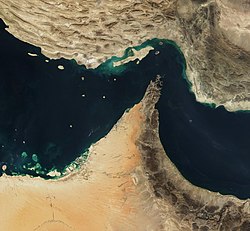
The Strait of Hormuz is a body of water that connects the Gulf of Oman and the Arabian Sea with the Persian Gulf. It is located between Iran and Oman. Approximately 20% of the global liquefied gas (LNG), petroleum products, and crude oil pass through it daily. As a result, bordering states like Iran and Oman can leverage maritime trade routes to serve their strategic interests. Asper, international law under the 1982 United Nations Convention on the Law of the Sea (UNCLOS), states that from the coastline of the state up to 12 nautical miles is considered part of the state’s territorial waters, and so the state can claim complete sovereignty over it. However, the state needs to guarantee innocent passage for foreign ships, whether civilian or military.
Weaponisation of Trade Routes and Their Implications on States:
Before the Iran-US-Israel conflict nexus, the Strait of Hormuz had never been closed despite occasional threats from Iran. However, the assassination of Iran’s Supreme Leader and the bombing of a girls’ school have forced Iran to close the Strait as a deterrence measure against the USA and its allies. This move aimed at sending ripples across the energy market, as Iran is aware of the reactions of states in the international political arena.
The soaring high prices of oil have sent EU member states into a frenzy because they fear the current conflict could lead to Russia sustaining the global energy market due to the possible relaxation offered by the Trump administration. Germany has clearly stated that it has no intention of easing sanctions on Russia. Whereas Hungary encourages EU states to ease sanctions on Russia.
In the Middle East, the GCC states have been caught off guard as the states were transitioning towards economic transformation; they intend to diversify their economic outputs by attracting tourism and to move away from their traditional roles of exporting oil. However, the ongoing conflict has completely shattered the illusion of safety and diversification. Similarly, Houthis in the Red Sea have restricted the access of US, UK and Israeli vessels in Bab-al-Mandeb (another vital chokepoint) in solidarity with Gaza; there are fears in the wake of recent escalations that the Bab-al-Mandeb strait could be closed as well. However, the chances of it closing are lower due to the fear of Israel’s attack on the Houthi leadership. Oman has tried to ease the Iran-US conflict, but to no avail.
The implications of the energy crisis are dire for smaller states like Pakistan, India, Egypt, and Turkey because of their relative proximity to the Strait of Hormuz and their dependence on energy imports to sustain their economies. Pakistan’s industries, particularly the transport industry, have been greatly affected by the geopolitical rivalry, which has led the state to take certain emergency measures, such as the closing of educational institutions and salary cuts for officials, along with the restrictions imposed on large social gatherings. These short-term solutions would buy the state some time to devise strategies and policies to navigate through the global energy crisis. Even so, Islamabad faces greater challenges ahead in the form of currency depreciation, which would lead to disorder and chaos in civil society.
1970s Oil Crisis:
After the Arab states endured defeat at Yom Kippur. OPEC decided to implement an oil embargo in 1973, which paved the way for a global energy crisis. Even though at the time, the USA and other Western states managed to absorb the shock and stay afloat. On the other hand, Arab states and Iran suffered tremendously because of the energy crisis. The difference between the energy crisis of the 1970s and 2026 lies in the fact that in the 1970s, the USA’s foreign policy posture was not offensive, and the value of the petrodollar remained stable.
After the embargo, the Arab states could not find new investments elsewhere, so they reinvested in the USA’s economy, which helped stabilise it. In contrast, the contemporary energy crisis differs from the previous one because the petrodollar is in the phase of decline, and other currency alternatives have emerged due to the rise of China in the global economy. Regional alliances, such as BRICS, present themselves as viable options for states to manoeuvre through the crisis. Moreover, the USA’s offensive foreign policy posture has earned it widespread condemnation inside the state as well as outside.
Way Forward:
In the wake of recent energy turmoil, small states like Pakistan are on the verge of social instability because of their fragile economy. Among the fears are skyrocketing oil prices and currency depreciation. Pakistan should strengthen its diplomatic ties with Russia and China while balancing its relations with the USA. The state’s diplomatic posture can leverage the crisis into a long-term opportunity for economic diversification. Moreover, the short-term solutions imposed by the state pave the way to implement sustainable reforms, focusing on the environment, as the recent petrol price hike has forced youth to opt for bicycles to travel.
Hence, the government can create specific cycling zones for people, especially students, making the commute easier and more efficient for students in order to avoid large traffic influxes. Apart from this, concessions are provided to individuals working in the transport sector by reducing fines on commercial vehicles during peak traffic hours and by providing fuel subsidies to curb price hikes on fares. Moreover, providing incentives to transition from reliance on gasoline, diesel, and LNG to electric vehicles would ease grievances in the transport sector and provide economic relief.
This transition would open up new avenues of investment for the state by encouraging the use of public transport, reducing fines, and promoting environmentally friendly projects, and over time, these initiatives would lead to economic stabilisation. Effective and efficient monitoring of schemes by the state at the national level remains a pertinent pillar in success, along with collaboration with regional organisations, which would help to alleviate the economic woes of small states due to the ongoing energy crisis, as the increased trade within the region would reduce reliance on foreign loans.
In essence, the 2026 oil crisis would strengthen regional economies, particularly those of South Asia. Whereas economic prospects in the Middle East can diminish further if escalation continues. The closure of the Strait of Hormuz is reconstructing the structure of the international economic system, which could eventually lead to shifting alliances and new rivalries.