





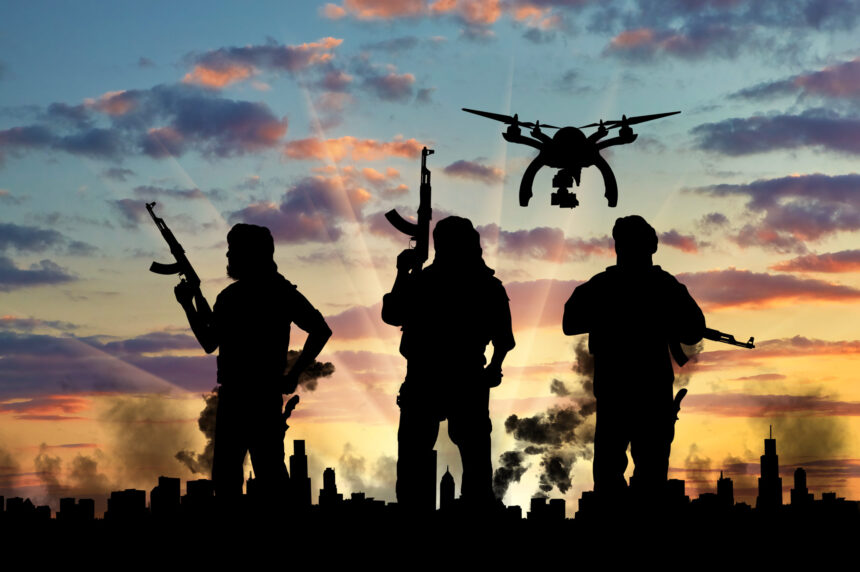
The United States, with its infamous “War on Terror”, redefined what constitutes terrorism after 9/11. As a response to the attack on the Twin Towers, this war grew into an excuse to exercise the power of the US military in areas such as Iraq, Pakistan, and Afghanistan. The US claimed that the “terrorists” were the same mujahedin they had trained to fight the Soviet Union in Afghanistan during the Cold War, but this fact was made dormant. It soon became clear that whatever the US political leaders define as “terrorism” will become “terrorism,” even without much proof, as was seen during the invasion of Iraq.
With both criticism and extensions of this concept, third-world nations have adopted their own stances and meanings of terrorism. On the surface, many simply define it as the use of terror as a motive against innocent civilians. But beyond it, terrorism has been divided into three broad categories:
- Terror issued by the state itself,
- Terror as a response to state terror, and
- Terror born out of Nazi-esque concepts of communities.
Despite the frequent overlap between these three, it’s important to distinguish between them in order to define terrorism. Ironically, nations, including the United States, have refrained from establishing a universally applicable definition for this phenomenon they purport to combat. This hesitation is also evident in the importance of distinguishing between types of terror in today’s society.
A classic example of terror issued by the state today is in the Indian-occupied side of Jammu and Kashmir. While the BJP and PM Modi are issuing statements against terrorism, claiming to be backed by Pakistan, their military has occupied the Kashmir area with state-sanctioned violence against civilians for decades now. All resistance is labelled as “acts of terrorism” and shut down. A similar case was seen with the PTM (Pashtun Tahafuz Movement) in Pakistan, where, under the anti-terrorism laws, over 200 arrests were made from the organisation ahead of their jirga, or assembly, to call for treatment of the Pashtun community. The federal government claimed that they “engaged in certain activities which are prejudicial to the peace and security of the country”. This begs the question of the fundamental rights of peaceful protests or even civilians’ demand of constitutional rights: where peaceful meetings or demonstrations are concerned, will they be labelled as terrorism themselves? Any public display or gathering might lead to disruptions of peace if interpreted from this angle. How do governments or the military create a distinction?
People often view terror as an isolated response. This usually happens when governments do the above-mentioned, and at times, the scale goes beyond what is considered humane and is met with violence. Here, a chain of events begins when violence is met with violence. Arguably, one might debate whether this is “terror” or rather “resistance”. If the violence is treated as resistance, support is formed amongst the public. The US and Israeli governments define acts done by Hamas as terror and support for the organisation as support for terrorism, consequently. This keeps the Israeli state from excusing its genocide and occupation since the 1940s, since it is, absurdly, also another newer War on Terror. Meanwhile, Palestinians and activists across the world label it as resistance in response to state-sanctioned violence. This, as seen widely, led to a positive view of the resistance amongst the public across the world, challenging the decades-long control of the US on global politics.
The term “Nazi-esque” can be used to mean the superior notions of self of certain communities. Here, hatred against one community perceived as inferior is the entire motive behind the violence. As mentioned before, distinctions often overlap, and here it can be argued that on the surface, the Israeli community justifies their terror against the Palestinian people as justifiable because of this. A clearer example is the recent suicide bombing in Islamabad’s Khadijatul Kubra Mosque-cum-Imambargah in Tarlai Kalan. The Sunni and Shia divide in Pakistan has led to decades of hostilities against the Shia population of the country to the point that political differences act as a motive for terrorist acts. Similarly, in 2019 in New Zealand, a white supremacist opened fire on Muslims performing Friday prayer in Christchurch.
A common theme occurring in these examples is the vague nature of the definition of terrorism and its causes. What it is and what it is not leaves the public in confusion, illustrating the reason why the phenomenon of terror is not given a standard definition. It acts as a form of social control, instilling fear of those in power and a state of perplexity in the masses so that even questioning, criticising, or demonstrating will lead to criminal charges. After the Pahalgam attack in April, Kashmiri activists were met with control and silenced in India. Furthermore, the general public’s view will be formed by those in authority, hence shaping popular opinion and, indirectly, even a response to the terror acts. Terror or resistance also presents this paradox. It follows that the state can be the “terrorist” that it claims to be against.
In ‘Good Muslim, Bad Muslim: America, the Cold War, and the Roots of Terror’, Mehmood Mamdani states that “We need to recognise the suicide bomber, first and foremost, as a category of soldier,” blurring the boundaries between actions taken for “national sovereignty” and those of a terrorist. Therefore, are the political leaders of the US not terrorists? Similarly, Frantz Fanon presents that colonialism speaks the language of violence. To eradicate or to “decolonise”, the response is naturally violence too. Those under the boot of occupation see that their occupiers speak in violence and do not understand anything but that. Actions that follow may or may not be justified, but are explainable in a wider context.
Terrorism today has formed itself into specific distinctions which inevitably wrap themselves into each other at many points. Much different from the Western view of a terrorist being a Muslim man from the third world, it has gone astray and framed the gatekeepers of terror and violence and their imposers as the ones spreading terror. It has, moreover, even extended itself and blurred any differences between state and person. With no set meaning, “terrorism” has become an entity of its own.