





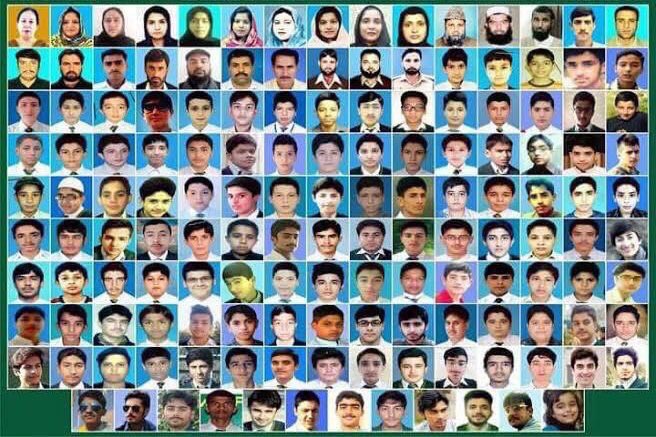
December 16: The Day the School Bell Never Rang Again
There are days that carve themselves into a nation’s memory so deeply that time seems to bend around them. December 16, 2014 is one such day for Pakistan — a morning that began with the ordinary rhythm of school bells and echoing laughter, and ended in a silence that has never fully lifted.
The Army Public School in Peshawar was, like any school anywhere, a place where children carried the weight of homework, not history. A place of small worries and everyday discipline. Until the day it became both classroom and memorial.
That morning began like countless others. Shoes were tied in a hurry. Lunchboxes were packed with distracted care. Mothers called after their children to come home on time. The bell rang as it always had, ushering students into classrooms filled with chatter, impatience, and the quiet certainty that afternoon would arrive.
For many families, it never did.
What followed transformed 144 lives — 132 of them children — into absences that cannot be reasoned with. The loss is not only in empty chairs or unanswered roll calls, but in the sudden collapse of assumption: that children leave in the morning and return by evening, that school is a temporary separation, not a farewell.
There are children who did not come home, and there are children who did — changed, quieter, older than their years. They carried with them memories that surface in sudden sounds, in crowded corridors annd in the sharp ring of a bell.
Yet it is the first group that time cannot soften: the children held forever at the age they were, living now in photographs, school certificates, and the careful way their names are spoken aloud.
Grief, people say, is not loud forever. It becomes procedural. It learns how to function, how to sit through weddings, how to answer questions it has heard too many times. But December 16 does not wait to be invited. Each year, it arrives intact.
It lives in homes where bedrooms remain untouched, where uniforms still hang in cupboards, where schoolbags were never unpacked. In some houses, an extra plate still finds its way to the table — not in expectation, but in loyalty. These are not failures to move on, but acts of devotion: a refusal to let love be edited out of daily life.
The parents did not only lose their children. They lost every birthday that would never come, every exam result, every argument, every ordinary evening that quietly builds a life. They lost the chance to discover who their children would have become.
Before that morning, schools in Pakistan were imperfect and ordinary — places of aspiration and frustration, strict teachers and fleeting friendships. They were safe in the way routine is safe: through repetition, through trust. That trust fractured. Sending a child to school, once an unthinking act, became a moment weighted with pause, with prayer, with fear carefully hidden from small faces.
The tragedy did not remain in Peshawar. It followed parents across the country to school gates, into classrooms, into the seconds after goodbye. The bell, once a signal of order and release, became a reminder of fragility. Each ring carried an unspoken question: Will this day end as it should?
Among those who survived, and among siblings left behind, are children who grew older in an instant. Some carried their grief into achievement, studying with a ferocity that felt like defiance, as though excellence might argue with fate. Others struggled, haunted by sounds that should never exist in a place of learning — the echo of fear where there should have been recitation and laughter.
They carry a double burden: their own grief, and the expectation to embody resilience. To become proof that the country endured. It is an unfair inheritance for young shoulders, yet they have carried it with a grace they should never have needed to learn.
Life, in its insistence, moved forward. The school was rebuilt. Classes resumed. New students filled its halls, many too young to remember the day itself. Memory, however, works on a different schedule than reconstruction.
The parents did not rebuild. They learned to live with rooms that remain incomplete, with futures that stop mid-sentence, with love that has nowhere to land.
December 16 marked more than the loss of 144 lives. It marked the end of a particular innocence — the understanding that school mornings are not invincible, that the spaces we trust with our children can fracture without warning, that childhood is not protected by its own smallness.
The smallest coffins weigh the heaviest, not because of what they contain, but because of what they interrupt.
And yet, the day does not belong only to loss.
We do not need to recount violence to remember the dead. We do not need to dissect causes to acknowledge consequences. The ache itself is evidence enough.
The bell did not ring again that day — but its echo remains. In quiet classrooms. In unfinished lives. In the collective resolve that these children will not be reduced to a number, a date, or a passing headline, but remembered as what they were: sons, daughters, students, futures.
Some dates pass.
Others stay.
December 16 stays.