




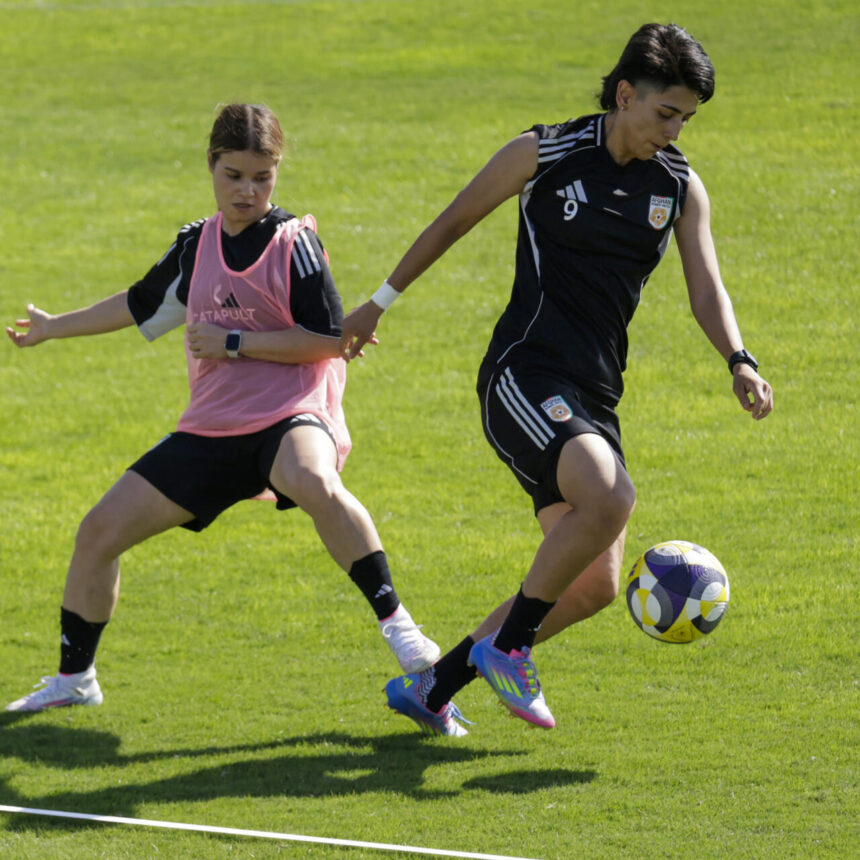
We constantly perceive football as a sport of joy and creativity, one that sparks heated debates and is easy to play. But it also carries a deeper meaning — one of freedom, rights, and citizenship.
The right to play football, though seemingly basic, remains a battlefield for millions of women around the world. The recent history of Afghan athletes reveals a reality in which sport becomes a symbol of resistance, liberty, and dignity. Across cultural and political contexts, the female body has been watched, controlled, and silenced — and the act of running, kicking, or simply exercising has turned into a political action.
In Afghanistan, the Taliban’s return to power in 2021 represented a brutal collapse of women’s rights. The regime banned women’s sports, deeming them “inappropriate” and “unnecessary”. Athletic practice — a symbol of health and freedom — became a clandestine act.
Still, women persist. Paralympic athlete Zakia Khudadadi, for instance, started a new life in France after competing in the Tokyo 2020 Games — a rare case of resistance transformed into a symbolic victory. At the 2024 Paris Paralympics, she became the first medallist from the Refugee Paralympic Team: “This medal is for all women of Afghanistan and all refugees around the world. I hope one day there will be peace in my country.”
International sports organisations Role for Women sports
International sports organisations have attempted to respond to this crisis. The International Olympic Committee (IOC) banned Taliban authorities from attending the Paris 2024 Games, insisting on gender parity. The International Federation of Association Football (FIFA), however, has maintained an ambiguous stance: it recognises the Afghan Football Federation — now controlled by the Taliban — while refusing legitimacy to the women’s team formed by refugees. Only in 2025 did the organisation create the “Afghan Refugee Women’s Team,” a symbolic gesture that, while significant, still failed to restore their full right to represent their country.
FIFA’s omission has been condemned by human rights groups, which accuse the organisation of complicity in institutionalised discrimination. After all, it cannot preach gender equality while recognising a federation that forbids women from playing football. Many players, therefore, have chosen exile in order to keep playing. Former captain Khalida Popal, for example, founded the Girl Power Organisation, which fights for refugee athletes to be recognised as legitimate representatives of Afghanistan. Her journey symbolises the struggle for the right to play — a right that, like education, should never depend on gender.
As Popal reminds us, sport has the power to change the world. But such transformation only occurs when words and actions align. The IOC and FIFA, as global institutions, cannot limit themselves to inclusive rhetoric; they must take a stand against regimes that violate women’s most basic rights. The historical example of South African apartheid shows that banning nations from international competitions can be a legitimate tool of ethical and political pressure.
Women must fight for their rights everywhere. Brazil, a nation proud to call itself the “country of football,” also denied women the right to play for nearly four decades. In 1941, President Getúlio Vargas issued a decree prohibiting women from engaging in sports “incompatible with their nature,” including football, weightlifting, and martial arts. The official justification cited health concerns and women’s “maternal function” — a moralistic and pseudoscientific argument.
The ban lasted until 1979, marking one of the longest legal restrictions on women’s sports in the world. During that time, women who insisted on playing were labelled “rude, classless, and malodorous,” as noted by researcher Heloísa Bruhns. Women’s football, which emerged among the working class, faced a double prejudice — of gender and class. While elite men ruled the fields, women were confined to the stands, expected to be spectators, not players.
Despite prohibitions, there was resistance. In 1958, Araguari Atlético Clube, in Minas Gerais (a Brazilian State), formed the first women’s team, gathering 22 players for a charity match that attracted a large crowd and coverage from the magazine O Cruzeiro. The success was short-lived: the team was dissolved months later under pressure from religious groups. The story of Léa Campos, the first woman to complete a refereeing course in 1967, also reveals the barriers of institutional sexism. Although the decree did not explicitly forbid female referees, she was prevented from working due to “sexist reprisals,” as she later related.
Only in 1988 did Brazil have its first Women’s National Team, starting a journey that still seeks recognition and equality. But the path toward full professionalisation of women’s football has been slow and uneven — a reflection of a culture that continues to associate sport with masculinity and physical strength.
The struggle for the right to play football — whether in the streets of Kabul or the fields of Minas Gerais — is a struggle for citizenship. It is not merely about competing in tournaments but about affirming bodily autonomy and the right to exist fully. Football, the greatest symbol of Brazilian national identity, was once an instrument of oppression and has now become a tool of liberation.
Therefore, the history of women in sports is, above all, a history of resistance. From exiled Afghan players to Brazilian pioneers, there runs a common thread: the courage to exist against imposed rules. Their struggle echoes Malala’s words — “I have the right to toy, to study, to speak” — and extends that right to the athletic field: women have the right to play.
As long as there is a girl forbidden from kicking a ball simply because she is a woman, football will remain incomplete. It is the duty of society, institutions, and the media to remember that this fight is not for medals, but for equality. Because for women, playing has always been — and still is — an act of freedom.