





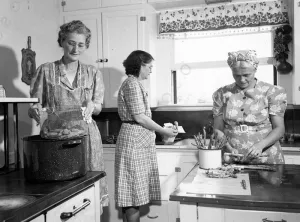
History often highlights battlefields, parliaments, and public speeches. However, there were numerous important political debates that took place elsewhere. They unfolded in kitchens. The kitchen, to many women, was not simply a place to cook; it was their silent place where ideas were exchanged, plans formulated, and resistance slowly developed.
Women were not involved in formal politics in many societies. They were not allowed to vote, have meetings, or speak publicly on change. Still, however, they managed to engage. The kitchen was like a backyard where political thoughts could be nurtured without drawing notice.
Women talked about the world around them as they were cooking. They talked about wrong laws, increasing prices, wars, and injustice. These discussions were informal but powerful. Visions were exchanged from one household to another through everyday visits, eating together, and family meetings.
Recipes were periodically attached to letters and messages. A written recipe could be sent through houses without arousing suspicion. Women would make personal remarks concerning protests, meetings, or local assistance. So, even the commonplace household communication had political significance.
Kitchens were secretly resistant to different movements. Women cooked for the activists, hosted visitors, and modified information. It served a group, and this might appear to be an ordinary way of sustaining political organising.
During independence movements and civil rights activities, women’s homes served as coordination centres. Tables were packed with people eating and plotting. The room smelt of bread or tea as conversations on change took place.
These little gestures could hardly be compared to the masses in the streets, yet they were necessary. Movements are based on faith, scheduling, and encouragement. Kitchens did that foundation work, and an environment was made where individuals could express themselves without fear and share ideas.
There was also a deeper symbolism of the kitchen. It showed that political action is not necessarily done in visible places. Rather, it can develop silently in the daily context, in the environment of domestic employment and political consciousness.
Historians are currently looking at these untold stories. They acknowledge the fact that contributions of women to the change in politics did not exist on the streets or in the formal groups. A good deal of those contributions, indeed, started at home, at a plain table.
Considering the political history, we are inclined to contemplate such famous leaders and events. But the change grows out of common talk as well. An idea shared in a common recipe, a letter written by hand, or even a cup of tea can create the future.
The kitchen, traditionally regarded as an intimate, home-related area, turned out to be a small and effective stage of political life. Out there within those walls, silent rebellion spoke. Inside those walls, quiet rebellion found its voice.