





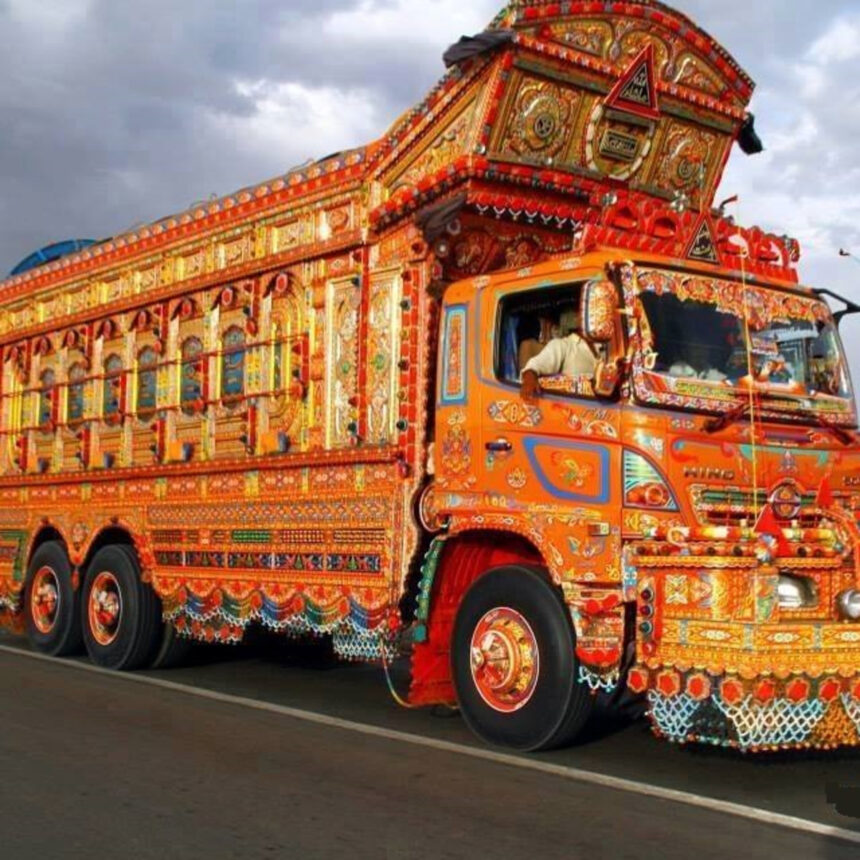
Growing up in Pakistan, I’ve seen thousands of these trucks and buses. You have too. Tigers roaring, shairi about love, politicians’ faces bigger than life, Quranic verses right next to film actresses, chains making noise, lights everywhere. The buses are wild — entire moving paintings rolling through the city packed with people. They’ve been just always there. Recently, I started actually looking at them, and now I can’t seem to unsee it. These things are saying something about us that we’ve been ignoring.
Nobody’s Filtering This
Truck and bus art is the most honest thing we make. More honest than anything on TV, social media or in fancy galleries. Why? Because nobody’s watching. There’s no committee saying, “That’s not appropriate” or “You can’t mix those things.” Just drivers and painters choosing what goes on there.
The trucks haul stuff across provinces. Buses carry people through cities. Both of them carry our whole culture painted on the outside, moving around for everyone to see.
And what do they choose to paint? That’s us. Actually us.
The Symbols Go Deep
That peacock everyone paints? It’s not just pretty. In our culture, it means beauty that’s stuck on the ground. Pride mixed with knowing you’re vulnerable. That’s literally us.
The tiger isn’t about looking tough. It’s about power that doesn’t come from papers or permissions. These drivers don’t have institutions protecting them. They survive on their own. The tiger is saying that.
Those huge eyes painted on the front? Protection from nazar, yeah. But think about what that means. We live somewhere jealousy actually matters. Where the gap between the rich and the poor is huge. Where someone else resenting you feels dangerous. The evil eye thing isn’t superstition — it’s how we understand our society. It’s saying envy has real power here.
This stuff means something.
We’re All Contradictions, and That’s Fine
Same truck or bus: verses from the Quran. Some politician’s face. A film actress. Love poetry. Pakistan flags.
Foreigners would say that’s confusing. Religious stuff next to romantic stuff next to political stuff? How does that work?
But that’s how we live. We pray, and then we gossip. We’re religious and obsessed with dramas, and we can never forget cricket. We don’t think it’s weird because it’s not weird; it’s just being a Pakistani.
The art isn’t mixed up. We are. And the art is showing that honestly.
The Jokes Are How We Survive
“Buri nazar wale tera muh kala” — that’s aggressive. That’s anger painted where everyone can see it.
“Awara hoon” on a truck that literally works for a living? That’s ironic. That’s playing with what people think about drivers.
“Awaz do, hum tumhare hain” — making a horn sign into flirting? That’s refusing to be boring. That’s finding fun in a hard job.
We joke about everything here. When things are difficult, we make jokes. The trucks are doing that at highway speed.
The Politics Are Real
One truck has Bhutto, another has Imran Khan. Kashmir symbols. Different regional patterns. Army slogans.
This is politics without worrying about consequences. A driver can paint what he believes without losing his job or upsetting his family. His opinions are mobile and loud.
Everywhere else we’re careful about what we say. But on trucks? No filter. What the driver actually believes, his pride in where he’s from, what he thinks Pakistan should be—it’s right there. This is us politically when nobody’s policing it.
The Dreams Show What’s Missing
Fighter jets. Foreign cities. Tall buildings. Beautiful mountains. Places these drivers probably won’t go.
This isn’t stupid optimism. This is wanting something painted where you can see it. A guy who’ll never fly a jet paints it on his truck. Someone who’ll never leave Pakistan puts Paris on there.
But it’s also saying something else. If you’re painting dreams, you’re admitting they’re not real yet. So it’s hope but also kind of a protest. Both at the same time.
The Chains Mean Something Too
Those decorative chains hanging off — yeah, protection and making noise. But chains usually mean being trapped, right?
These drivers are taking chains and making them pretty. Making them loud. Demanding attention with them.
It’s like making your restrictions into jewellery. Saying, “Yeah, I’m stuck in this economic situation, this hard labour,” but making that into art. Taking what holds you down and using it to announce yourself.
That’s not giving up. That’s fighting back through decoration.
We’re Losing This
Truck art is disappearing. New rules, modern styles, younger people wanting plain vehicles. And we need to pay attention to what that means.
Everywhere else we’re performing. Curating Instagram. Being careful politically. Switching how we talk based on who’s listening. Even gallery art is made thinking about foreign audiences and critics.
Truck art was never made for approval. Just pure expression from people who don’t care if you like it.
When that’s gone, we lose the only place all our contradictions exist together without someone saying it’s wrong. We lose seeing ourselves unedited.
What I Mean
These trucks and buses we see constantly — they’re not just moving things around. They’re a mirror, the kind that shows who we actually are when we’re not pretending.
Religious and romantic. Political and funny. Traditional and ambitious. Using jokes as protection. Believing in invisible threats. Demanding to exist when society ignores you.
Want to understand Pakistan? Forget the books. Get stuck behind one of these painted vehicles and look at it.
It’s all there. The real version. Not what we show outsiders or pretend to be.
The tigers, the poetry, the eyes, the chains, the dreams, the mess of it — that’s us.
We just stopped looking at what’s been in front of us the whole time.