





The Biblical account in 1 Samuel 15:3 states: “Now go and smite Amalek, and utterly destroy all that they have, and spare them not” (1 Samuel 15:2).
This command from the Lord to King Saul reflects Israel’s historical memory of how Amalek laid wait for them in the way when they came up from Egypt. Understanding this historical context is essential for properly interpreting contemporary conflicts.
In recent discussions on social media, some have drawn parallels between the biblical Amalekites and modern Palestinians in Gaza.
However, this comparison requires careful historical examination.
The Amalekites, descendants of Esau (son of Prophet Ishaq, who was the son of Prophet Ibrahim), were a major early enemy of the Israel nation. Their hostility toward Israel was characterized by several key events:
Understanding the Biblical Account of Amalek and Its Contemporary Relevance
Introduction/Historical Background:
Who Were the Amalekites
It is crucial to understand that the Amalekites were not believers in the God of Israel. They were pagans who worshipped many gods. In contrast, Israel was the community which God Himself had chosen as His people, nourished them, taught them His words, gave them His laws, and established His covenant with them. The many acts of disobedience by Israel resulted in punishment ordained by Holy God.
These punishments were executed on the spot, and the recipients are known in scripture as “Holy God’s people.”
In the second verse of 1 Samuel 15, Holy God asked King Saul, the first king of Israel, to smite Amalek, destroying everything—man, woman, infant, and suckling—to eliminate every trace of bloodshed. This was
The Amalekites in Biblical History
The Amalekites were notorious for ambushing the Israelites from behind while they were weary and escaping Egypt, specifically at Rephidim, launching unprovoked brutal attacks targeted at the vulnerable and leading to divine condemnation for Israel’s enemies
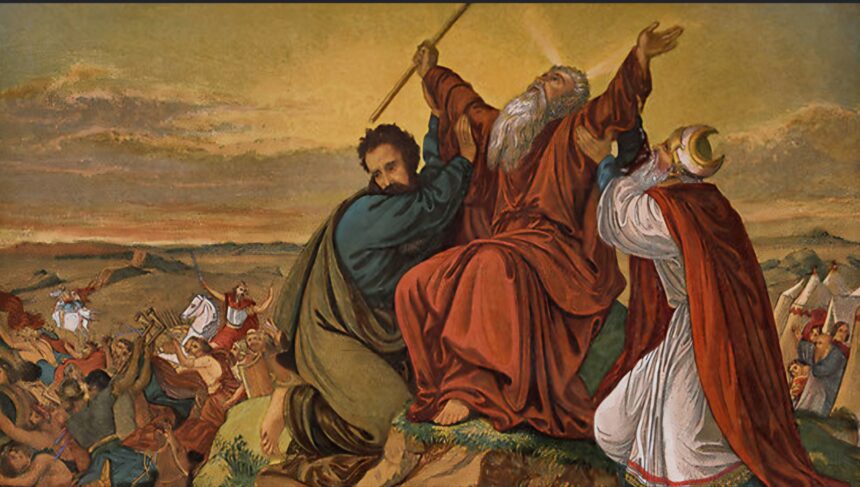
• At the Battle of Rephidim (Exodus 17), Amalek attacked Israel just before they reached Mount Sinai to receive the Torah
• During the battle, Moses held up the staff of God—the same staff that had parted the Red Sea, split it, and provided a way for Israel to cross through the sea, ensuring that every Israelite had the same stick of wood that Moses used to bleed a rock and provide water
• Victory for Israel was secured as long as Moses’ hands remained raised
• The Torah commanded total war against Amalek (Deuteronomy 25:17-19) because they struck the “weary and famished” trailing behind the main group
• This event established a lasting generational feud between Israel and Amalek, which became a central theme in Israel’s fight for survival
• In Numbers 14 and during the time of Judges, Amalek continued to have conflicts with Israel
• Religious Identity of the Amalekitewhat Holy God demanded as divine judgment against a pagan nation that had attacked His covenant people.
The contemporary situation involving Gaza, Iran, and Israel requires a fundamentally different analysis. Gaza and Iran are home to believers in one God—Muslims who share the Abrahamic faith tradition. They should not be treated in the same manner as the ancient Amalekites, who were fighting against the Holy God’s chosen people when God was actively leading and protecting them.
Several important distinctions must be made:
1. Religious Identity: Today, we are fighting against believers of one God, not pagans who worshipped multiple deities. Muslims,
Christians, and Jews all worship the God of Abraham.
2. Divine Promise and Protection: God has made a promise to Prophet Abraham that if there are found ten righteous people, a city will not be destroyed. Given the populations involved, it is certain that Palestinian Gaza, Iran, and even Israel contain many believers and righteous people—Muslims, Christians, and Jews alike.
3. Moral Responsibility: These populations should not be indiscriminately killed. The proper approach is to ensure that good people do not become casualties of conflict or earn their livelihood through means that disrespect their dignity. People should be treated as noble citizens of the countries in which they reside.
4. International Cooperation: The path forward involves asking the United Nations to facilitate peaceful resolutions. Rather than military conflict, the international community should work to transfer power to suitable leaders committed to democracy and peaceful coexistence.
Contemporary Application: Gaza, Iran, and Israel
The Modern Situation
Key DistinctionThere are extremist voices—approximately 40 million people in Iran who claim that afterwards 400 should be sure they have crafted many “good Shia Muslims”—who advocate for violence. Some suggest that America should “happily transfer their power” after “closing a social media blogger” while advocating for burning people alive, comparing it to a “Mach box and burn fire” that may result in “few likes but will consume millions of people in war.”
Such rhetoric calling for violence and mass casualties is fundamentally incompatible with the teachings of the Abrahamic faiths. As the message states: “God bless his peace to the world.”
The heading of this discussion should be clear and unequivocal:
“Peace Only Peace”
The ancient command to destroy Amalek was specific to a particular historical context involving a pagan nation that repeatedly attacked God’s covenant people during their exodus from slavery. This cannot and should not be applied to contemporary conflicts involving believers in the one God of Abraham.
The call today must be for justice, peace, dignity, and the protection of all innocent life—regardless of nationality or religious affiliation.
Only through dialogue, mutual respect, and commitment to peaceful coexistence can the children of Abraham honor their shared heritage and build a future worthy of the divine promises given to their common ancestor.
Addressing Extremist Rhetoric
Conclusion: Peace, Not Genocide
• No believer in Gaza, Iran, or Israel should be killed
• Peace—and only peace—should be the guiding principle
Believers of one God should not be killed like the pagan Amalekites were in ancient times.
May God grant wisdom to all leaders and people of goodwill to pursue peace rather than perpetuate cycles of violence. May the righteous in every land be protected, and may all people come to recognize their common humanity and shared responsibility to build a world of justice and peace.
“Blessed are the peacemakers, for they shall be called children of God.” (Matthew 5:9)
Final Reflection