





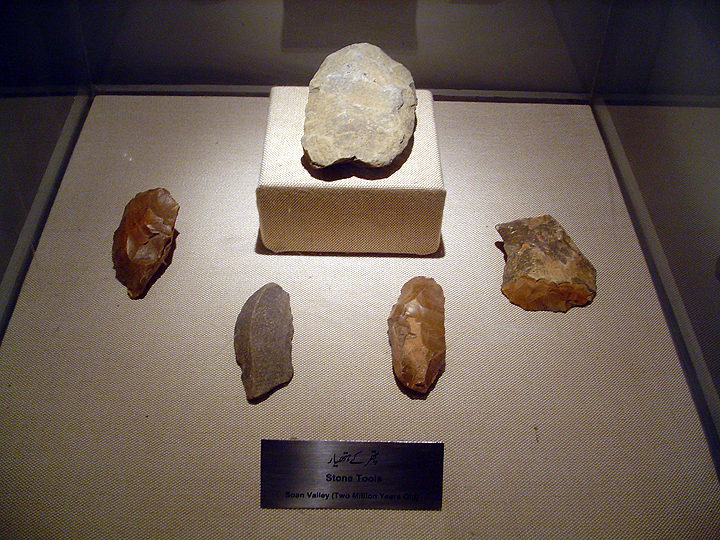
(The soil that witnessed the odyssey from Homo erectus to Homo sapiens)
From Alexander the Great’s invasion to the Gandhara civilisation, there has been no wave in history that hasn’t passed through Pakistan. The archaeological importance of Pakistan is widely known because of the Indus Valley civilisation, dating back 5000 years, but little do we know that in the Pothohar region lies a valley with breathtaking natural beauty of lakes, which dates back in time to as old as 2.6 million years, laying the basis of the Palaeolithic Era of the Stone Age.
Researchers first discovered Soanian culture, which spread widely from Khushab to the mid-Himalayan region, in the 1930s. Since then, archaeologists have conducted major excavations to learn more about the tools of the Soan Valley. Like in other regions of the world, the Stone Age period is studied in three periods of time: Palaeolithic, Mesolithic and Neolithic times, depending upon tools and artefacts found by techniques like carbon dating. Pakistan has been fortunate to witness all three periods on its land. Palaeolithic period artefacts found in the Siwalik Hills are some of the oldest tools found outside Africa, dating back to 2.6 million years ago — pre-modern human testaments. The sites near the Soan River and other regions of Pakistan not only speak of archaeological importance but also establish the evidence of the migration of early hominids such as Homo erectus. This mobilisation was not only limited to lifeless tools, but it also covered the voyage that allowed humans to meet the standards of being humans.
Similarly, tools found in Riwat date back to 2.5 million years, and others found in Pabbi Hills are up to 2.2 to 0.9 million years old. Major tools that were discovered include light- and heavy-duty tools and simple end choppers, marking evidence of hunter-gatherer living. These featured tools are made of quartzite pebbles and cobbles with supplied raw materials. This highlights a time when their only source of survival was hunting, as agriculture was not developed. In 1988, such tools were discovered that not only indicate the physically striving lifestyle of human beings but also give an index that the land of the five rivers was never void of life and remained one of the most suitable shelters that safeguarded life. Additionally, in 1988, seven flakes were discovered in Riwat through several excavations; flakes were used in the Last Glacial Period for digging snow. These mark early symbolic behaviour of humans and serve as a testament to anatomically advanced humans.
The Mesolithic showcase, at the end of the last glacial period, and microliths found in Sindh show human activity around 10000 BC. Lastly, Mehrgarh in Balochistan witnessed a civilisation dating back to 6500 BC and also showed agricultural farming evidence. These remarkable pieces of evidence show that this region, with an abundance of natural supplies, was always capable of supporting human civilisation.
A study in 2012–13 of the Bulletin of the Indo-Pacific Prehistory Association gave evidence that the later Harappan civilisation, featuring big cities like Harrappa and Mohenjo-Daro, when faced with climate changes and geographical turns of rivers, returned to prehistoric tools, and migration to the Sub-Himalayan region tended to cross paths with Soanian cultural technology. It highlights how humans always find survival methods and tactics, whether it means building big cities or returning to survival tools.
From the very beginning, this land remained host to life, showcasing that nature never abandoned the soil of Pakistan and supplied it with abundant supplies and geographically favourable landmarks for civilisations to exist here.