





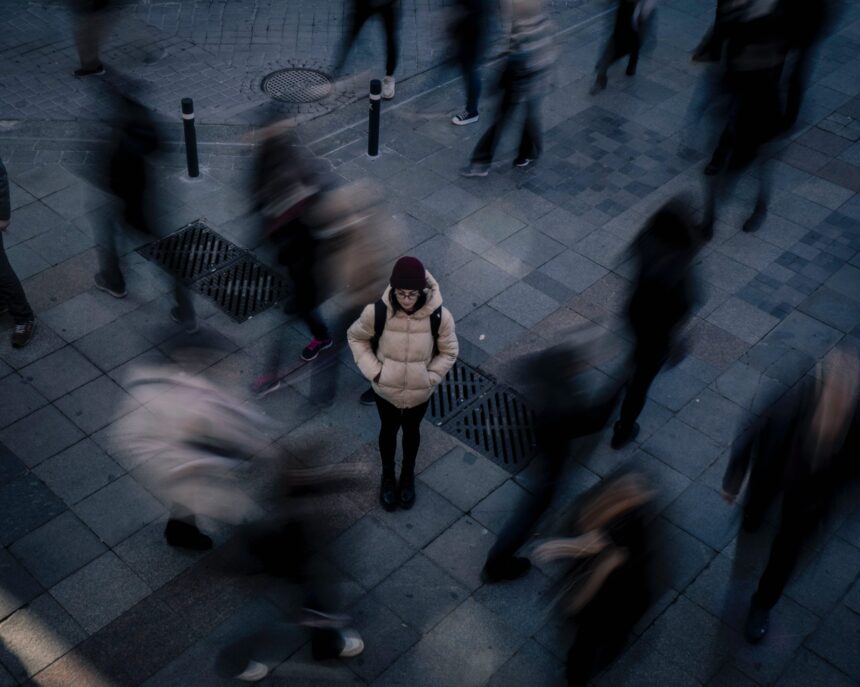
A crowded metro coach at peak hours is usually the most realistic demonstration of today’s urban life. Despite the crowd of people standing side by side, the space remains remarkably quiet. People are focused on the shining screens, tilting their heads occasionally and readjusting their positions, yet the glances are fleeting, and discourses are intentionally avoided. This scenario isn’t unusual, but it is actually quite the routine.
Historically, cities were presented as places in which connection was nurtured by distance, where bustling bazaars, flourishing neighbourhoods, thronged streets and gridlocked roads would keep people together. In modern cities, though, this seems to have proven to be baseless; they have exemplified that the formation of meaningful bonds and emotional belonging is unrelated to proximity.
This urban loneliness paradox suggests that although people coexist, they still suffer from social isolation. Loneliness is caused by the gap between the social encounters we have and the bonds we want, not just solitude. Research increasingly shows that being in crowds may intensify this feeling rather than ease it, subtly hinting that being surrounded by people doesn’t guarantee a sense of belonging. What truly warrants a sense of pure connection is the profound sincerity of interactions and relationships, not their mere quantity.
Loneliness diminishes when one feels truly integrated, valued, and understood in a community; when dialogue becomes inane and shallow, the city’s bustle can often carry a haunting void, and crowds feel like a sea of ghosts, which may be physically available but emotionally absent. The silent epidemic of loneliness in urban cities, in this way, reveals an abstract truth about the nature of human beings, and that is, we don’t just seek inclusion, but what we truly desire is to belong.
Urban cities may offer visibility, but that is without recognition. A person passes by thousands of faces on elevators, buses, and sidewalks and streets each day but hardly has a chance to engage with any of them. The hectic pace of city life often hinders the formation of meaningful relationships, reducing these interactions to fleeting moments. Time is another challenge to connections. Protracted labour, gruelling shifts, and lengthy daily commutes leave no time for social mixing, promoting communal cohesion. Residents prefer efficiency over interaction due to their rigidly defined schedules of moving between home and work. The primary consequence of time constraints is the rapid fragmentation of casual human interactions.
The structure of modern urban life also plays a role in this hushed reclusion. Patterns of housing have varied significantly in recent times. High-rise apartment buildings appear to be concrete silos in which, although thousands reside, their interaction is rare beyond a hurried greeting in the hallways. Consequently, the single-person household seems to be gaining popularity globally. In South Korea, specifically Seoul, 40% of households now have single residents. In Pakistan also, single households seem to be on the rise; at the core of this transformation lie rapid urban expansion, macroeconomic pressures, and shifting matrimonial structures. These transitions reflect a collective trend toward increased urban atomisation.
This emergence of the “solo dweller” culture, contributing to civic disconnection specifically in Pakistan, occasionally appears in severe manifestations. Over 58,000 unclaimed bodies (lawaris) have been buried by the Edhi Foundation in its graveyards located in Karachi, Lahore, and Rawalpindi — the deaths of these individuals are simply ignored. Further reports reveal more cases like these: 20-year-old university student Aman Kumar was found days after he died in a Karachi hostel; 26 unidentified dead bodies in 2024 were discovered across Lahore during the Eid holidays; and the isolated passings of actresses Ayesha Khan and Humaira Ashghar Ali and many others emphasise how quietly and easily life drifts into obscurity and silence. These incidents are reminiscent of an unsettling reality: that even in cities inhabited by millions, isolation can loiter beneath the surface of a crowded city street.
Researchers have regarded loneliness as a public health concern in today’s era. Linkages between chronic social isolation and increased risks of anxiety, depression, cardiovascular diseases, cognitive impairment, and neurodegeneration have been subsequently demonstrated by modern studies. However, the perpetuation of social seclusion still does not mean that the innate human desire for human connection has withered. Belonging is still reflected through the silent rhythms of daily life — neighbours helping each other during difficult times, the brief exchanges between strangers while waiting in line, or a silent nod of recognition from a known peer or colleague. These encounters display that the community has not disappeared; in most instances, only its social venues have been displaced.
Such venues or places have usually been described by sociologists as “third places,” where people get together without any compulsion; these settings are beyond homes and workplaces. Rebuilding cafes, community centres, libraries, and parks that once supported the daily cadence can be integral to restoring connection.
The importance of pedestrian-centric infrastructure, accessible public seating, and green spaces that invite people to engage and connect and not merely pass by has been highlighted by urban planners. Beyond these developments, organic networks like neighbourhoods, volunteer groups, and other small-scale communities of people sharing similar interests will foster a sense of belonging often absent in urban spaces. Lastly, the crowded metro coach shouldn’t necessarily be deemed a monument of silence; in truth, at times, we are only a gesture away from connection.
In conclusion, sometimes the distance between strangers in cities is far narrower than it seems. And this distance is measured not in streets or buildings but in the silent reluctance before a greeting.