





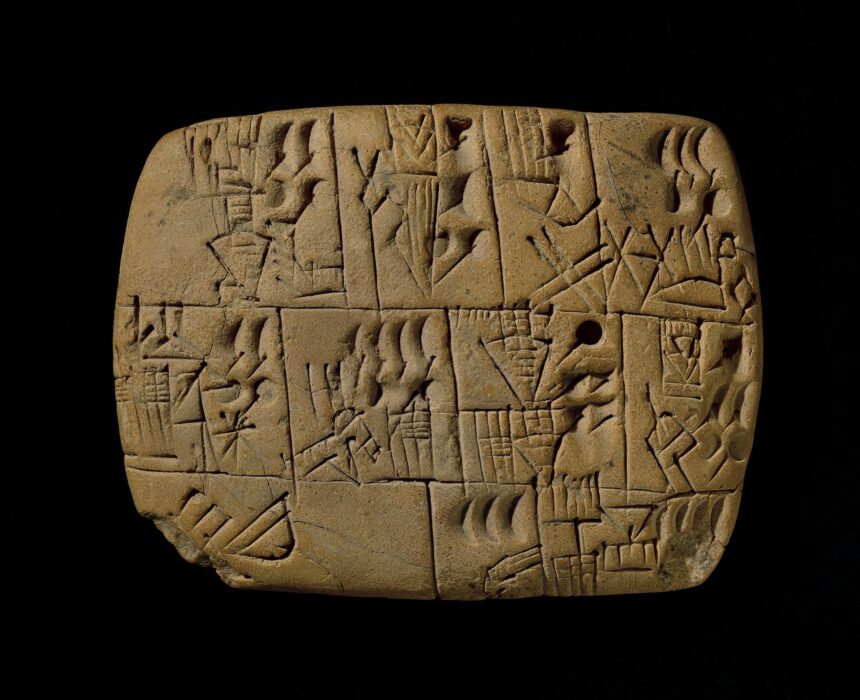
3200 BCE Mesopotamia: trade routes from Uruk mapped out carefully after months of consideration. Mouth to ear, from king to priest to merchant to slave, a game much like Chinese Whispers ensued, and the caravan of wool and pottery meant for Sumer found its way to Babylon. Perhaps… a written command would have been helpful?
After ages of struggle, Mesopotamia grew and flourished, and so did its population, administration and inventory, all of which necessitated records. As Plato observed, “Necessity drives innovation,” and so, the world was introduced to handwriting.
Penmanship, like most things, evolved through the ages, from pictograms to hieroglyphs to later scripts. The mere concept of transmitting news from one location to another through written expression led to the development of innovative communication methods, such as Morse code during wars and telegrams during emergencies.
As time passed, handwriting assumed multiple roles: as expression, as comfort, as news, as order. In battle, it served as solace to the mother who waited for a letter every week. In government, it was employed as a list of accomplishments. In court, it was provided as evidence of innocence.
Furthermore, in school, it was a tool of memorisation for a little girl fearing embarrassment in front of her peers. At home, it was an outlet for a teenager to express his frustrations towards life; it was a string of communication between childhood friends in different cities.
Handwriting is code: a missed letter of a word indicates hurry, while lack of uniformity hints at anxiety, as a tremor in the scribble shows fear. This idea is shared by Herman Zapf through his description of handwriting as “Calligraphy is the most intimate, private, and spontaneous expressive means.” Like a fingerprint or a voice, it is unique to every person.”
Gradually, however, people with a lifetime centred around one purpose discovered multiple suns to orbit, and leisure time faded. Writing, a process demanding quite some time and complete attention, faded with it. The satisfying texture of paper and the anchoring presence of a pen were supplanted by the metal brick we now know as a phone.
Pressed for time, people stopped sitting down to write thoughtfully and began opting for typing hastily on the go. This urgency also warranted quick transmission of information, thus aiding in the shift from paper to phone as the primary mode of communication.
The loss of handwriting was gentle; it came as one soft wave but swept with it various key pillars of interaction. Without handwriting, eloquence altogether took a backseat: the elegance of cursive and the care of addressing an audience, and the adaptation of tone and vocabulary as per status and emotion — all these standards were left behind.
Consequently, without the filter of a pen between thoughts and words, knowing the recipient won’t be able to interpret the standard font and format as any emotion, people began to lose inhibition: the purpose of writing shifted only to getting information across. Hence, we let the rules of grammar slide for the ease of interpretation, and the wonders of the lexicon were reduced to a few customary sentences.
The disappearance of handwriting also acts as a symbol for the substance we’re losing as a society: people wanting to look all the same with similar features, clothes, and makeup; all colours and warmth being muted to beige instead of the vibrant hues of the past; and everyone adopting identical, widely accepted stances in various matters. In essence, we’re disregarding individuality in favour of conformity.
As the article comes to an end, we must keep in mind the importance of handwriting, and no better example comes to mind than the revelation of the Holy Qur’an: had Allah wanted, the Holy Book could have been passed on through verbal tradition, through habits, or through repeated disclosure. However, the method best suited for the preservation of such an esteemed code was chosen to be handwriting.
Taking the aforementioned significance into account, we must do our part in making sure handwriting doesn’t end up a dying practice, not just for better cognitive function, but also as a means of expression, of relaying truths and tales through history.