





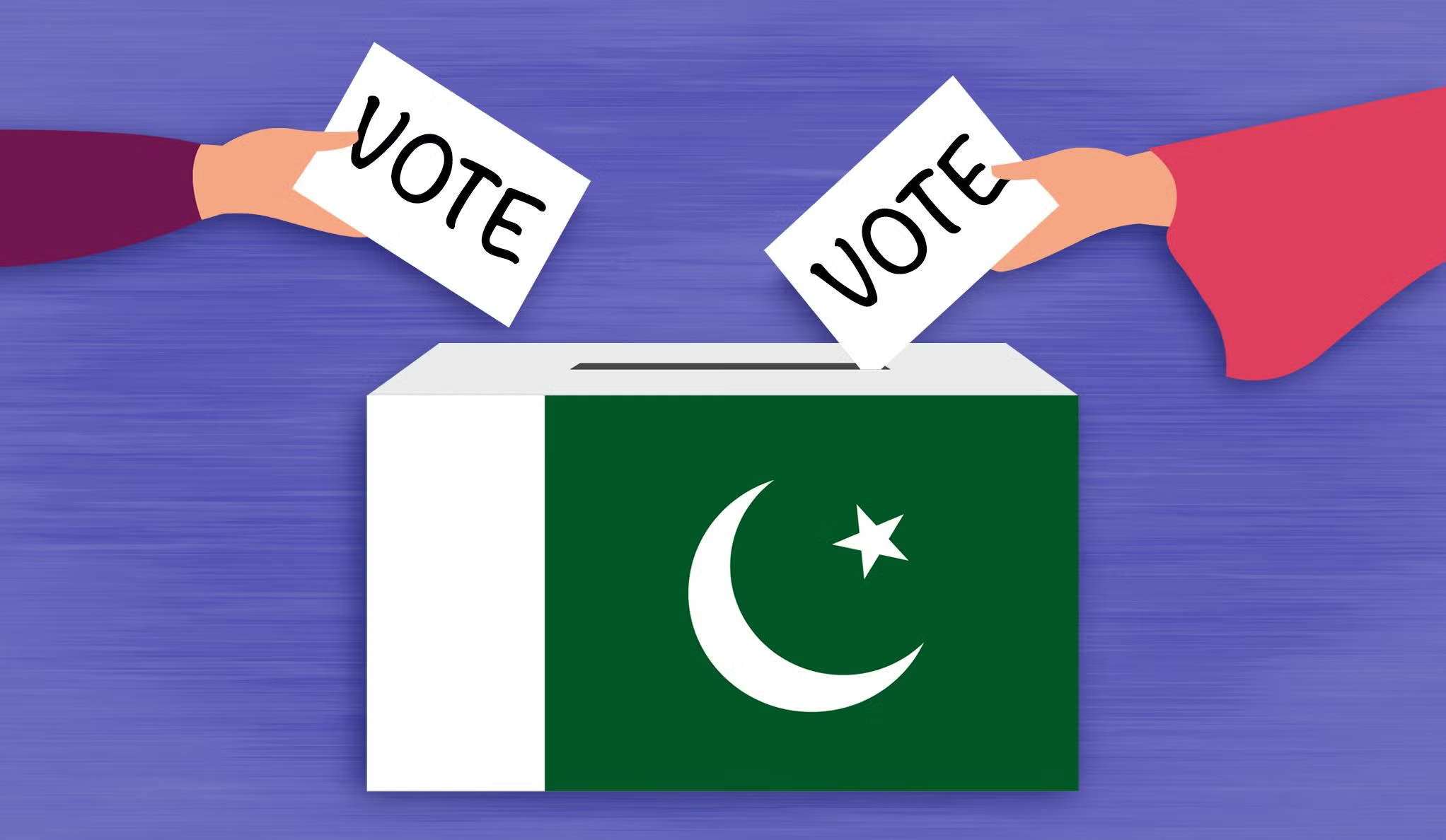
Why do we vote for someone we don’t like? This question disturbs the youth of Pakistan. For decades, political opinions have been influenced by family loyalties instead of independent evaluation. However, the rise of PTI suggests a shift in these traditional patterns, as the youth of today actively take part in political debates, and they have a different perspective on politics than their elders.
Historical Context:
Two major political parties, PMLN and PPP, dominated politics in the 1990s and early 2000s. These parties were empowered alternatively, and their politics were mainly on a provincial basis. PPP had strong roots in Sindh, while PMLN enjoyed full support in Punjab. KPK and Balochistan had their own provincial parties. PPP has been enjoying power in Sindh since 1973, only interrupted by martial laws. PMLN was considered a representative only of Punjabis, and PPP was viewed as a Sindh-based political party. It increases political polarisation, which weakens national identity.
Family Influence:
Families are important agents of political socialisation. ‘Political socialisation’ refers to the development of political opinions. All members of the family naturally share similar political ideas, values, and behaviours due to living in the same environment (Ibid). Many of us grow up hearing praise for a certain political party from our parents. This repeated exposure naturally convinces us to support that party without keeping in view their policies or performance. Our parents sometimes try to convince us simply because they have supported a party for years and feel unable to support a new party. According to a survey by Gallup Pakistan, nearly 2/3 (64%) of Pakistanis report that they support the same political party as the rest of their family members.
Youth Shifts:
In recent years, young voters have started questioning the inherited political hate. They like or dislike someone only on the basis of governance. PTI has somehow built an anti-corruption and youth representative narrative which has attracted a significant number of young voters. The rise of the PTI may also be an indicator that people are against inherited and family politics. Other parties promote family politics, like the PPP, which was founded by Zulfiqar Bhutto, then Benazir took charge, and now Bilawal is the chairman.
The youth think that there is no space for them in such parties. They are frustrated as to why they should support such parties in which positions are given to family members instead of considering merit. PTI has answered this apprehension to some extent and so is now enjoying widespread support.
In this era of social media, everyone can analyse different political narratives and then form their own opinion independently. According to the Gallup Exit Poll 2024, youth voter turnout was 11% higher than in 2018 and 22% higher than in 2013, and PTI was the most popular choice of new voters (age 18-24). It indicates a hope for change. Instead of evaluating parties on a regional basis, young voters want parties that address their issues. They only want the progress of their country. 46% of voters in 2024 advised the new government to provide electricity, roads, education, health facilities and employment to the public compared to 17% in the 2018 elections.
So the youth are breaking away from the traditions that have been functioning for decades. According to a survey by Gallop Pakistan, 64% of voters voted for a candidate not belonging to their Biradari compared to 59% in 2018. The trend is gradually changing, and the core idea is the betterment of Pakistan.
Implications for Democracy
Critical and independent political evaluation strengthens democracy. Voting patterns based on performance create a sense of accountability and transparency as parties and leaders fear public opposition if they don’t work for public welfare. Democracy cannot be built on blind following or blind opposition; it requires meaningful and careful participation.
Conclusion
Political opinions are not like genes. They cannot be inherited, like bodily traits, but rather learned. Democratic states give the right to every individual to vote according to their own understanding. Suppression of free will undermines the very foundations of democracy, ultimately leading to weakened institutions and economy.