




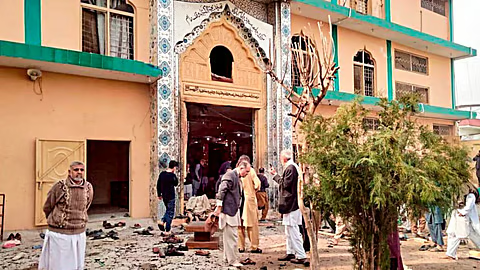
On February 6, 2026, during Friday prayers, when thousands of people gather to worship, a tragic attack and fire incident occurred at Khadijatul Kubra Imambargah in Islamabad, Pakistan. This event shocked the entire state and became one of the deadliest incidents in Islamabad, as religious places are typically considered safe areas. Attacks on these locations target civilians and spread sadness across the country, highlighting how groups continue to assault religious sites and harm civilians. According to news reports, the attack took place at a Shia imambargah, and approximately 600-700 individuals were present at the time. The perpetrator opened fire at the entrance, and then an explosion occurred, resulting in a loud blast and the sounds of gunshots being heard by a worshipper.
Following the event, emergency personnel responded promptly, and the civilians were sent to the hospital in Islamabad, where doctors worked late into the night to save lives, and many casualties were in serious condition. The explosion resulted in numerous casualties, destruction of the area, fear among the populace, and flames inside the Imambargah. The attack was quite serious, as evidenced by the press reports that the number of fatalities was over 36 and about 171 were injured. The fire and attack at the Imambargah were part of a terrorist strike, not an unplanned event. The attacker carried an explosive device on his body and fired upon the security officers who attempted to stop him. In addition to making people afraid, the attack left the structure in ruins, with smoke damage, structural damage, inside damage, and smashed windows, demonstrating its devastation.
The Islamic State Khorasan Province (ISKP) asserted responsibility for carrying out the attack in Islamabad following the incident. ISKP is a branch of ISIS and has carried out attacks in Pakistan and Afghanistan, frequently targeting Shia Muslims and civilians. These attacks demonstrate that sectarian violence is still prevalent in Pakistan and are indicative of sectarian hatred, as evidenced by previous attacks on mosques and religious gatherings. Following the attack, Pakistani officials condemned it and stepped up security, and the police started looking into it. They gathered forensic evidence and CCTV footage to determine the identity of the perpetrator. The public in Pakistan responded to the incident emotionally, expressing sorrow for the victims and spreading fear. Following the attack, other leaders of different religious sects expressed concern and demanded peace.
Pakistan has been fighting terrorism for years, but these assaults demonstrate that the security danger persists. Although terrorism has declined in Pakistan since 2010, these surprise acts disrupt the entire state. It is not just a simple attack that may be forgotten; behind every death, there is a genuine life. It could include a father, a student, a worker, or a worshipper. People with dreams to fulfil, work to complete, and families waiting for their loved ones to arrive. Imagine a kid waiting for his father to arrive, but what happens next? News of a sudden attack? A dead body? A wounded person? On what basis? Only because of sectarian hatred? Is this a justification to justify the attack? Justify the pain of losing a loved one in an attack? Many of the injured may survive, but this attack will have long-term consequences for their lives; they may live in fear and refuse to go anywhere. After such tragedies, we need unity. It is not only an issue of a certain sect that only Shias understand; it is a question of humanity, and everyone should disregard sectarian divisions and step up to speak out against the attack as a united Pakistan. It is time to stand up rather than sit silently due to the sectarian divide. When people come together, the state can develop.