





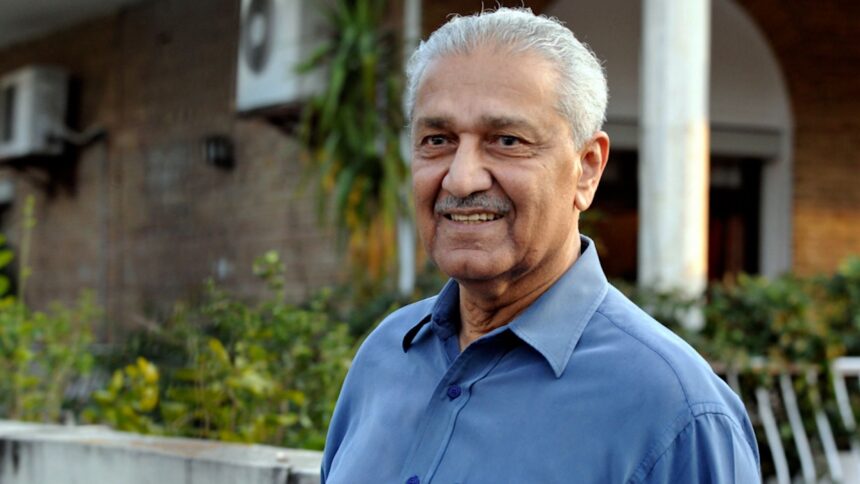
Never forgotten in the hearts of Pakistanis
Born: 1 April 1936
Died: 10 October 2021
Early Life and Education
Dr Qadeer Khan was a Pakistani nuclear physicist and metallurgical engineer. He is widely known as the “father” of Pakistan’s atomic programme. He was born on 1 April 1936 in Bhopal, Madhya Pradesh, India, and received his early education there. After migrating to Pakistan, he graduated and completed postgraduate studies from Karachi, Delft University of Technology, the Catholic
University of Leuven, and the Jinnah Government Sciences College.
He joined important public institutions, including the Pakistan Institute of Nuclear Science and Technology, and became an authority in the eld of research.
Migration and Career Development
At the age of 16, Dr Khan migrated to Pakistan. In 1952 he graduated in metallurgical engineering. He gained expertise in many important elds: uranium metallurgy, design and production of advanced centrifuges, and isotope separation based on gas centrifuge technology. He was a talented and determined person who worked tirelessly for Pakistan, particularly in nuclear technology and metallurgy. He supervised and led many key projects. The focus of his work was the study of the structure and properties of metallic materials, especially steel and uranium, and their behaviour in di erent conditions.
Pakistan’s Nuclear Programme
After learning that India had exploded a nuclear device in 1974, Dr Khan joined Pakistan’s nuclear e orts to develop atomic weapons. He founded the Khan Research Laboratories (KRL) in 1976 and served as its chief scientist and director for many years. At the age of 66, Dr Khan remained actively involved with the laboratories and continued his work on centrifuges. After India’s nuclear test in 1974, he made determined and clandestine e orts to develop atomic weapons when he founded the Khan Research Laboratories in 1976, and was its chief scientist and director for many years.
Proliferation Controversy
In January 2004, Dr Khan was placed under detention by the Musharraf administration after the United States government presented evidence that nuclear proliferation had occurred. He was accused of assisting other countries to acquire nuclear technology. The US administration of President George W. Bush and international agencies claimed that he had sold nuclear secrets and equipment. Under pressure, Dr Khan appeared on national television and read a formal statement in which he accepted full responsibility for the proliferation activities, while the government of Pakistan maintained tight control over him.
In 2004 Dr Khan was accused of selling nuclear secrets illegally, and there was intense international controversy. After several years of restrictions, he approached the Islamabad High Court, which decided that he should be released from strict house arrest. A later order on 6 February 2009 allowed him limited freedom of movement, but he remained under security observation. Many Western leaders and analysts continued to describe him as a serious proliferation risk. Former CIA Director George Tenet once described Dr Khan as “at least as dangerous as Osama bin Laden,” because of the fear that nuclear technology could fall into the hands of terrorists after the September
11 attacks. In USA, former CIA Director George Tenet described Dr Khan as at least as dangerous as Osama bin Laden. He was a controversial gure.
National Hero Status
Despite these accusations, many Pakistanis regarded Dr Khan as a patriot and national hero. They saw him as the person who gave Pakistan a credible nuclear deterrent against external threats. In their view, he had ensured the country’s defence and preserved its independence.
Dr Khan was also considered a highly valuable national asset, admired by scientists and specialists in nuclear proliferation studies. Many countries and terrorist groups reportedly wanted to capture or assassinate him for his sensitive knowledge. Because of this, his security in Pakistan remained very high on red alert, and the government did not allow him to travel. Their story states that scientist is su ering because he was also a valuable asset of Pakistan, who was admired by all people with atomic proliferation knowledge and successful term out, many countries and territories groups were after him, so the government of Pakistan raised his security very high on red alert, their story states that scientist is su ering because he was vulnerable and might be kidnapped because we also could make atomic weapon in pennies because we know he also has enriched
Uranium and can make them lose atom bombs anywhere in Pakistan or outside. If he wanted to lead our border, anybody or country cause if will be consumed. More over he has left a memoir to memorize our national records, we can not enriched uranium to needy countries only at the assurance and guarantees from world that they will not use it militarily, for peaceful use only like making electricity for industries.
He was known as a simple, modest man who was not interested in personal wealth. He was aware that hostile powers might try to take him away or even kill him, so he accepted many limitations for the sake of Pakistan’s safety. You have seen that many countries build around them wall like China, or case themselves with trusted wires, or barbs dynamite to make their borders absolutely safe but my hero Dr Khan, has atomized our border, any body or country cause it will be consumed. More over he has left a memoir to memorize our national records, we can pass only at the assurance and guarantees.
Death and Legacy
After his death on 10 October 2021, Dr Khan was buried with state honours in the H‑8 graveyard in Islamabad. A large number of people and many o cials attended his funeral prayer at Faisal Mosque, where tributes were paid to his lifelong services to Pakistan before being buried at the H-8 graveyard in Islamabad.
Dr Abdul Qadeer Khan raised Pakistan’s status in the world. Many nations today respect and fear Pakistan because of its nuclear capability, which he helped to build. He often warned that if Pakistan were ever attacked, it could respond with enriched uranium bombs and other nuclear weapons. He also argued that, with full international guarantees, nuclear technology could be used for peaceful purposes, such as producing electricity and supporting industry.
We can remember him without any hesitation: “Father of Defence.”