





Lights, Camera, Action!
But wait, are we not talking about an era where radio was flamboyant, unravelling the tales of legends and shaping political discourse, which we of course now call history?
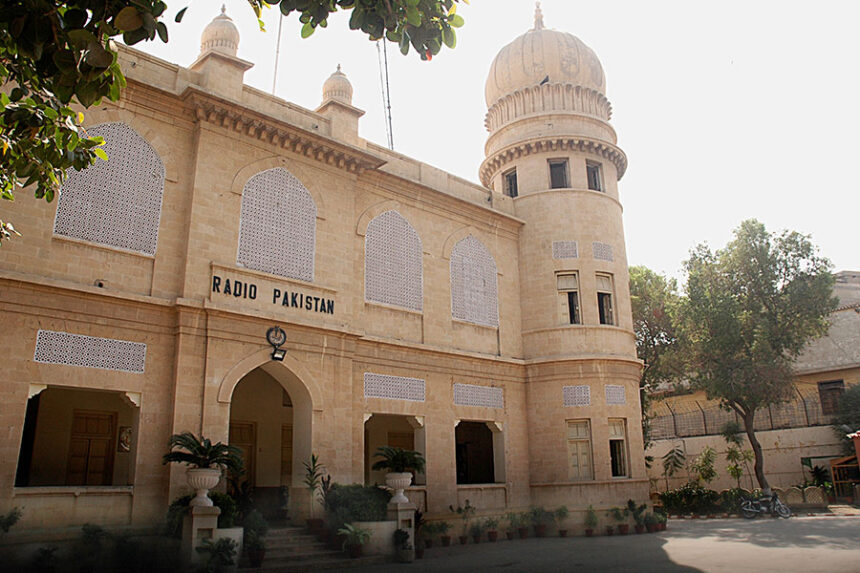
Post-partition, the Pakistan Radio Station emerged as a haven for entertainers eager to showcase their diverse talents, providing a much-needed respite for the nation, which had been deeply affected by the loss and grief caused by the partition. Manto has highlighted the psychological trauma of an ordinary man through his short stories like ‘Toba Tek Singh.‘
Therefore, Radio Pakistan, infused with patriotism, was represented by the enigmatic voice of Mustafa Ali Hamdani. The radio station gradually started to heal the wounds of people via voices, dramas, and broadcasts. Mustafa Hamdani’s voice dominated the streets of Lahore. On the other hand, Abdullah Jan Maghmoom inspired liberation and joy for the people of Peshawar. Who would’ve thought one announcement from a radio station could turn a long-lived dream into a reality?
Pakistan Radio Station can be viewed as the amalgamation of three radio stations present in the cities of Peshawar, Lahore, and Dhaka. Once a part of the All India Radio Station, these radio stations ushered in a new era of eminent broadcasters, drama actors, and singers alike.
Pioneers of the All India Radio Station, such as Patras Bokhari, who served as Director General, inducted a plethora of artisans, nurturing talents like Mohini Hameed and Satnam Mehmood. We cannot shy away from the contributions of endearing and resilient women who not only created new opportunities for women to enter the workforce, but through commitment to their craft, they showed women how to hold their ground unapologetically. After independence, Mohini Hameed became the country’s first female broadcaster; her clear enunciation of the Urdu language set her apart from the crowd, and soon her voice was heard on every prominent radio drama and in all the important announcements.
Inspired by Mohini Hameed, Satnam Mehmood followed in her steps. However, her area of interest was Punjabi, and so she became the first Punjabi broadcaster. In contrast to Mohini Hameed’s soft approach, Satnam Mehmood set a powerful precedent for fighting for causes she dearly believed in, such as women’s rights, while weaving garlands of roses. Her work in radio plays earned her recognition from Faiz Ahmed Faiz and Patras Bokhari alike.
Everyone has quite an admiration for Patras Bokhari for his numerous contributions and chaste Urdu. Similarly, his brother Z.A. Bukhari, also known as Zulfiqar Ali Bukhari, was a little bit more devoted to radio than his brother. Some sources claim that Z.A. Bukhari possessed such skill that he could even identify a tiny flaw in the equipment. Moreover, he voiced several radio dramas and was fluent in the art of reciting ghazals.
His alluring voice earned him the title of ‘king of voices’, serving in the top position at the radio station. Interestingly, Z.A. Bukhari’s career trajectory illustrates the political stance at the time and their shifting priorities. Known for his innovative and persuasive storytelling, Bokhari believed art forms shouldn’t be constrained. However, these sentiments were not shared by the authoritarian government at the time. Hence, he was removed from his position as the director general of radio by General Ayub Khan.
The constraint king of voices heralds the way for the ‘Queen of Melodies,’ widely known as Noor Jehan. Her strong vocals played a quintessential role in raising the morale of soldiers and of the people across the nation during the 1965 war. It is quite ironic to note how creativity and imagination can be shackled if deemed risky for the cultural fabric. On the other hand, the same creativity feels free and liberating to fan intimate emotions of patriotism onto the surface for the benefit of all.
Radio was not only a medium of information to get the gist of the current domestic politics and geopolitics, but also programmes aired on Radio Pakistan were literary and diverse in terms of content. Some programmes focused exclusively on certain themes of nation-building, accompanied by history, culture, and social issues. Along with poetic recitations and dissemination of folklore of almost all cultures from Gilgit-Baltistan to Sindh, on top of its recitation of religious books such as the Bible, the Geeta, and the Tipitaka, it was quite normal and was not considered an attack on certain religious factions.
The glory of Radio Pakistan lies in the fact that it has survived political strangulation. Radio Pakistan became an institution tasked with knitting a new cultural fabric for a fragile country. It shaped the country’s national identity through collective imagination and shared love of arts and literature. Even though Urdu united all factions’ local languages, such as Punjabi, Pashto, Hindko, Siraiki, Shina, and Brushuski, it added to the allure of radio, which inevitably strengthened social cohesion among the various cultures present within the country.
The era of radio has long been gone, and with it, sentiments of collective unity have been eroded as well. Radio Pakistan had a charm of inviting people of all backgrounds and, in its dramatic, cinematic way, made an ordinary person feel seen and heard without foreshadowing any culture. It felt as if all traditions had a voice at the table. Now with AI and social media, our attention span has thinned just like our patience.
All these platforms hail the slogans of inclusivity, rights, and freedom. However, more voices get censored every day. A throng of videos of various cultures can be found today with better aesthetics and sound, but why is the space for dialogue constricted? Why have we divided ourselves into close circles, creating borders within borders?
Radio Pakistan united a newly formed country with a low literacy rate and fractured geography, forming a collective imagination and a cause to unite despite the political upheaval. Now the fleeting trends have scattered that unity. We voice our opinions fervently, but we have forgotten the impact our voices can have reverberating through the socio-cultural and political fabric of the country.