





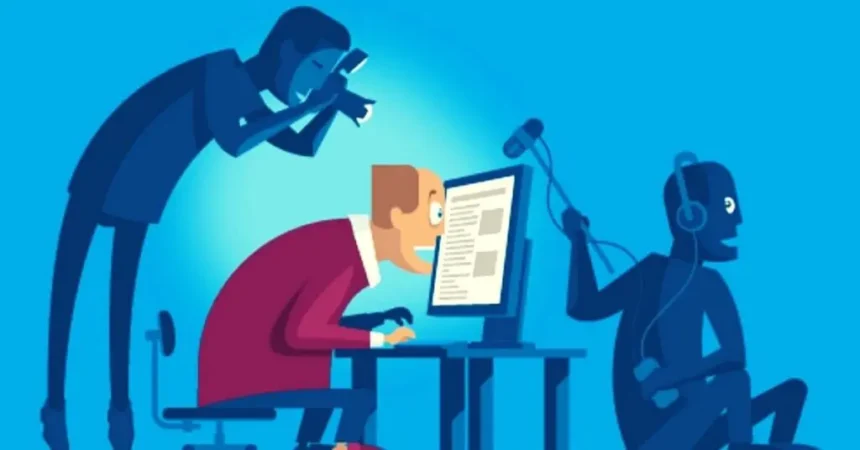
“Arguing that you don’t care about privacy because you have nothing to hide is like saying you don’t care about free speech because you have nothing to say.”
These words by Edward Snowden underscore a misguided concept of the modern digital age. Privacy is often dismissed as a concern only for those with secrets. However, in reality, it is a fundamental moral right that safeguards human dignity, freedom, and autonomy.
Today’s world is increasingly shaped by surveillance technologies and data collection. Hence, the protection of privacy is no longer a luxury but a necessity for preserving individual liberty.
Privacy allows individuals to exercise control over their personal lives, from thoughts and communications to data generated online. According to Alan Westin, privacy is the ability of individuals to determine when, how, and to what extent information about them is communicated to others. Without this control, autonomy is subtly eroded. People begin to self-censor, alter behaviours, and avoid expressing themselves freely, not because they are coerced, but because they feel watched. The philosopher Michel Foucault described this as the “Panopticon effect”, where constant observation makes control internalised, even when no one is actively policing.
In 2013, thousands of protesters gathered in Washington DC, demanding limits on government surveillance and stronger privacy protections. Their famous slogan was “Stop Watching Us Rally”.
The Clearview AI scandal, which involved harvesting billions of social-media images for facial-recognition systems used by law enforcement in the US and Israel. This starkly illustrates how emerging AI technologies can threaten personal privacy on a massive scale. The use of artificial-intelligence-driven facial recognition systems by Israel. Its purpose was to monitor Palestinians, which has intensified debates about how emerging technologies can enable mass surveillance and threaten individual privacy.
The mass surveillance through technology has put individuals and their mental health at risk, causing disruptions to daily life. In one documented case, a US teenager faced severe harassment after her personal data and photos were exposed online. It demonstrates how breaches of privacy can directly threaten the safety, freedom, and wellbeing of young people.
Many people fail to notice the leakage of their information across various platforms, which is alarming. Several websites obtain pictures of numerous individuals through their age verification feature for various purposes.
In Middle Eastern and South Asian countries, people don’t pay attention to the restriction of their privacy because they had no privacy growing up. Traditional societies often relied more on communal rather than individual privacy. Without a cultural norm of personal data being protected, people grow up with a sense that exposure is just part of life. As these regions rapidly digitalised, they didn’t see the harm in sharing personal details because, for them, privacy wasn’t a deeply ingrained concept.
Furthermore, lack of awareness about digital rights exacerbates the problem. Educational systems in many regions rarely teach students how their data can be exploited or the importance of strong privacy practices. As a result, even tech-savvy youths may inadvertently share sensitive information, thinking it harmless.
Along with that, when such a case of exploitation of privacy is presented, people shrug it off because it seems like a minor action – majorly because it didn’t involve them. This attitude boosts its rapid spread, acting as a supporting factor for authoritative companies to leak individuals’ privacy, as the companies wouldn’t be facing any sort of harm.
This must be noted: we must not rely on the government or NGOs for the preservation of our privacy. Efforts must be made on individual levels to spread awareness among the youth, as well as among the elderly, regarding surveillance of masses and the issues accompanied with it. Moreover, people should participate in privacy-related protests, making it clear to authoritative personnel that they have no tolerance towards invasion of privacy.