





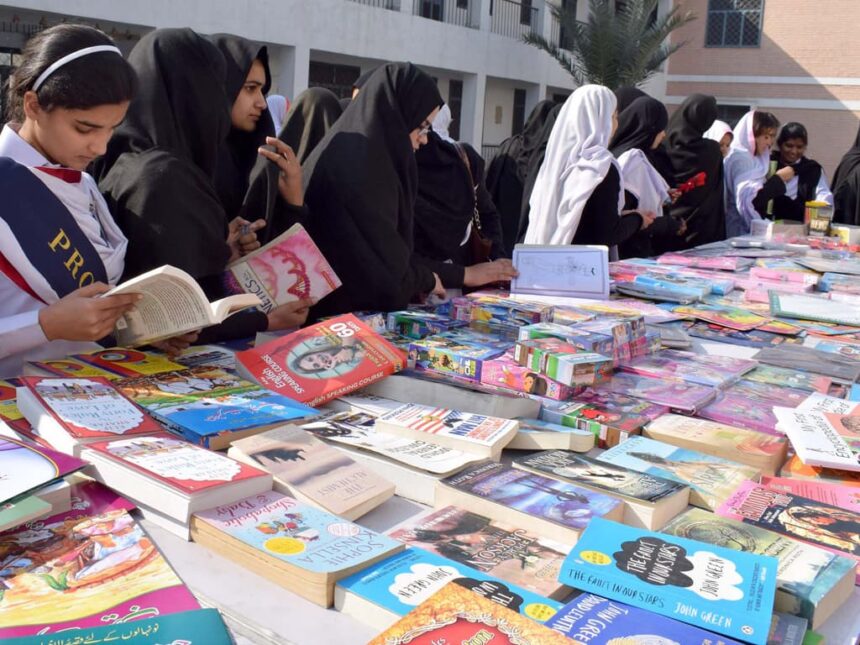
Pakistan’s literary festivals promise celebration, but too often, they end up reinforcing elitism. Who gets to speak, and who gets left out? While these heavily curated events offer an incredible line-up of guest speakers and seminars on literary themes. There needs to be a line of inquiry into the fundamental nature of these festivals and who exactly is allowed to partake in this intellectual sphere. As the name suggests, a literary ‘festival’ implies the inclusion of a diverse populace. It is meant to be a celebration of books, readers and a shared love of learning. However, these ideals quickly fall apart if the very nature of a literary festival turns into an exclusionary affair. This situation occurs when the speakers are detached from the context of the space they occupy. And those in attendance are either removed from the conferences droning on in the background. Or they simply wish to have their intellectual egos stroked.
William Dalrymple
In 2020, William Dalrymple was invited to commence the 11th Karachi Literary Festival. While quite a notable speaker for the event, William Dalrymple’s work is far removed from the Pakistani imagination. His work on the Mughal Empire and the history of British imperialism in South Asia is fascinating but ultimately inaccessible to most people in Pakistan. And the root of this issue lies in the glorification of “foreign” voices in such literary festivals. International authors and speakers are given precedence over the lived experience of the average Pakistani citizen. Where are the marginalised representatives? Where is the social and economic diversity in the panels? Those who attend these lectures and grand commencement events are privileged enough to not only understand the primarily English-speaking guests. But they also fit the perfect mould of the type of rich, distant and exclusive “intellectuals” that are welcomed at Pakistan’s largest literary festivals.
Pakistan’s Literary Festivals
Similarly, you cannot hold a conversation about climate education without addressing the plight of those directly suffering from the climate crisis in Pakistan. You cannot hold a seminar on Pakistan-Bangladesh relations without including the voices of the countless Bengali living in Pakistan who are refused the right to have their own identity card and are left to live in a state of constant statelessness. These are just some of the glaring issues that become evident once the effects of the “intellectual high” start to dissipate. You find yourself in the midst of an event where words are spoken but they fail to land anywhere concrete.
Despite being a free event, the atmosphere reeks of a peculiar sense of elitism. This elitism unconsciously creates a divide between the “intellectuals” and the rest of the population. The conversations around media, climate change and human rights are all rendered meaningless when the target audience of the literaray festival itself has to seldom grapple with these issues in any meaningful capacity. Sitting in a curated space and discussing issues as if they are distant ideas on an alien planet is easy. However, we cannot tackle these topics in a vacuum, given the political and socio-economic structure of Pakistan.
In a country like Pakistan, one rife with poverty, disenfranchisement and constant violations of several human rights, a literary festival is more than just an exclusive space. It serves as a medium for fostering dialogue and amplifying voices. However, over the years, the so-called monolith of the literary festival has failed to include anyone who can provide an authentic voice. What we witness now is a grand gathering of glittering stars, jaded news anchors and international personalities. The entire event is sensationalised, a mass-produced media coverage which looks good in the lifestyle section of a magazine. Such an affair is not the main purpose of a literature festival and it points towards a stark failure at the very root of the intellectual society in Pakistan.
This is not to say that literary festivals should be entirely removed from Pakistan. These gatherings still bring a shared love of the literary world and what it has to offer. The festival has also celebrated countless Pakistani writers and their mesmerising work. As a nation, we require a space where individuals can unite and celebrate the contributions of Pakistan’s literary scene. From poetry to essays and even films, these works form the bulk of Pakistan’s literary voices and through the literature festival, they are given an important platform. With that being said, a lot more can be done to ensure that these beloved literary festivals do not devolve into preformative centres.
Instead of betokening the working class and marginalised, their voices should be kept at the heart of the festival. We should not approach topics such as climate change, journalism, and feminism from the perspective of intellectualism and academia. These topics should further include the context of these issues and uphold them against the larger backdrop of Pakistan’s collapsing structure. Panels should be reserved for grassroots activists, publications made available in Urdu alongside English, and spaces extended in smaller towns instead of just Karachi/Lahore. After all, complex jargon, fluent English, and vibrant festival pictures cannot disguise the subtle yet persistent line of discrimination found at such gatherings. Only by addressing this disparity can future literary festivals hope to be truly more inclusive and holistic.