





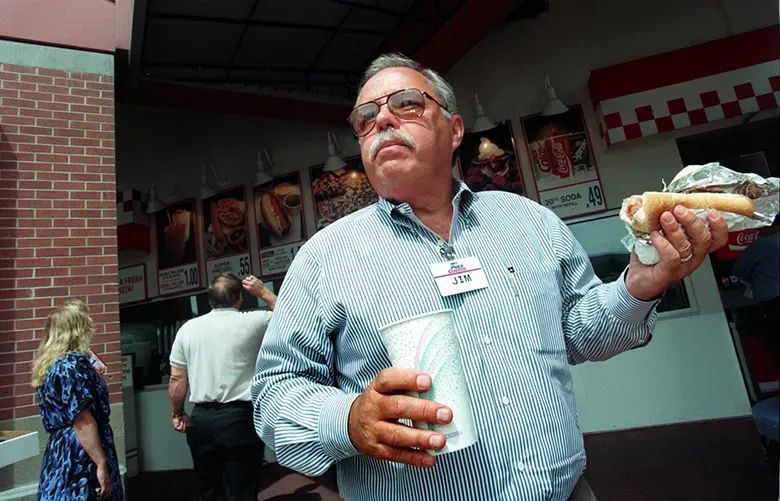
Walmart told him selling bulk toilet paper out of a warehouse would never work. He kept a hot dog at $1.50 for 41 years just to prove a point. His company now does over $250 billion a year.
A former bag boy at FedMart built the third-largest retailer on Earth by breaking every rule in the industry.
Jim Sinegal was 47 years old.
Seattle, Washington. 1983. He and his partner Jeffrey Brotman were standing inside a converted warehouse on a Tuesday morning. Concrete floors. Steel shelving. Pallets stacked floor to ceiling. No decorations. No music. No signage telling customers where anything was.
It looked like a distribution center, not a store.
And they were about to ask people to pay an annual fee just to walk inside.
The entire retail industry thought they were insane.
But Sinegal had spent 30 years studying this model. He’d started as a bag boy at FedMart in 1954, working for Sol Price. The man who invented the warehouse club concept. Sinegal rose from bagger to executive vice president. Learned every principle. Watched Price build Price Club from scratch.
And now he was going to take everything he’d learned and build something bigger.
The first Costco opened in September 1983.
Immediately, the criticism started.
“You’re charging customers for the privilege of buying from you?”
“You’re not going to advertise? At all?”
“You carry 4,000 products. Walmart carries 120,000. How is that a business?”
“Selling 48-packs of toilet paper in a warehouse isn’t retail. It’s storage.”
He didn’t listen.
Here’s what Jim Sinegal knew that everyone else missed: customers don’t want more options. They want fewer options, better prices, and zero manipulation.
Every major retailer in America was doing the same thing. More products. More promotions. More coupons. More loyalty programs. More ways to squeeze an extra dollar from every shopper.
Sinegal did the opposite.
He capped markups at 14% on national brands and 15% on private label. Not targets. Hard caps. Nobody at Costco was allowed to exceed them. Ever.
When a buyer brought him a deal on Calvin Klein jeans that would let Costco mark them up 40%, Sinegal said no. Sold them at the standard 14% margin.
“Do you know how tempting it is to make another $7 on a pair?” he said. “But once you do it, it’s like taking heroin. You do a little and you want a little bit more.”
While Walmart was optimizing for every last cent of margin, Sinegal was leaving money on the table on purpose.
Because the money wasn’t the product. Trust was the product.
The membership fee was the business model. Everything else existed to justify the fee.
And here’s where it gets brilliant.
In 1985, Costco introduced a hot dog and soda combo at its food court. Price: $1.50.
That was 1985.
In 2026, the price is still $1.50.
41 years. Multiple recessions. The Great Financial Crisis. The pandemic. Inflation hitting 9%. Supply chain chaos.
The hot dog stayed at $1.50.
Not because Costco could easily afford it. Because Sinegal demanded it.
The story became retail legend.
Craig Jelinek, who would succeed Sinegal as CEO, went to him in 2008. The cost of Hebrew National hot dogs was killing them.
“Jim, we can’t sell this hot dog for a buck fifty. We are losing our rear ends.”
Sinegal looked at him.
“If you raise the effing hot dog, I will kill you. Figure it out.”
So Jelinek figured it out.
He fired Hebrew National as the supplier. Built two Costco-owned meat processing plants. One outside Los Angeles. One in the Chicago area. Started producing Kirkland Signature hot dogs in-house.
When Coca-Cola’s contract came up for renewal and the price didn’t work, he switched the entire food court to Pepsi products. When San Francisco passed a tax on sugary drinks, he replaced the sodas with diet options and unsweetened tea.
He rebuilt the entire supply chain. Twice. Rather than raise the price 25 cents.
Because it was never about the hot dog.
In 2009, the Seattle Times asked Sinegal what it would mean if the hot dog price ever went up.
“That I’m dead,” he said.
In 2025, Costco sold 245 million hot dog combos. More than every Major League Baseball stadium combined. Up 23% from the year before.
The $1.50 hot dog became the most recognizable price point in retail history. People buy T-shirts with the food court sign on them. It has its own Wikipedia page.
But the hot dog was just the symbol. The real weapon was Kirkland Signature.
In 1995, Sinegal consolidated over 30 scattered private labels into one brand. Names like “Simply Soda” and “Clout” and “Ballantrae” all became Kirkland.
The idea was simple. One brand. Trusted quality. Lower price than national competitors.
Kirkland Signature vodka is made in the same distillery region as Grey Goose. Kirkland batteries test comparably to Duracell. Kirkland olive oil wins blind taste tests against brands costing three times as much.
Today, Kirkland Signature generates roughly $90 billion in annual sales. From a single private label brand.
If Kirkland Signature were its own company, it would be one of the largest consumer goods companies in the world.
But Sinegal still wasn’t done.
While other retailers were signing leases and renting space, Costco was buying. Land. Buildings. Warehouses.
Today, Costco owns the vast majority of its 914 warehouses worldwide. A real estate portfolio valued at $31.9 billion.
They spend zero dollars on advertising. Zero. While Walmart spends billions annually on marketing, Costco lets the membership model do the work.
The results speak for themselves.
914 warehouses globally. Nearly 137 million cardholders. A membership renewal rate above 90%. Annual net sales surpassing $250 billion. Membership fees alone account for roughly 65% of Costco’s operating income.
Let that sink in. A company doing over $250 billion in revenue makes most of its actual profit from the membership card in your wallet. Not from the products on the shelves.
The pallets of toilet paper, the rotisserie chickens, the Kirkland olive oil, the $1.50 hot dog. All of it exists to make you feel like your $65 annual membership is the greatest deal on Earth.
Because it is.
Sam’s Club, owned by Walmart, tried to compete. In 2022, they dropped their hot dog combo to $1.38. Twelve cents cheaper than Costco.
Nobody cared.
Because Sam’s Club was competing on price. Costco was competing on trust.
All because a 47-year-old former bag boy who opened a warehouse store in Seattle refused to believe that more options, more advertising, and higher margins were the path to winning.
He turned a warehouse with concrete floors into the third-largest retailer on Earth.
He turned a $1.50 hot dog into the most powerful trust symbol in business.
He proved that the company willing to make less money on every transaction can make more money than everyone else combined.
What are YOU overcomplicating right now?
What margins are you chasing that are slowly destroying the trust your customers have in you?
What’s the hot dog in your business? The one thing you should never, ever change?
Sinegal started as a bag boy. He opened a warehouse with no advertising, no decorations, and 4,000 products. He refused to raise the price of a hot dog for four decades. He fired his suppliers and built his own factories rather than break a promise.
Because he understood something most businesses don’t.
Your brand isn’t your logo. It’s the promises you keep when it costs you money to keep them.
Every business says they put customers first. Sinegal actually did. Every day. For 41 years. One hot dog at a time.
Stop optimizing for this quarter’s margins. Start building the kind of trust that makes nearly 137 million people pay you just to walk through the door.
And never let anyone tell you that keeping a promise is bad business.
Don’t quit.