





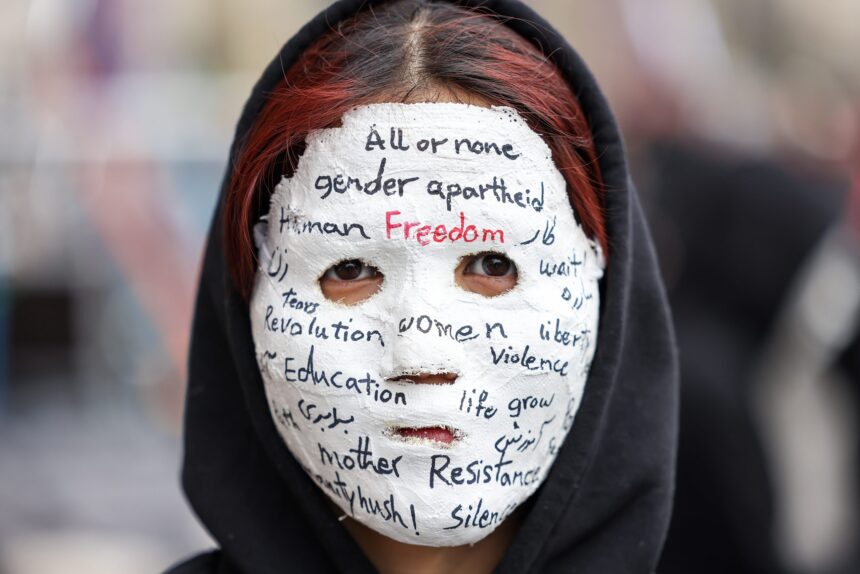
Gender inequality is not a new phenomenon in the world. However, the rule created by the misogynistic authorities and the legalisation of marital abuse towards women is heart-wrenchingly new. The prolonged abuse confined women to the cage of fear. Around us, we witness examples that resemble a human zoo, where the Afghan authorities give men the right to violence towards their spouses, and they are exercising it through whatever abuse they desire. Afghanistan has been engaged in efforts to eliminate gender bias. However, it is alarming how an extremist mindset can wipe out the hard-fought progress of 20 years. Afghanistan is not regarded as a country defined by terror and gender-based violence. Looking back, women were effectively contributing in the workplace and significantly contributed to the overall GDP. Later, due to the Taliban’s control, women’s rights deteriorated drastically.
The 1964 constitution of Afghanistan is widely regarded as one of the most progressive documents in the history of Afghanistan, where gender equality was not merely a Western ideology but had domestic constitutional roots. In the early years, 1919-1929, King Amanullah Khan and Queen Soraya promoted women’s inclusivity; they built the first girls’ school. The 1950s and 1970s marked a progression towards women’s rights, legislating an 18 to 21 age limit for girls’ marriage. However, in the Soviet era, which resurfaces, the Soviet-Afghan war went to such an extent that it caused instability, causing women to flee abroad.
The first Taliban regime (1996-2001) banned women’s education, curtailing women’s social involvement without a chaperone (mahram). In 2001, NATO intervened, disregarding the Taliban; the intervention enshrined equal rights and freedom. Yet this progress was ephemeral; in 2021, the Taliban returned to power and imposed “gender apartheid,” resulting in severe restrictions for women; they claimed that it reflected the influence of Islamic teachings.
To justify their policies, in order to align their constitution with the teachings of Islam, they invoke Quranic verses. It is essential to highlight that human rights were embodied in the Quran nearly fourteen hundred years ago, long before the enactment of Magna Carta and UN instruments. Numerous Quranic ayat emphasise equality between men and women and categorically prohibit oppression against the weak. Therefore, any statute that marginalises women and legitimises injustice is against the teachings of Islam.
Surah An-Nisa (4:75)
“And what is [the matter] with you that you do not fight in the cause of Allah and for the oppressed among men, women, and children who say, ‘Our Lord, take us out of this city of oppressive people…’”
The Taliban made promises to prioritise women’s rights within the framework of Sharia law. However, the reality is completely opposite. They have denied women their basic rights and coerced them into forced marriages and sexual violence.
“For now, I wish for the women of my land to be empowered, patient, and not disappointed, and I want them not to lose their spirit of struggle and righteousness. A little patience; dawn is near!” – Former employee of an Afghan partner organisation of Medica Mondiale
Recently, the Taliban released a 90-page decree profoundly irrelevant and in violation of human rights, a decree ranging from dress codes to limits on domestic violence. This decree is also in violation of their prior constitution, Article 22 of freedom of movement. In areas where women cannot leave their houses without a mahram, they should be properly covered with a veil; otherwise, their male companion will be subject to imprisonment. Safe houses have been forcibly closed down, leaving women without any safe haven. Since 2009, around 22 maltreatment cases against women have been registered under the Law on the Elimination of Violence against Women (EVAW Law). As the Ministry of Affairs has been abolished, which results in the acquittal of gender-based offenders, the efforts to hold them accountable become null.
A female reporter, shot by the Taliban, as she was involved in peace negotiations, describes the utterly disheartening situation of Afghanistan: “Women are coercively forced to marry Taliban fighters. In Herat, multiple female parliament leaders’ cars have been taken forcefully to stop their participation, and they are being murdered en masse without any accountability. They displaced pregnant women, providing less medical assistance.” She also highlighted that these extremists are not scared of superpowers or B52 or B56 American bombers, but they fear women.
Subsequently, due to the deteriorating conditions of the country, many women faced constant hardships. Soraya Sobhrang, an Afghan women’s rights activist, stated, “Even before the Taliban regained possession in 2021, families wed off their young daughters for the sake of dowry. Many young girls are at risk of forced marriage as the famine raging in Afghanistan drives people to desperation; they sell their daughters in the hope of at least saving the rest of the family from starvation.” Nevertheless, although the latest decree formally prohibits forced marriage, this claim, like other assurances, lacks genuine enforcement.
This latest decree was issued by de facto authorities (DFA) and was signed by the supreme leader Hibatullah Akhundzada, which diminishes the rights of women completely. According to Decree No. 12, the husband holds the position of authority, thereby removing the equality between husband and wife. The decree permits husbands to inflict domestic violence; it is requisite not to break any bones or inflict a beating after an unhealed wound. Sexual violence, marital rape, is not a crime. In case of broken bones, the man will be imprisoned for 15 days if the wife can prove the case in front of a male judge. Moreover, the women will face imprisonment if they often go to their relatives’ houses without their husbands’ permission. Acts deemed immoral or corrupt by Afghan authorities will face the highest penalties. Thus, this decree dictates how a woman can survive without punishment, rather than live freely without intimidation.
U.N. Women Special Representative in Afghanistan Susan Ferguson:
“It places husbands in a position of authority over their wives and limits women’s ability to seek protection or justice.”
Meanwhile, the U.N. High Commissioner for Human Rights, Volker Turk, said, in conversation with the Human Rights Council in Geneva. Urging Afghan authorities to rescind the decree.
“The punishment for an animal abuser is 12 months, more than for a woman abuser. The cockfight is a traditional pastime in Afghanistan, but it was banned after the Taliban seized power in 2021.”
However, when we delve deep into this decree, it’s not the discrimination against gender alone but also against social status. For instance, the punishments vary from class to class. Scholars and “high-ranking people” will receive a warning. Businessmen and tribal leaders will receive a warning along with a court summons. Average citizens will face imprisonment, and the lower classes are subject to physical beatings (39 lashes).
Furthermore, the sect-based violence perpetrated against the minorities is eradicating the Hazara community, which many describe as a ‘silent genocide’. UNAMA informed that “50 Ismaili men had been taken out from their houses at night in Badakhshan and compelled to convert to Sunni Islam,” creating endless disorder in society and disrupting peace.
Despite substantial empirical evidence, the Taliban have denied the discrimination allegations. On March 8th, “International Women’s Day,” the Taliban’s spokesperson, named Zabihullah Mujahid, stated, “Ensuring the dignity, honour, and Sharia-based entitlements of women remains a paramount priority for the Islamic Emirate.”
Under the fear of repression, approximately 85 per cent of journalists stopped reporting. In the prior judiciary, women held the position of 265 female judges out of 1951; today, not a single woman judge remains in office.
What type of paramount priority is this for women if girls are banned from taking secondary and higher education? Even those who are learning online are prohibited from sitting in the examination. As Afghan human rights lawyer Hamaira Rasuli asserted, “All girls should be allowed to go to schools and universities. All women should be allowed to return to their work without any delays or preconditions.” These implementations will never align with the Sharia laws. However, the situation in Afghanistan contradicts this claim.
According to reports by the United Nations, Afghanistan has one of the highest maternal mortality rates in the world, exacerbated by early pregnancies, malnutrition, inadequate medical care, and restrictions on contraceptives, measures that have had devastating consequences for women.
The Taliban have established a new and unprecedented form of oppression in history. Considering women as an outlet to overcome their frustration will not be justified. They have fused a misogynistic worldview with oppressive practices to construct a society of absolute control. They claim to be the protectors of Islam while oppressing the vulnerable, referring to themselves as men of the house (Mizaji Khuda), completely disregarding both moral and societal norms. Their claim of governing an Islamic country is completely baseless. Islam does not promote inequality, discrimination, or oppression; it does not endanger women’s health, and it has historically condemned sect-based violence, offering lessons in prosperity and social harmony instead. With this systemic oppression, Afghanistan cannot hope for progress, as waves of injustice erode both hope and the possibility of a sustainable livelihood.
There is support for gender equality in the 1964 Afghan constitution, for which Article 26 provides that “the people of Afghanistan, without any discrimination or preference, have equal rights and obligations before the law.”