





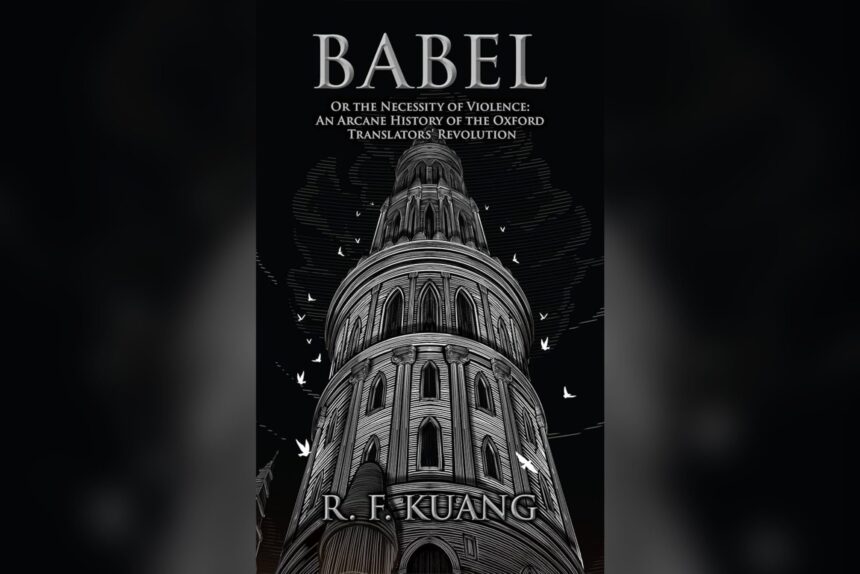
Set in 1836, Babel, the Royal Institute of Translation, is the hub of civilisation, knowledge and power in the British Empire. Professor Richard Lovell brings Robin Swift, a young Chinese boy from the Canton slums, to study at the institute. At its tip, the institution, through its 8 departments, translates most of the world’s text into English and minor content vice versa. The book depicts a fictional approach to the lines of colonialism; the act of translation is directly linked to silver working, which apparently runs the empire from its trivial to consequential matters. The arch begins when Robin starts to understand how Babel actually works. Like any other instrument of imperialism, Babel is based on exploitation, economic gain, the consolidation of authority, and resources plucked from the colonies. Robin finds himself on the verge of agitating ideologies when, through means, he learns that the British Empire is planning to attack his homeland, China. Thus, Robin finds himself in a precarious position at the intersection of conflict between the empire and China.
The theme of the novel revolves around language, how it acts as a tool for the imperial system, and its majestic powers. Kuang weaves this through the persistent dialogue between her characters, where Robin and his cohort, except for Letitia Price, have their lives substantiated in a colonial residence, interwoven with the persistent debate of identity. Babel offers them privilege and education, but also demands that they participate in a system which undermines and threatens the lives and civilisation of their colonised homes. The lurking tension of character from choosing Oxford as their permanent home or performing rebellion for their homeland creates an incongruous air of human psychology and one’s affectionate belonging to the spatial dominion.
The narrative continually returns to the challenging realities of imperialism with its recurring debate on complicity, resistance, and systematic oppression. However, a book as complex as this cannot be simplified to understand the mere plot and storyline without taking a deeper look into the subsequent theme.
The book, despite being a linguistic masterpiece, has been criticised as well. One of the most contradictory themes of the book is how the silver work is directly linked to the meticulous working of the British Empire and how the fall of the industry will ultimately lead to the collapse of the empire, which we later witness in the novel as well. Babel is weakest at its strongest link; it is the only argument which could be forwarded to understand the novelty of the situation. It has been argued that R. F. Kuang has persuasively constructed the ideology of anti-colonialism, which, in general, is a prevalent theme in the majority of her works. She presents another argument based on the idea that violence itself is the solution to violence. The readers argue that the author failed to manage the arch, which was initially built.
In my opinion, Babel stands as a strong historical fantasy. Why I value this book so much stands at the sheer irony of colonialism itself. When the book presents its major argument at groundwork through imperialism, it is almost impossible to leave the narrative behind. Babel in general presents a dense and detailed analysis of imperialism. The novel thoroughly documents the imperial realities of language and cultural extraction in the 19th century. The novel’s emphasis on translation and language as a heritage aligns with the modern debate of how colonialism, even after centuries, still has its roots in the regional erosion of languages. Oversimplifying the narrative as ‘too political’ undermines the ethnic and psychological complexities present in the characters of Babel. Thus, the novel’s engagement with colonialism is neither didactic nor ornamental but rather a lens through which the author views identity, politics, and morals.