





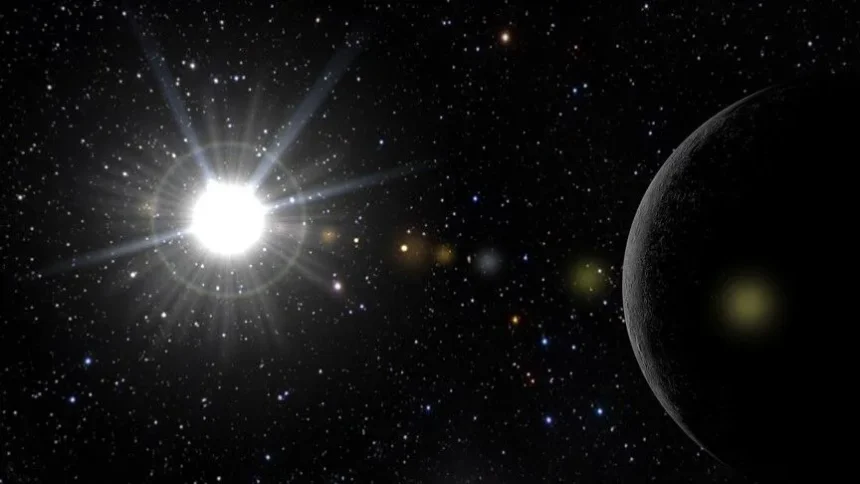
The joint European-Japanese BepiColombo space mission is preparing to enter orbit around Mercury on Saturday, November 21, completing an extraordinary eight-year voyage of nearly 10 billion kilometres (6.2 billion miles) through the inner solar system.
According to the European Space Agency (ESA), the orbital insertion will represent a major achievement in the international effort to investigate Mercury, the smallest planet in the solar system and the one closest to the Sun.
Launched on October 20, 2018, the spacecraft has travelled along a complex trajectory, relying on nine planetary flybys to gradually adjust its speed and direction. These manoeuvres included one encounter with Earth, two with Venus and six with Mercury itself.
The carefully planned route has enabled the spacecraft to approach Mercury at a velocity suitable for being captured by the planet’s gravitational field.
During the critical arrival manoeuvre, four thrusters aboard ESA’s Mercury Planetary Orbiter will be activated to reduce the spacecraft’s speed as it approaches the planet’s south polar region.
BepiColombo will initially settle into an elongated orbit, with its two scientific spacecraft, the European Mercury Planetary Orbiter and Japan’s Mio orbiter, still connected.
The orbiters are scheduled to separate on December 9 and 10, marking the beginning of preparations for coordinated observations of Mercury from two different orbital positions.
The European spacecraft will concentrate on examining the planet’s surface composition, internal structure and geological characteristics. Mio, developed by the Japan Aerospace Exploration Agency (JAXA), will investigate Mercury’s magnetic field and the surrounding space environment.
Researchers expect the complementary observations to provide valuable insights into several longstanding scientific mysteries, including why Mercury possesses an unusually large metallic core, how its magnetic field originated and what materials are preserved inside permanently shadowed craters near its poles.
Although the spacecraft are approaching their destination, full scientific operations are not expected to commence until April 2027, following additional orbital adjustments, equipment testing and instrument calibration.
An important preparatory milestone was achieved on September 3, when BepiColombo successfully released its Mercury Transfer Module, which had supplied propulsion and electrical power throughout much of the interplanetary journey.
The separation allowed the remaining spacecraft to proceed towards Mercury using their onboard systems for the final stages of orbital insertion.
Once established in orbit, BepiColombo will become only the second space mission to orbit Mercury, following NASA’s MESSENGER spacecraft, which conducted scientific investigations around the planet between 2011 and 2015.
Before MESSENGER, NASA’s Mariner 10 became the first spacecraft to examine Mercury at close range, completing three flybys in 1974 and 1975 and transmitting the earliest detailed images of its surface.
Unlike its predecessors, BepiColombo will eventually deploy two scientific orbiters around Mercury simultaneously, allowing scientists to study different aspects of the planet and its environment through coordinated measurements.
The mission is expected to substantially expand scientific understanding of Mercury’s formation, composition and evolution, while providing new information about the processes that shaped the innermost regions of the solar system.