





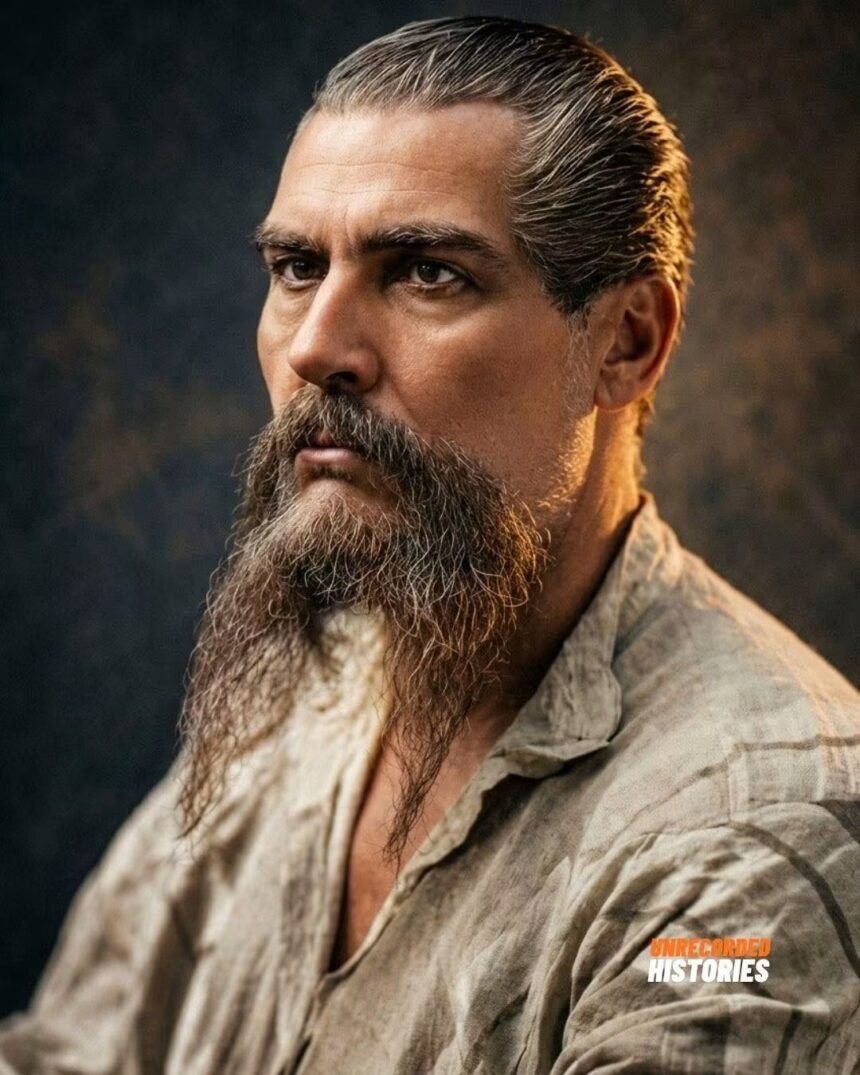
He entered Mecca disguised as an Afghan doctor, survived a spear driven through his face in Somalia, and translated some of the world’s most controversial ancient literature into English. Sir Richard Francis Burton lived the kind of life that sounds impossible even in an adventure novel.
He was a soldier.
Explorer.
Linguist.
Swordsman.
And one of Victorian Britain’s most extraordinary characters.
Born in Torquay, England, on March 19, 1821, Burton spent much of his childhood travelling across Europe.
His family moved between France, Italy, and England.
By fifteen, he reportedly spoke five languages fluently.
He also possessed a fierce temper and an appetite for confrontation.
When he entered Oxford University, trouble followed almost immediately.
On his first morning, another student made a remark about his moustache.
Burton challenged him to a duel.
The student declined.
Burton’s relationship with the university never improved.
He openly mocked its rules and professors.
When officials discovered he had attended a forbidden horse race, they expelled him.
Burton departed Oxford in a carriage, reportedly blowing a bugle at the professors as he left.
He joined the East India Company’s army and travelled to India.
There, his unusual abilities began attracting attention.
While other British officers remained within their familiar social circles, Burton immersed himself in local cultures.
He learned Hindustani.
Gujarati.
Marathi.
Punjabi.
Persian.
Arabic.
And several other languages.
He passed multiple military language examinations.
He even kept forty monkeys in his quarters, attempting to understand their communication.
He claimed to have identified sixty distinct sounds before his commanding officer ordered him to release them.
His fellow officers called him Ruffian Dick.
It wasn’t entirely affectionate.
But Burton was preparing for adventures far beyond military life.
In 1853, he undertook an extraordinarily dangerous journey.
He disguised himself as an Afghan Muslim doctor named Haji Mirza Abdullah.
He grew a beard.
Studied religious customs.
Memorised passages of the Quran.
And joined a caravan travelling toward Mecca.
At the time, discovery as a non-Muslim inside the holy city could have placed his life in grave danger.
Yet Burton completed the pilgrimage.
He visited the Kaaba.
Drank from the Zamzam well.
And carefully observed the places around him.
At night, he recorded details and reconstructed maps from memory.
He eventually returned safely, having accomplished something few Europeans of his generation had attempted.
But danger was becoming a familiar companion.
In April 1855, Burton was exploring the Somali coast when armed warriors attacked his expedition’s camp during the night.
The fighting was brutal.
One British officer was killed.
Another, John Hanning Speke, suffered numerous wounds.
Burton fought with his sword.
Then a warrior drove a javelin through his face.
The weapon entered one cheek and emerged through the other.
For a moment, Burton’s mouth was pinned by the iron shaft.
Somehow, he escaped the attack.
He survived with a deep facial scar that remained visible for the rest of his life.
Most men would have abandoned exploration.
Burton returned to Africa.
In 1858, he and Speke travelled deep into the continent’s interior.
They became the first Europeans to reach Lake Tanganyika.
Speke later reached Lake Victoria and believed he had identified the source of the Nile.
Their partnership collapsed into bitter rivalry.
They argued over geography, credit, and scientific conclusions.
A public debate was eventually arranged.
But Speke died from a gunshot wound the day before it was scheduled.
Authorities ruled the death accidental.
Burton remained convinced there was more to the story.
After his African expeditions, Burton entered diplomatic service.
He served as a British consul in West Africa, Brazil, Damascus, and finally Trieste.
But his greatest productivity came through writing.
Across his lifetime, he produced dozens of books and translations.
He introduced English readers to an unabridged version of One Thousand and One Nights.
He translated the Kama Sutra.
The Perfumed Garden.
And the Portuguese epic The Lusiads.
He wrote about swordsmanship.
Geography.
Anthropology.
Poetry.
And falconry.
His interests seemed almost limitless.
He reportedly spoke twenty-nine languages and believed he could develop working knowledge of another in just six weeks.
By his later years, Burton had become a legend.
His piercing eyes, intimidating moustache, and scarred cheek made him instantly recognizable.
But the final chapter of his life contained another mystery.
On October 20, 1890, Burton died of a heart attack at his residence in Trieste.
He was sixty-nine.
His wife, Isabel, was a deeply religious Catholic.
After his death, she arranged the last rites.
Then she gathered his private journals, unpublished manuscripts, and portions of his unfinished translations.
And burned them.
She believed she was protecting his soul and reputation.
Decades of observations, experiences, and potentially invaluable historical material disappeared into the flames.
Historians have spent generations wondering what those pages contained.
Burton left behind an extraordinary record of exploration and scholarship.
But perhaps his most recognisable reminder was something much smaller.
The scar across his cheek.
A permanent mark from a night in Somalia when death had come within inches.
He carried it for thirty-five years.
Through diplomatic appointments.
Through literary achievements.
And into the final photographs of his life.
Richard Francis Burton had crossed deserts, explored continents, challenged conventions, and survived dangers that would have ended most lives.
And even after his death, he left the world with mysteries it could never fully solve.