





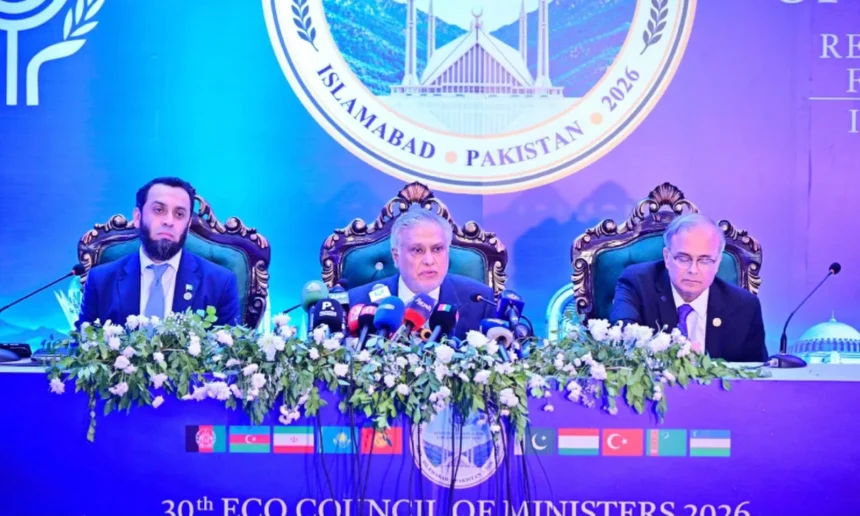
Pakistan is expected to host the next meeting of the Makkah Defence Alliance’s highest decision-making committee later this month, Deputy Prime Minister and Foreign Minister Ishaq Dar announced on Monday, signalling further progress in defence cooperation between Pakistan, Saudi Arabia and Turkiye.
Speaking at a press briefing following a ministerial meeting of the Economic Cooperation Organisation (ECO) in Islamabad, Dar said preparations were underway for a meeting of the Strategic Political and Defence Committee (SPDC), the alliance’s apex body.
The committee is expected to convene in Islamabad towards the end of November, although a final date has yet to be announced.
Dar recalled that Pakistan, Saudi Arabia and Turkiye signed the Makkah Joint Defence Agreement on August 7, establishing a collective defence arrangement under which an attack on any one member would be treated as an attack on all three.
The agreement is intended to strengthen military cooperation and provide a framework for coordinated responses to threats against member states.
“The SPDC will actually be meeting, hopefully [at the] end of this month, in Islamabad,” Dar said.
He explained that Pakistan had offered to host the committee’s next formal meeting during its inaugural session and that the proposal had been accepted by all participating countries.
“We offered in our inaugural meeting that our next formal meeting will be held in Islamabad and everybody accepted,” he said.
Dar also revealed that the committee had held an emergency meeting in Riyadh last month in response to Houthi attacks on Saudi Arabia.
The SPDC comprises the foreign and defence ministers of Pakistan, Saudi Arabia and Turkiye, along with senior military officials from the three countries.
Responding to a question about the possibility of a new regional security framework, Dar said recent developments had demonstrated the importance of countries developing their own collective security arrangements rather than relying exclusively on international institutions.
He suggested that the Makkah Defence Alliance could represent an initial step towards a broader regional security architecture.
“This region should have its own security architecture. Maybe this is a beginning,” he remarked.
The foreign minister noted that major international security institutions had evolved over time and that regional arrangements could similarly develop through cooperation among participating states.
Dar emphasised that the Makkah agreement was defensive in nature and consistent with Article 51 of the United Nations Charter, which recognises the inherent right of individual and collective self-defence.
He rejected the suggestion that the alliance would necessarily remain limited to its three founding members, indicating that the possibility of future expansion had not been ruled out.
“Now, it is not restricted that these three countries will have a monopoly and will not have, will not entertain ever [any] other membership,” he said.
His remarks suggest that the alliance’s membership could eventually expand, although no additional countries or formal enlargement proposals were announced.
The forthcoming Islamabad meeting is expected to provide an opportunity for senior political and military representatives to review the alliance’s progress and discuss its future direction.
Dar’s comments come amid heightened regional security concerns and renewed debate over the role of collective defence arrangements in maintaining stability across the Middle East and neighbouring regions.