





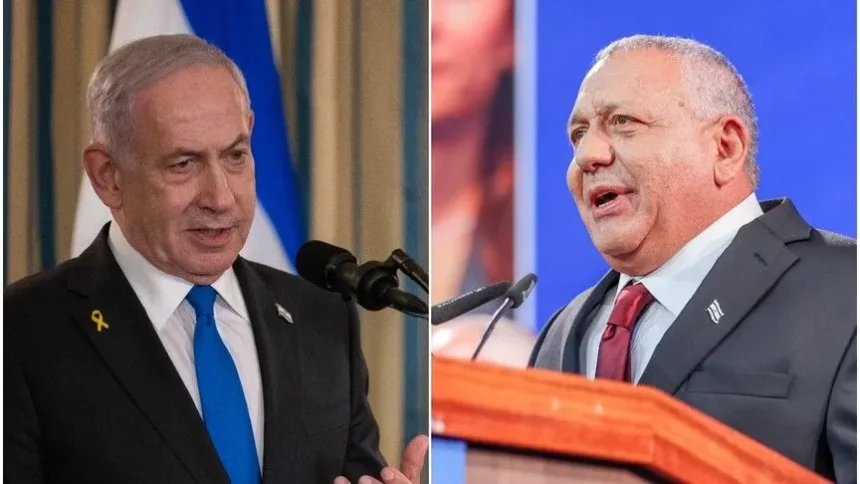
Israeli caretaker Prime Minister Benjamin Netanyahu has discussed the possibility of renewed military strikes against Iran with Gadi Eisenkot, who has been tasked with forming Israel’s next government, according to Israeli media reports published on Friday.
Israeli broadcaster Channel 12 reported that Netanyahu met Eisenkot on Thursday to share intelligence concerning Iran and discuss the possibility of resuming military operations.
Citing an informed source, the broadcaster said the intelligence presented during the meeting “could change his view” of Netanyahu’s motives for considering further attacks on Iran.
The report did not disclose the nature of the intelligence or indicate whether Eisenkot had been persuaded by Netanyahu’s assessment.
Channel 12 also reported that Eisenkot had been unaware of a visit to Washington by Mossad chief Roman Gofman, who was reportedly holding discussions concerning the possibility of renewed military action against Iran.
The broadcaster did not establish whether Eisenkot had deliberately been excluded from information about the Mossad chief’s visit.
The developments come during a sensitive political transition in Israel following the October 27 parliamentary elections, in which Netanyahu’s political bloc lost its majority.
Eisenkot has since been tasked with forming a new government, leaving Netanyahu in office in a caretaker capacity while negotiations over the next administration continue.
Amid the transition, Eisenkot has warned Netanyahu against launching unnecessary military operations before the formation of a new government.
His concerns have added a political dimension to discussions over the timing and justification of any renewed Israeli offensive against Iran.
Meanwhile, Israeli public broadcaster KAN reported that military Chief of Staff Eyal Zamir supports the possibility of an operation against Iran but believes the current circumstances are unsuitable for launching one.
According to the report, Zamir favours coordinating any potential military action with the United States and ensuring that the timing and operational conditions are appropriate.
KAN cited an unnamed security source who said the Israeli military does not currently assess Iran as presenting an immediate threat that would require another attack.
The source also indicated that military officials have warned against initiating an operation that could draw Israel into a prolonged war of attrition.
The reported reservations suggest that while senior Israeli officials continue to consider military options against Iran, there are differences over whether renewed strikes are necessary or strategically advisable at this stage.
Neither report established that a decision had been taken to resume attacks.
The discussions come as Israel navigates a change in political leadership, with questions surrounding the authority of the caretaker government and the potential consequences of launching a major military operation before the next administration takes office.