





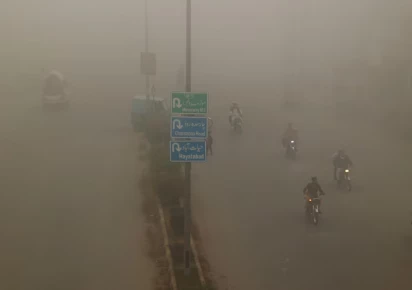
Lahore remained the world’s most polluted major city on Thursday as hazardous smog continued to engulf Punjab, with several cities recording Air Quality Index (AQI) readings exceeding 500 and raising serious public health concerns.
According to Punjab’s official air quality monitoring data, Lahore recorded an AQI of 346 at 8am on Thursday, compared with 444 at the same time on Wednesday, reflecting an improvement of 98 points over 24 hours.
Despite the decline, pollution levels remained dangerously high, with Lahore retaining the top position in global air quality rankings compiled by monitoring platform IQAir.
The platform recorded Lahore’s AQI at 344, 363 and 371 at different times during the day, while India’s capital, New Delhi, ranked second among the world’s most polluted major cities.
A recent report by the Pakistan Air Quality Initiative (PAQI) found that air pollution in Lahore had increased by 32 per cent compared with the corresponding period last year, highlighting the worsening severity of the city’s air quality crisis.
Conditions were equally alarming in several other parts of Punjab, where pollution levels exceeded those recorded in Lahore.
According to IQAir, Raiwind registered an AQI of 519, followed by Bahawalpur at 515 and Multan at 507. Gujranwala recorded an AQI of 411, also falling within the hazardous category.
Meanwhile, Punjab’s official air quality monitoring network reported readings reaching 500 in Kasur, Jhang, Nankana Sahib, Okara, Pakpattan and Sahiwal.
Under standard AQI classifications, readings above 300 are considered hazardous, indicating air pollution levels that pose serious health risks to the entire population.
Prolonged exposure to such conditions can aggravate respiratory and cardiovascular illnesses, particularly among children, older people and individuals with existing health conditions.
Health authorities generally advise residents to minimise outdoor activities, avoid strenuous exercise in polluted air and take appropriate precautions to reduce exposure.
Although Lahore’s morning AQI showed some improvement compared with Wednesday, the persistently hazardous readings across Punjab underscored the continuing severity of the province’s smog crisis.