





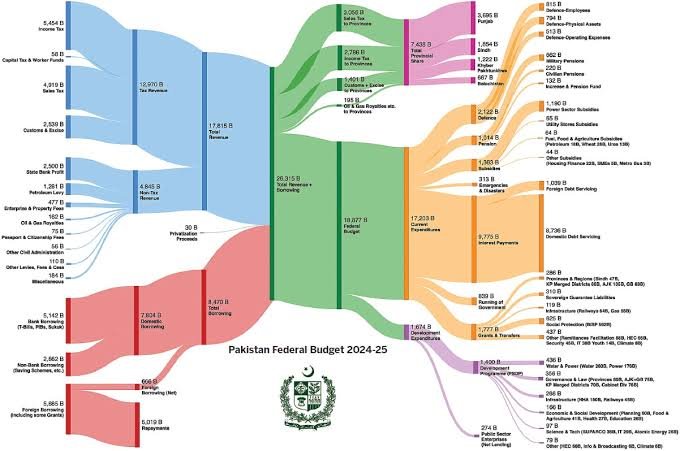
The Annual Fiscal Statement — or, in layman’s terms, the annual budget — is one of the most critical instruments at a government’s disposal to fulfil its political commitments and drive development across the country. The budget not only paints a picture of the nation’s vision for the upcoming fiscal year, but also exerts a powerful influence on the broader socio-economic landscape. In Pakistan, the national budget is determined through months of deliberation, calculation, and inter-departmental consultation.
A simple question that few citizens ask is: who actually decides the budget? We hear about it on the news, read about it in newspapers, and debate it over tea. Yet we rarely consider the strenuous and lengthy administrative process the budget must navigate before being enacted into law.
Step One: The Budget Call Circular and Departmental Estimates
In reality, the entire process is initiated when the Ministry of Finance issues the official “Budget Call Circular.” This administrative directive is dispatched to all federal ministries, divisions, and provincial departments.
Upon receiving the circular, individual ministries formulate their respective revenue and expenditure proposals based on baseline operational requirements and prospective development projects. These financial estimates are subsequently submitted back to the Ministry of Finance for rigorous technical review.
Step Two: Executive Review and Parliamentary Role
After receiving these departmental reports, the Ministry of Finance evaluates their technical feasibility, reconciles projected deficits, and finalises a unified draft budget in accordance with federal government priorities. Once approved by the Cabinet, the draft budget is submitted to Parliament.
Unlike in countries such as Canada, Pakistan’s Parliament plays a relatively constrained role in shaping the budget’s core allocation details. This limited parliamentary input is driven in part by tight legislative review timelines, as well as the fact that the Ministry of Finance houses specialised economists and technocrats equipped to handle complex macroeconomic modeling.
Step Three: Presentation, Voting, and Senate Recommendations
Prior to the commencement of the new fiscal year on 1 July, the Finance Minister presents the annual budget statement and the Finance Bill to the National Assembly on behalf of the sitting government. The presentation includes an official budget speech detailing policy objectives, revenue targets, and projected spending.
Following general debate and voting on demands for grants, the National Assembly votes on the Finance Bill. Once passed, the Bill is transmitted to the President for royal assent to be signed into law.
Regarding the Senate’s role in this fiscal process: under Article 73 of the Constitution, the Money Bill is transmitted simultaneously to the Senate for review. While senators may debate the allocations and transmit formal recommendations back to the National Assembly, these comments are advisory rather than legally binding on the lower house.
The Imperative for Fiscal Transparency
A fundamental challenge within public administration in Pakistan is that regulatory frameworks and fiscal policies remain largely opaque to ordinary citizens. Public disengagement has persisted for so long that few question the mechanics of national policy-making. From Senate debates to budgetary allocations, asking a typical citizen about parliamentary procedure often yields uncertain answers.
As citizens, we must advocate for greater fiscal transparency and civic awareness — ensuring that the public remains informed about how national resources are managed and distributed.
References
- Paradigm Shift. (2024). Understanding the Federal Budget Formulation Process in Pakistan. Public Policy Insights.
- Pakistan Institute of Development Economics (PIDE). (2023). A Critical Evaluation of the Budget-Making Process in Pakistan. PIDE Policy Research Series.