





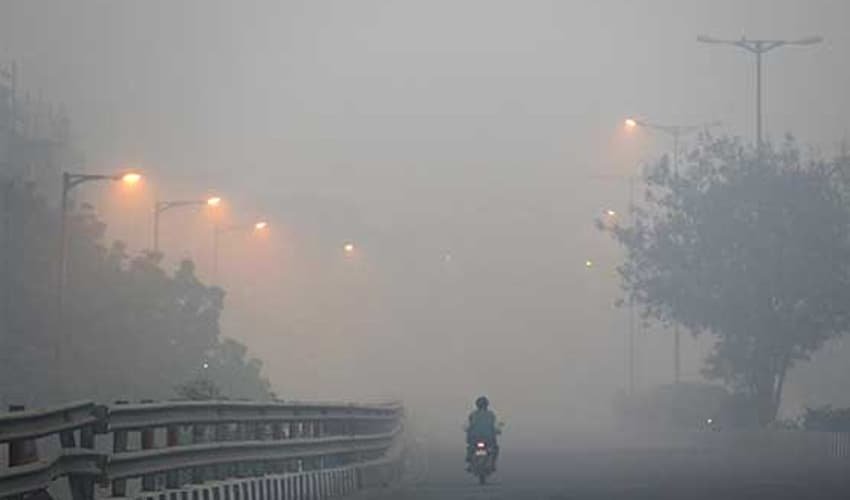
A thick blanket of toxic smog has engulfed Lahore and several other cities across Punjab, with the provincial capital recording its worst air pollution of the season as its Air Quality Index (AQI) climbed above 530, according to reported monitoring data.
Lahore was ranked the world’s most polluted major city in the reported readings, with several neighbourhoods registering exceptionally hazardous pollution levels exceeding 800.
Iqbal Town recorded an AQI of 836, followed by Samanabad at 828, Gulberg at 822 and Barki Road at 798. Other severely affected areas included Model Town at 748, Cantt at 652, Defence at 622, Pine Avenue at 621, Islampura at 611, Shadman at 561 and Johar Town at 541.
The reported pollution levels have raised serious health concerns, particularly for children, older residents and people suffering from respiratory or cardiovascular conditions.
Air monitoring reports also indicated that pollutant concentrations in Lahore had reached approximately 68 times the World Health Organization’s recommended guideline levels, although the specific pollutant and averaging period were not identified.
Light easterly winds, reportedly blowing at around five kilometres per hour, accompanied the severe pollution conditions.
The smog crisis extends beyond Lahore. Faisalabad recorded an AQI of 441, followed by Multan at 260, Peshawar at 255, Sialkot at 218 and Islamabad at 173, according to the reported figures.
The readings indicate that air pollution has reached dangerous levels across several major Pakistani cities, with Lahore and Faisalabad experiencing particularly severe conditions.
Medical experts have advised residents to minimise unnecessary outdoor activities, particularly during periods of extreme pollution, and to wear well-fitting protective masks when venturing outside.
Children, elderly people and those with existing medical conditions have been urged to take additional precautions as hazardous air continues to affect daily life across Punjab.
The latest episode has renewed concerns over the recurring smog crisis and the need for sustained measures to improve air quality in Pakistan’s urban centres.