





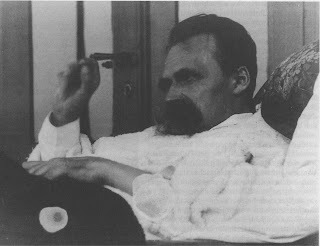
Friedrich Nietzsche was a German philosopher who became one of the most influential modern thinkers of all time. His influence easily extends to generations of theologians, philosophers, poets, and playwrights through his work on religion, morality, and philosophy. Today, Nietzsche is one of the most misunderstood philosophers of the nineteenth century, with his work on concepts such as slave morality, the Übermensch, and master morality being invoked by fascists to legitimise the very things he despised.
The Hijacking of the Übermensch
One of the most notoriously misused notions by Nietzsche stands to be the concept of the Übermensch. In 1883, Nietzsche began his work Thus Spoke Zarathustra, a book consisting of a series of parables and speeches given by the titular protagonist, Zarathustra. Nietzsche introduces the idea of the Übermensch in the book’s prologue, which he insinuated to be the ultimate goal of mankind: to become a complete, enlightened being. Nietzsche felt that humans were incomplete beings who relied heavily on outdated notions of religion as a means of fulfilment, and many interpretations suggest that this work is centred around the idea of humankind surpassing the bounds of humanity.
The problem began in the translation of the term Übermensch. The German term Über translates to “over” or “above”, and Mensch to “human” or “man”, as in collective mankind. In 1933, the Nazis came into power and used the concept of the Übermensch as a justification for their belief in racial superiority. Nazi authorities placed Germans in a racial hierarchy of superiority, with Übermenschen, or “supermen”, at the top, and Untermenschen, or “subhumans”, at the bottom. Although these terms were derived from Nietzsche’s work, Nietzsche himself was fiercely opposed to antisemitism and nationalism.
Nietzsche’s work on Übermenschen, coupled with his disdain for socialism and democracy, made him the fascists’ favourite philosopher. Nietzsche called socialism “the tyranny of the meanest and the dumbest” and the “degeneration and diminution of man into the perfect herd animal”. His criticism of democracy often stemmed from his fear of majority rule. He felt that democracy was a manifestation of “herd morality” in which exceptional individuals of society were brought down to the level of the masses, thus enforcing mediocrity and the erasure of individual excellence. Nietzsche also believed that socialism was a result of resentment “held by inferior people”.
In Nietzsche’s actual published works, such as Thus Spoke Zarathustra and Beyond Good and Evil, he introduces the “Will to Power” as a fundamental drive inherent in every individual: “Wherever I found a living thing, there found I Will to Power… not, however, Will to Life, but — so teach I thee — Will to Power!” He framed life as “a will to war, a Will to Power, a will to overpower!” One specific form of the Will to Power that Nietzsche focused on is what he called “self-overcoming”, where the Will to Power is to be directed towards self-mastery and self-transformation. However, Adolf Hitler and other fascists adopted Nietzsche’s phrase to justify aggression and authoritarianism, interpreting the quest for power as an inherent human drive.
“God Is Dead” and Online Subcultures
One of Nietzsche’s most infamous quotes is “God is dead”. These words single-handedly transformed Nietzsche into an idol for a plethora of online subcultures, including “doomers” and “incels”. “Doomer” refers to a twenty-first-century neologism for an online subculture of men who hold pessimistic and cynical views of the world, largely defined by nihilism. Similarly, “incel” refers to an online subculture of men who claim to be “involuntarily celibate”, with the subculture largely characterised by self-isolation, social rejection, self-pity, misogyny, and nihilism.
In reality, Nietzsche was a staunch advocate against nihilism. The full quote of “God is dead” is as follows:
“God is dead. God remains dead. And we have killed him. How shall we comfort ourselves, the murderers of all murderers? What was holiest and mightiest of all that the world has yet owned has bled to death under our knives: who will wipe this blood off us? What water is there for us to clean ourselves? What festivals of atonement, what sacred games shall we have to invent? Is not the greatness of this deed too great for us? Must we ourselves not become gods simply to appear worthy of it?”
When analysing the full version of the quote, we realise that Nietzsche’s perspective never resonated with nihilism, but rather alludes to the erasure of the belief in God and morals in modern society. By rejecting belief in God, humankind has eradicated the traditional meaning of life, causing moral frameworks to eventually collapse. As traditional values lose meaning, humans must strive to create their own new values to prevent falling into despair.
This adoption of nihilism within online subcultures has proved to be highly dangerous, often perpetrating violence, terrorism, and the encouragement of suicide. Since 2014, there have reportedly been multiple mass killings or instances of attempted violence, mostly in North America, at the hands of self-proclaimed incels. Incels also believe that the “black pill” mentality leaves them with finite choices on how to navigate life, including the choice of suicide; therefore, many incels engage in suicidal fantasies on forums and encourage other incels to attempt suicide. “Doomer” culture also frequently overlaps with this problematic incel culture.
The Esoteric Strategy
These instances make it clear that Nietzsche’s philosophy has time and time again been misinterpreted and taken out of context, which raises the question: What exactly is it about Nietzsche’s work that makes it so easy to misunderstand?
Nietzsche writes in The Gay Science: “one does not only wish to be understood when one writes; one wishes just as surely not to be understood.” This quote reflects Nietzsche’s esotericism, which refers to philosophical traditions that reserve their deepest “inner” teachings for a select few. An esoteric book consists of two separate and distinct teachings: one that is obvious, and another concealed to all but the most attentive readers. Since true teachings are frequently controversial and provocative, they are not stated in obvious places, but rather deeply embedded within the text.
German philosopher Martin Heidegger strongly believed that Nietzsche was an esoteric writer: “For every great thinker always thinks one jump more originally than he directly speaks,” Heidegger writes. “Our interpretation must therefore try to say what is unsaid by him.” It is also true that Nietzsche rejects structured discourse and instead enacts his ideas in aphorisms, allowing interpretations to stay open and unfinished. This allows for conceptual thinking and perspectivism while simultaneously rejecting dogma. The elusive nature of Nietzsche’s work is not accidental, but instead a strategic response to his own deep scepticism regarding the nature of truth and language.