





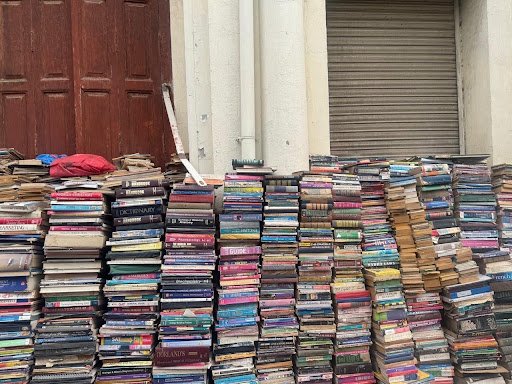
I remember, two years ago, a reclining evening in the Mall, when the sun seemed to be completing her slow descent. A friend and I were browsing hungrily through the road’s Sunday book bazaar, hoping to secure a copy of Parveen Shakir’s Khushboo. I do not go out wearing glasses and am more or less blind without them, so the chances of finding a good edition were therefore already slim. We had also arrived late, which made them slimmer. (The bazaar begins to wind down around six or seven. The earlier one arrives, the better the finds.)
A bookseller, nevertheless, reached beneath a pile of books and procured two crisp copies!
The first was a breathtaking jasmine-white 1976 edition from a publishing house in Pakistan, while the second was a series of beautiful translations cloaked in a magenta cover. Both were hardbacks. Both were in very good condition. He asked no more than Rs 250 for each.
This was what the Sunday bazaar once did particularly well. You could go looking for one thing and return with another. Unlike a conventional bookshop, whose stock is organised by demand, this bazaar operated through contingency and anticipation. One did not necessarily arrive knowing what one would buy. The pleasure was in discovering, with a pulsating heart, what books were there awaiting oneself.
That distinction matters because the second-hand book market has historically performed a cultural function that ordinary retail does not. It preserves books after their commercial usefulness has diminished, allows old editions to circulate beyond their original readership and, most importantly, exposes readers to texts outside their predetermined interests. A student who wants to buy a prescribed novel may find a poetry book, or someone who wants a Faiz book might end up with a Sarvat Hussain collection, or someone might come to buy an English grammar book and bring back a lost travelogue. It was the disorder which made the bazaar valuable, in part.
The contemporary Sunday market increasingly appears to be losing this quality. A substantial portion of the contemporary stock consists of reproduced editions, many of them visibly pirated. The pirated edition is often sufficiently competent to make the distinction difficult for an inexperienced reader, whether wearing glasses or not. The covers are tightly laminated (so one cannot browse the inner pages). The titles are printed reasonably well, and the books themselves are sometimes so clean in font and appearance that they become misleading. The reader who does not know what a particular authorised edition looks like, or who has never compared the paper, typography, binding and printing quality of different editions, has little reason to suspect that anything is amiss. The irony is that piracy does not necessarily produce the dramatic price reduction one might expect.
For instance, rather than buying a pirated Penguin edition of a book, authorised Readings editions can be purchased at a lower cost, with discounts of approximately 25 per cent offered by established Urdu Bazaar booksellers such as Ilmi Book Store. That does not mean that every reader who buys a pirated book is making a foolish bargain. Piracy exists in an economy where readers have limited money, and we know books can be expensive. It also keeps informal booksellers and a certain kind of low-cost literary exchange alive. But in this very instance, the most frequent argument for buying pirated editions, ‘access to books at significantly lower prices’, is rendered futile.
That is why it is also important not to do the same stock over and over. A retail store can afford a limited line if it aims to be efficient and stock what its customers want to buy. There was something different that this bazaar used to provide. Its stock consisted of a variety of collections, old stock, discontinued editions, and by-products of used books, all of which were inherently diverse. If the same books are sold week after week, it becomes increasingly like the retail outlets the bazaar has historically tried to emulate.
Moreover, booksellers no longer rely on Sunday themselves. One can find some of them throughout the week in and around the established book districts and the university neighbourhoods of Lahore. I have seen an uncle setting up a stall on weekdays near the Urdu Bazaar gate of Government College University. For students, this is an entirely sensible arrangement. A book that is required on Tuesday does not have to wait until Sunday.
On the flip side, this convenience does weaken the bazaar’s cultural significance. Historically, in the 1960s, ordinary urban space would, for one day, become a place of literary exchange. The pavement was transformed into a makeshift library. Students arrived with limited money and unlimited curiosity. Older readers searched for editions they remembered from earlier decades. Families wandered through the piles. Booksellers relied upon the accumulated knowledge of their regular customers and the unpredictability of the day’s crowd. It was rare and hence more valuable.
There is another, more recent transformation. The bazaar has acquired a second life as an image. Instagram reels have begun to popularise the Sunday book bazaar as a recognisable literary aesthetic. Young women draped in pretty cotton saris pause between the stalls to be photographed turning the pages. Suited-and-booted men sit by heaps of books. Cameras glide in tortoise pace over the gaunt, aged faces of the books’ covers, the wooden tables, the old postage stamps, the wilted brass utensils, the uncle displaying his sketches, and a cup of tea and chocolate brownie under a portrait of Faiz at the Pak Tea House.
However, I must admit, though painfully, that there is nothing inherently frivolous about this. Literary culture requires public visibility, and a picture of someone reading in a book market can inspire people to want to read!
So, in some ways, Instagram has added a new set of users to these old spaces, such as younger users who might not have many other reasons to access these places. However, there is a difference between visibility and vitality. The book bazaar is more visible as an image at the very time that it is becoming less meaningful as a venue for literary discovery. It has a very marketable visual vocabulary. The stacks of books, the narrow streets, the worn book covers, the handwritten prices and the overcrowded sidewalks are an immediate shorthand for intellectuality as an aesthetic rather than intellectuality in flesh and practice. A place can stay busy, get tagged and get filmed over and over again, and the ideals that made the place culturally significant can get thinner. The Sunday bazaar is threatened with just this sort of paradoxical fate as it is becoming ever more visible as an aesthetic, but ever more dispensable as a place to read.
The particular, almost sacred kind of relationship between reader and city that this marketplace once created is fading.
I get up early on Sundays and drag a friend to it, anyway. In part, because I’m still book hunting. And partially, there is the fact that I don’t want to give up the satisfaction of discovering a satiating book.