





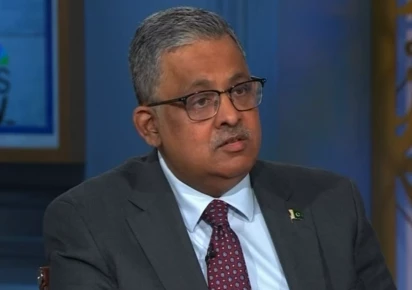
Pakistan’s Ambassador to the United States Rizwan Saeed Sheikh has called on India to honour the Indus Waters Treaty (IWT) and reverse unilateral measures affecting the decades-old water-sharing agreement.
Writing in Newsweek, Sheikh responded to an article by India’s Ambassador to the US Vinay Kwatra, titled A Treaty Pakistan Destroyed Long Before India Set It Aside, rejecting the Indian envoy’s characterisation of the treaty and its history.
Sheikh accused Kwatra of presenting the IWT as an arrangement that granted disproportionate concessions to Pakistan while portraying Islamabad as an obstacle to Indian hydropower development on the western rivers.
He argued that India had increasingly advanced this narrative since announcing in April 2025 that it was holding the treaty “in abeyance”, describing the move as unilateral and without a basis in either the agreement itself or international law.
According to Sheikh, the treaty was not an act of generosity by India but the outcome of nearly a decade of negotiations aimed at establishing legally defined rights and obligations for both countries.
He described the agreement as a framework intended to provide certainty, predictability and stability in the management of the Indus River system, replacing unilateral upstream discretion with mutually agreed rules.
Under the treaty, Sheikh said, India obtained rights over the Ravi, Beas and Sutlej rivers, while Pakistan’s rights concerning the Indus, Jhelum and Chenab rivers were protected through the agreement’s legal framework.
He also stressed that Pakistan made significant adjustments following the treaty, relinquishing its previous dependence on the eastern rivers and undertaking extensive infrastructure projects to reorganise its irrigation network around the new allocation.
The ambassador called on New Delhi to return to compliance with the treaty and withdraw its unilateral measures, maintaining that disagreements between the two countries should be addressed through the mechanisms established under the IWT.