





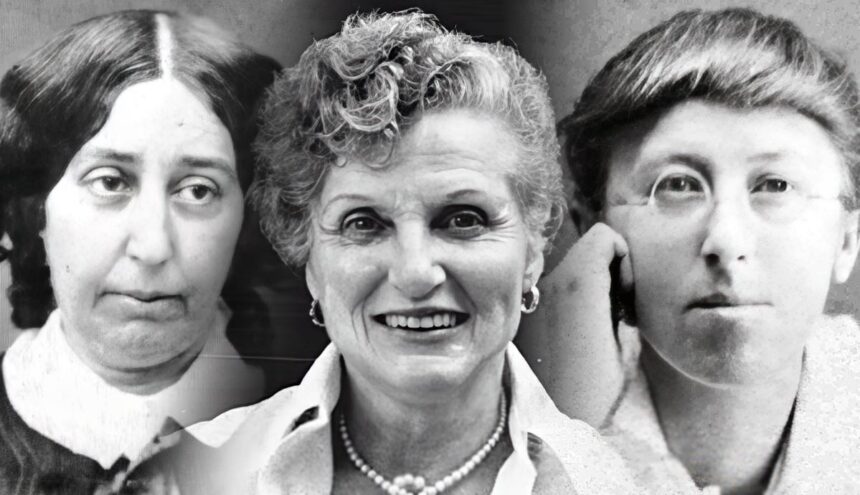
What was masculinity, if not a draping laid over the divine feminine– a costume stitched to conceal an imminent truth? But every once in a while, these stitches would fray at the edges, threatening to unravel a myriad of women once sworn to remain hidden.
In an era when nearly every field was monopolized by men, the women had adopted an unusual tactic– publishing under male names. In doing so, not only did they gain visibility having their work circulated around freely being called the pinnacle of “masculine-intellect” albeit it all came at the cost of erasure of their true identities.
Thus the paradox becomes abundantly clear, the craftsmen of literature were being told to hand in their tools, to make way for an absence where their words would be preserved yet their names concealed.
I. A World That Wouldn’t Listen
Perhaps the wind had dispersed a swarm of rumours–an assumption hardened into deception–women were incapable of writing “serious” literature. The belief flowed easily through salons, publishing houses and universities, unquestioned and unchallenged. Yet it compels one to ask: In the light of their intellect, what was serious literature? Was it emotional depth in the book? Moral enquiry? Or simply a masculine surname stamped on the front cover?
Beforehand it had become profusely clear where women stood in the literary world, the world itself did not reject them for a lack of talent but for lack of masculinity. Thus staking the claim that their supposed “serious” literature was never really serious but simply a ploy, a measure to permit who could speak and who couldn’t.
Many attempted to seek out a way through this loophole desperately wishing for a way to write under their own names– only to collide into this labyrinth of a wall, one constructed brick by brick by male editors, critics and even readers, who guarded the publishing industry as a pure masculine field of art.
The objections raised by the editors against women-composed books were all constantly familiar; too emotional, too sentimental or just intellectually inferior.
Never based on literary evaluations but simply disregard and disdain concealed as coded refusals in the name of professionalism.
II. The Mask Of Masculinity
Despite the massive blow to women’s credibility, they resigned to their fate, opting to write instead of forsaking their love for the language. For a brief moment, they had a taste of what success felt like, only if delivered by a calloused hand, not their own. It worked, but at what cost?
A handful of now household names opted to take on more masculine identities to leave their mark on the literary world; the Bronte sisters, whose novels were titled immaculate at that time, were received with applause and had taken up the identities Currer, Ellis and Acton Bell amongst many others who had succumbed to the realization that their words only mattered if traces of womanhood were stripped away from them. Jane Eyre and Wuthering Heights were praised for their psychological depth long before critics figured out they were by a woman.
Mary Ann Evans adopted a similar strategy, settling on the name George Elliot, to ensure her work got the same visibility as any other male counterpart. Her novels were lauded for their moral gravity and realism–a high praise deemed undeserving for women at that time. When the barrier broke, and her alter ego had done his part, the admiration persisted, backed by surprise–proof that credibility did reside on the basis of your gender.
Others followed suit, ranging from George Sand and Vernon Lee, familiar names who took on male ones to bypass the prejudice that lingered in the air, and reach audiences that would otherwise turn them away. Every time the same pattern was followed, there would be praise for the work, without anyone knowing the woman behind it.
What was once known as “universal” became quite unachievable; the contrast writes itself; male names had little effect on the quality of writing but had an impact on the reader. Only when female authorship was exposed as tyranny did the women finally learn what caged them: the permission to speak or die.
III. What Was Lost In Silence
The silencing of women in every era has only ever led to unseen costs that play their hand in the future. But right now, the women were bound by shackles forbidden to go and smear their literary knowledge over the parchments.
Manuscripts piled on top of manuscripts, catching dust like traps, a voice of reason silenced by the whip. This had become a common occurrence–one overlooked for centuries, being told to clamp their mouths shut if they had nothing better to say. For every woman who had adopted a male name, there were others whose manuscripts had never been submitted, not by a fear of rejection but by the acute awareness of futility.
These were supposedly muted voices, never given the chance to mature their larynx before being extinguished. The literary world formed a massive circle, smoothed deliberately so female authors would slide off its edges.
By denying many women access to these mechanisms, this supposed circle had ensured many potential authors could never grasp the tools to shape their craft. Depriving their talent of its primary fuel. Perhaps the narrowing down of the literary canon was one of the biggest setbacks, entire registers of emotional memoirs dismissed as excessive and interior lives of women thrown into the margins, supposed genres of introspection, relational complexities and moral ambiguity were reduced to zero, by being called something distinctly feminine.
The overall boycott of female authors was so profound, it leaves us wondering what sort of stories would have emerged if the pen wasn’t snatched from their grips. What genres were never given the details to flourish? Thus the only conclusion would be that a literature built on absences was never meant to be read.
IV. Reclaiming The Names
To even step foot into this spectrum of writing, women were told to abandon their legacies and move towards a field which completely erased their identities, and any sense of womanhood that lingered, still they persisted.
Even behind borrowed names the brilliance endured, these women continued to rewrite themselves in history even as history refused to hold them. To reclaim their names became an act of responsibility, responsibility towards the craft, responsibility towards their legacy.
Recognizing these women today makes sure that even now no voice goes unheard, no word uttered should be discarded and no genius left unattended to.