





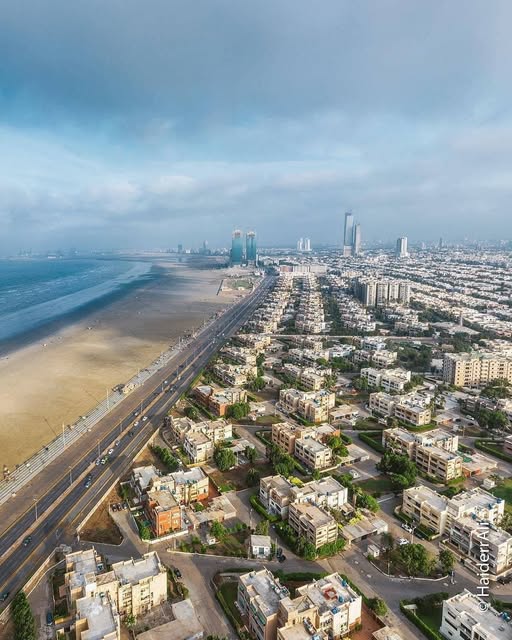
There is a word we use in Pakistan for people who have given up on the system. We call them practical.
The practical person does not wait for the municipal corporation. They buy a generator. They do not trust the thana. They hire private security. They do not send their children to a government school. They move somewhere with a gate, a residents’ committee, and a maintenance fee, and they call it a good life. And maybe it is. But what they have actually done, what we have all quietly agreed to call practicality, is leave. Quietly, legally, one housing scheme at a time.
This is what DHA is. Not a housing society. An exit.
The roads inside are smooth because someone decided these roads deserved to be smooth. The bijli is stable because someone decided these people deserved stable bijli. The parks are maintained, the sewage lines function, the streets have names and lights and the kind of basic dignity that most Pakistani neighbourhoods spend decades petitioning for. That is not a coincidence. That is priority, and priority is always a political decision, even when it is dressed as urban planning.
That decision was not made by an elected body or a public mandate. It was made by an institution that does not need your vote and is not obligated to explain itself to you. The Corps Commander chairs the board. The Ministry of Defence sits at the top. The legal framework governing what DHA can actually do, what powers it holds, how far its jurisdiction extends, and who it answers to is left deliberately vague. Scholars who have studied it say the ambiguity is not accidental. Institutions that cannot be clearly defined cannot be clearly challenged. And so DHA functions with the confidence of a state within a state, because that is more or less what it is.
What I find hard to move on from is the land.
It did not come from nowhere. Someone was farming it. Someone was living on it. Someone had a claim that predated any presidential order or development authority notification. That person was moved through coercion dressed as paperwork, through legal mechanisms designed to make dispossession look like procedure. The Bahria Town Karachi case made it impossible to ignore. Villagers went to court. The Supreme Court agreed. Hundreds of billions in settlements were ordered. The city stayed exactly where it was. We call that justice. I think it is closer to a receipt.
Outside every gate in this country, the same geography repeats. Informal settlements pressed against the boundary wall. Vendors, domestic workers, daily labour, all the people who make the enclave function; none of whom will ever live inside it. The shanty town does not exist despite the housing society. It exists because of it. Concentrated deprivation is not a side effect of elite urban planning. It is its logical outcome. Build a wall high enough and everything you excluded simply piles up on the other side.
And the people most excluded are always the same people. The communities that appear last in every housing index, every utility access survey, every study on who the Pakistani state actually serves. The gate does not create this hierarchy. It did not invent it. But it makes it permanent, architectural, and allows the people benefiting from it to drive past every morning without having to think too hard about what they are driving past.
That is the function of the wall. Not just security. Selective blindness.
What the housing society model does is allow the people with the most power to demand better governance to permanently remove themselves from the conversation. They are not fixing the system. They are not pressuring it from within, not organising, not agitating, not even complaining loudly enough for it to matter. They have bought their way out of needing it and left everyone else to manage whatever remains. A public sector expected to serve all citizens, hollowed out because the citizens with the most leverage already left.
There is something almost theological about it. The idea that you can purchase your way out of collective obligation. That the ummah of the Pakistani city, the shared fate of living in the same broken place, can be dissolved with a down payment and a transfer letter. That the gate is not just a physical structure but a moral one, marking the boundary between those the state chose and those it didn’t.
That is not practical. That is abdication with a maintenance fee.
Two Pakistans. The one inside the gate, and the one that built it. Outside, in the city that remains, the rest of us are still waiting for the garbage truck.