





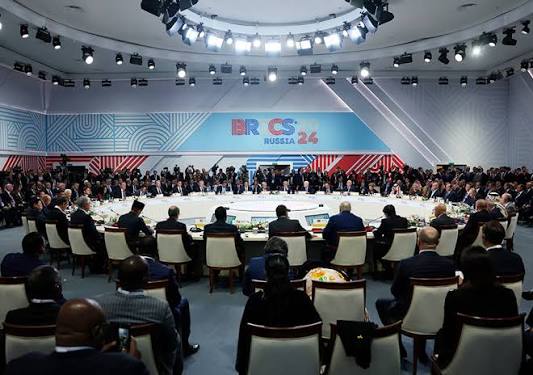
Between 2023 and 2025, the rapid growth of BRICS gave rise to one of the most pertinent debates in contemporary international relations: is a post-Western international order emerging? BRICS started with five economies but now has ten members after adding eight more partner countries to the bloc. This region has more than 3.3 billion people, i.e. 43% of the world, and more than 22 trillion USD, i.e. 41% of world GDP. However, ambitions and size do not ensure coherence by themselves. The essay argues that, despite being the most institutionalised expression of the Global South’s dissatisfaction with the Western-led order, BRICS’ internal contradictions – strategic, ideological, and structural hinder its ability to form a genuine alternative order.
The Origin and the Logic of Expansion
The BRICS Summit Forum was born in 2009 as the post-1945 Bretton Woods institutions – the IMF, World Bank and G7 no longer fairly reflected the interests of the developing world. The first five members (Brazil, Russia, India, China and South Africa) had a more generic but common interest in cooperating to reform global governance. Their foreign policy orientations, however, differed quite markedly. The grouping got a fresh lease of life at the 2023 Johannesburg Summit with the invitation of six more countries. Egypt, Ethiopia, Iran and the UAE formally joined in January 2024. In January 2025, Indonesia joined, becoming the first full Southeast Asian member. Another thirteen countries were invited as partner countries at the Kazan Summit in Russia in October 2024, nine of whom accepted.
The figures are incredible. BRICS is now responsible for over 40% of global oil production and over 36% of global gas production (KAS, 2024). At least thirty nations lodged applications to join in 2024 alone. The increased membership has huge value; its leadership can credibly claim to speak for the global majority in a
way no non-Western forum can. The presidency of Russia was explicitly framed around this idea; Foreign Ministry spokesperson Maria Zakharova stated that “BRICS is a viable alternative to a world living by someone else’s foreign rules”
What Connects the Group
BRICS is held together by several overlapping interests despite the heterogeneity. The first is a common complaint of under-representation. The governance structure of the IMF, World Bank and UN Security Council was calibrated to the age of Western dominance; it has never really kept pace with the realities of the twenty-first century. Nations such as Ethiopia, Indonesia and the UAE can articulate development priorities – infrastructure, climate resilience, sovereign financing as part of BRICS without Western-led conditionality.
Fear of being financially coerced is another. The exclusion of Russia from the SWIFT financial messaging system after its invasion of Ukraine in 2022 showed that dollar hegemony and control of global financial infrastructure could be weaponised. Iran, which has faced US sanctions for decades, sees BRICS membership as a way towards alternative transaction channels. In 2024, over 95% of Russia–Iran bilateral trade was done in rubles and rials, highlighting how sanctions pressure can boost financial decoupling at the bilateral level. As of January 2025, China’s Cross-Border Interbank Payment System (CIPS) has 1,467 indirect participants from 119 countries, which provides an alternative infrastructure to SWIFT for yuan-based settlement (Chicago Policy Review, 2025).
Next is the wish for strategic self-sufficiency. For countries like Brazil, India and South Africa, becoming part of BRICS was less about standing up to the West than about preserving optionality. Participating in BRICS and the G20 at the same time, having trade links with China and the US, and having access to both IMF and NDB financing is a type of insurance in a world that is becoming more bipolar. As Carnegie (2025) noted, “the capacity of BRICS members to realise their goals through BRICS depends on which vision for the future of world order ultimately prevails within BRICS.”
The Divisions That Define the Limits
In spite of those common interests, the bloc’s structural divisions impose real institutional constraints. The China–India fault line, involving the two heavyweight economic nations of the grouping, is perhaps the most consequential one. The two nations have failed to resolve their border dispute, which escalated in the Galwan Valley into a deadly military confrontation in 2020. The two countries are also competing for economic and geopolitical leadership of the Global South, making true BRICS solidarity on substantive issues structurally difficult (CFR, 2025).
This is clearly evident in the failure of de-dollarisation plans. The July 2025 Rio Summit hosted by Brazil resulted in a 126-point merged declaration which did not refer to de-dollarisation or other currency-related initiatives (Stimson Center, 2025), representing a significant backpedaling from earlier rhetoric. India was clear about its opposition to a common BRICS currency, as that could enhance Chinese financial influence and damage trade with the US.
In December 2024, RBI Governor Shaktikanta Das stated that reducing dollar dependence is merely a matter of “de-risking” trade and carefully limited framing (Wikipedia – BRICS, 2026). Brazil’s President Lula removed any currency proposals from his summit agenda following a threat by Donald Trump. In November 2024, Putin himself at the Valdai Discussion Club stated that Russia does “not wish to abandon the dollar.” The US dollar currently constitutes 59% of global foreign exchange reserves, and more than 80% of global trade is underpinned by the dollar (IMF, 2024; CFR, 2025). Even though China has increased globalisation efforts for the yuan, its usage is still less than 5% of worldwide reserves. The BRICS framework lacks the key essentials for any other currency to be given the status of a global reserve.
The bloc’s institutional goals are similarly limited. The New Development Bank (NDB), founded in 2014 as a BRICS alternative to the World Bank, lent $33 billion within its first decade, roughly one-third of the World Bank’s global annual commitment (Carnegie, 2024). The Contingent Reserve Arrangement, intended as an alternative to the IMF, is still being revised under treaty terms to admit new members. It has never been operationalised. According to Carnegie (2024), BRICS has been more symbolic than substantive.
The limits of the structures are complicated by political diversity. The bloc includes liberal democracies, a theocracy that is sanctioned internationally (Iran), Gulf monarchies with deep security ties to the US (UAE), and a country conducting a war on an internationally condemned basis (Russia). Getting all these actors to agree is structurally difficult. In September 2024, the foreign ministers’ meeting of the BRICS group did not reach an accord on a framework for UN Security Council reform – a topic on which all members theoretically agree (CFR, 2025). Brazil vetoed partner bids from Nicaragua and Venezuela, while Argentina withdrew after a government change; Algeria rejected its invitation. These incidents indicate that national political calculations often take priority over bloc discipline.
The war in Ukraine remains a chasm within the group. Russia and China want to use BRICS to contest the Western order, while most other members India, Brazil, South Africa, the UAE have carefully avoided endorsing the invasion. The 2025 Joint Declaration did not mention the US by name and contained nothing on Ukraine, leaving consensus on the decade’s defining geopolitical crisis impossible.
Coherent Project or Symbolic Challenge?
BRICS operates on both registers at the same time. In terms of symbolism, it has worked. The grouping demonstrates that the legitimacy of Western-led global governance is actually contested and that large, dynamic, and populous countries find it useful to signal their dissatisfaction publicly. The applications for 2024 membership from over 30 countries represent the real appeal of the BRICS reform narrative, more so from the Global South. Putin has expressed his belief in BRICS and that it can help world growth at the first session of the BRICS Business Forum, held from July 25 to 26.
The evidence, on the other hand, is structural. Despite rising competition from other currencies, the dollar remains pre-eminent. Western alliance structures have not only endured but have also laid down deeper roots. In addition, the internal contradictions of BRICS, above all the rivalry between China and India as well as the impasse over de-dollarisation, prevent BRICS from acting as a single, coherent bloc on any genuinely contested issue related to hard power. The Rio Summit that took
place in July 2025 saw both Xi Jinping and Vladimir Putin missing, and the declaration issued was not one of transformative ambition.
Conclusion
BRICS is important as a benchmark of legitimacy deficits in global institutions, as a platform for alternative norms, and as an institutional hedge against Western financial coercion. Through its history, it has expanded greatly. Ultimately, orders will limit themselves to the coalitions that give them life. A collective that fails to reach consensus on de-dollarisation, struggles with UN Security Council reform, lacks a common stance on an active conflict involving its own members, and experiences structural geopolitical rivalry between its two largest economies does not amount to a new world order. The current system is not good enough; nonetheless, that itself is already an important political fact.